An imminent power-supply shock is reportedly expected to hit China just as the world’s second-biggest economy is gripped with uncertainty over the probable bankruptcy of one of the country’s real estate majors, Evergrande.
The crackdown on power consumption has reportedly been triggered by surging demand for electricity, along with soaring prices for coal and gas that are exacerbated by strict targets set up by China’s authorities to cut emissions.
The country’s manufacturing sector with energy-intensive aluminum smelters, textiles factories and soybean processing plants became the first to get hit hard, as they had to curb activities or shut down.
“With market attention now laser-focused on Evergrande and Beijing’s unprecedented curbs on the property sector, another major supply-side shock may have been underestimated or even missed,” Nomura analysts said, as quoted by Bloomberg.
Nearly half of the country’s 23 provinces missed targets set by the government with Jiangsu, Zhejiang and Guangdong – China’s key industrial hubs that account for about a third of its economy – being among the worst, thus remaining under pressure to slash power use.
“The power curbs will ripple through and impact global markets,” Nomura’s Ting Lu said. “Very soon the global markets will feel the pinch of a shortage of supply from textiles, toys to machine parts.”
China’s energy crisis, which is partially attributed to Beijing’s decarbonization campaign, comes amid an extreme global shortage of energy supplies that has sent European markets into chaos. The power crunch may be overshadowed by current concerns over Evergrande, which could default on its massive debts.
The Chinese economy is reportedly at risk of a dire shortage of coal and gas during the upcoming winter, as the country has never had to deal with global prices for those fuels at their current levels.
“Policymakers seem to be willing to accept slower growth in the rest of this year in order to meet the carbon emissions target,” Larry Hu, head of China economics at Macquarie Group, told the agency. “The GDP goal of more than 6% is easily achievable, but emissions targets are not easy to hit given robust growth in the first half.”
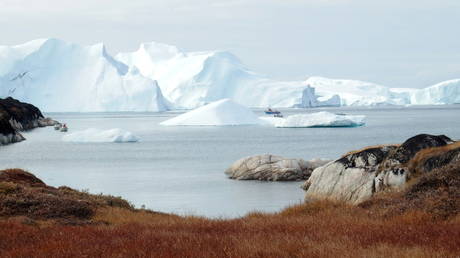
Global energy firms are expanding fossil-fuel production in the Arctic region, driven by boosting their profits and with no regard for the consequences, research by Paris-based climate watchdog Reclaim Finance claims.
According to the group’s data, there are currently 599 oil and gas fields in the resource-rich Arctic region, with some 220 sites already in production. Also, some 338 new fields have been discovered and may enter development at any time. This means that if the companies find the necessary financing to exploit all these deposits, the reserves in production could double in the near future. And the group believes financing will soon be found.
“The Arctic is a climate bomb, and our research shows that the oil and gas industry is hellbent on setting it off, thus blowing up our chances of avoiding runaway climate breakdown. But they aren’t the only culprits: financial institutions have bankrolled these companies, making a mockery of their own climate commitments,” Alix Mazounie, co-author of the report, claims, as cited by Bloomberg. According to the group’s estimations, some 120 major global banks provided more than $314 billion in investments for Arctic resource development from 2016 to 2020.
Researchers claim that Gazprom PJSC, ConocoPhillips, and TotalEnergies SE are the largest of the energy firms expanding their fossil-fuel extraction in the region, able to boost production of Arctic oil and gas by 20% over the next five years.
The report questions the intentions of financial institutions and energy companies that often declare green credentials but act contrary to them, investing in the development of fossil-fuel sites in the sensitive Arctic region. According to researchers, two-thirds of the top 30 banks that finance Arctic reserve exploration have so-called Arctic restriction policies.
Next month, the world’s leaders are scheduled to hold climate talks following a warning in August from the Intergovernmental Panel on Climate Change, which claimed that the goal for keeping global warming below 1.5 degrees Celsius is unreachable under current extraction levels. The new research adds that developing Arctic reserves could lead to a climate crisis.
“The more the ice melt accelerates in the Arctic, the more fossil fuel reserves become accessible. However, the more oil and gas projects there are in the Arctic, the less the Arctic can play its role as an air conditioner for the planet,” it states, suggesting that the region should be excluded from fossil-fuel production altogether.
“In order to truly protect the Arctic, financial players must apply their policy of exclusion to the Arctic perimeter, which makes the most sense from an environmental and climatic point of view,” the group concludes.
Crude prices extended gains on Monday, rallying to their highest levels since 2018 as global refineries fail to keep up with fuel demand that is projected to reach pre-pandemic levels by early next year.
Brent futures for November delivery grew 1.23% to more than $79 a barrel, the highest price since October 2018, while US crude benchmark West Texas Intermediate surged 1.28% to nearly $75 a barrel after a run of five consecutive weekly gains.
The rally is being attributed to the swift recovery of demand across the world as economies open up with the easing of pandemic restrictions. At the same time, a natural gas rally is expected to further push demand for oil higher as users switch fuels. However, global oil refining capacity is inevitably weighing on the supply-demand balance.
One reason markets are tightening is because the Organization of Petroleum Exporting Countries (OPEC) and allied producers including Russia have been easing the agreed production limits, but not enough to meet global demand. Another is the extreme weather conditions impacting US crude output.
Oil “continues to be supported by broader concerns over tightness in energy markets,” Warren Patterson, head of commodities strategy at ING Group NV told Bloomberg.
“Demand is looking as though it will be stronger than expected in the near term,” the expert added.
The Taliban government in Afghanistan has appealed for international flights to be restored, claiming that all the problems at the Kabul airport have been resolved while promising full cooperation with airlines.
According to the Foreign Affairs Ministry, the new administration has stepped up efforts to open up the country and gain international acceptance. The airport, which was damaged during the chaotic evacuation of tens of thousands of foreigners and Afghans that followed the Taliban’s seizure of the capital, has since been reopened with the assistance of technical teams from Qatar and Turkey.
Foreign Ministry spokesman Abdul Qahar Balkhi said the suspension of international flights has left many Afghans stranded abroad and also prevented people from traveling for work or study.
“As the problems at Kabul International Airport have been resolved and the airport is fully operational for domestic and international flights, the IEA [Islamic Emirate of Afghanistan] assures all airlines of its full cooperation,” he said, as quoted by Reuters.
A limited number of aid and passenger flights, including from Pakistan International Airlines, have been operating from Afghanistan’s airport. However, regular commercial services have been halted.
Natural gas prices on the European market surged by more than 5% on Monday, hitting nearly $900 per 1,000 cubic meters, according to ICE futures trading data.
The price tag for the October futures contract on the TTF hub in the Netherlands reached $895.30, marking a growth of 5.4% against the levels reached at the end of last week.
European gas prices have been hitting record highs over the past month with the estimated price of October futures reaching a decade high of $963.90 on September 15.
The spike is being attributed to the approaching winter season and economic rebound from Covid-19 lockdowns across the world. This has reportedly boosted demand from households and businesses, while lower investment by global drillers is constraining output.
Last week, the CEO of Ukrainian state-controlled energy corporation Naftogaz accused Russia’s Gazprom of deliberately withholding gas supplies from Europe, thus manipulating the markets.
The Russian energy corporation says the surge in gas prices are the result of low reserves in European underground storage facilities ahead of the winter season. As of September 19, those reserves were reportedly only 72% full, which is nearly 14% lower than in the past five years.
Earlier this month, Germany’s energy ministry said Russia is fully compliant with its gas supply obligations to Europe, stressing there was no need for the state to intervene in the situation with gas prices.