UFC flyweight Maryna Moroz has denied that she pulled out of a fourth scheduled fight in a row, with the Ukrainian declaring that she is “healthy” despite the news that she won’t be competing as planned on October 16.
Moroz was due to end her 19-month absence from the Octagon against Luana Carolina at UFC Vegas 40, but according to MMA Fighting the Brazilian will now face America’s Sijara Eubanks instead.
For Moroz, 30, it will be a fourth canceled bout since she last competed in March 2020, when the star earned a unanimous decision victory against Mayra Bueno Silva to improve her record to 10-3 overall.
In the ensuing period much of Moroz’s publicity has come through her personal OnlyFans-style website where she shares exclusive content with subscribers, as well as a public spat with fellow UFC star Mariya Agapova over claims of the Kazakh fighter’s wild behavior.
But in an attempt to clarify the latest failure in her efforts to get back to the cage, Moroz issued an Instagram message in which she said she was not to blame for the collapse in her bout with Carolina.
“I am healthy and continue to prepare for the fight. I don’t care who my [opponent] will be. I just want to fight,” said the Miami-based fighter, sharing a clip of herself training at the fabled American Top Team gym.
One unhappy fan took Moroz to task, replying: “Then why did you pull out of the second fight in a row? Something don’t make sense here…”
That touched a nerve with the Ukrainian however, who shot back: “Are you stupid I did not refuse, I am healthy and continue to train.”
“I’m not stupid. I’m a huge fan and want to see you fight. If you’re healthy, why not fight?” responded the fan.
Another chimed in: “You’ve pulled out of 4 fights in a row. Stop getting rude to people in your [Instagram] comments, this is why you’ve got no fans. You want some?”
“At what point do you cut Maryna Moroz due to her pulling out of so many fights?” argued one fan.
“Moroz hasn’t done anything memorable since her first UFC fight against Jojo [Calderwood]. She’s basically an Instagram ‘model’ now,” scorned another person.
Elsewhere, though, there were messages of support for a fighter who has had her hand raised in five of her eight outings in the UFC Octagon since making her debut with the promotion in April of 2015.
“I sympathize. You will prove yourself, we’re waiting for a new date!” read one message.
Moroz is not the only casualty of UFC Vegas 40, set to take place at the promotion’s Apex facility in Las Vegas.
Recently-returned superstar Miesha Tate was forced out of her headliner with Ketlen Vieira after contracting Covid, and the bill will instead be topped by a showdown between Holly Holm and Norma Dumont.
In the first few minutes of the new documentary Missing in Brooks County, Eddie Canales idles his truck along a long stretch of trees, brush, and barbed wire. A few steps away a plastic barrel marked “Agua” sits under a tattered Red Cross flag where Canales retrieves a few empty water jugs and replaces them with full ones. Here in Brooks County, a rural Texas community located near the U.S.-Mexico border, summertime temperatures regularly exceed 100 degrees. A person could easily die of thirst out here, and as Canales drives his truck down the road he halts when he sees buzzards nearby. “Whoa,” he says, watching the birds as they circle. “They’re here.”
A grizzled, aging man, Canales gingerly climbs over barbed wire and hacks through tall grass to discover what the buzzards have already found. A migrant is lying on the ground, dead. The man faces the sky, his arms outstretched, his chest swollen.
Hundreds die traversing this sweltering landscape every summer to evade the state’s largest border patrol checkpoint in nearby Falfurrias. There is no infrastructure to help them: Canales is the one-man engine behind the tiny South Texas Human Rights Center, providing humanitarian help where it can in Brooks County. Yet this unnamed soul is one of thousands of missing migrants whose families will never know what happened to them.
Missing in Brooks County, a documentary by Connecticut-based filmmakers Lisa Molomot and Jeff Bemiss screening periodically across Texas and currently streaming on Laemmle Virtual Cinema, zooms in on this immense issue in one particularly dangerous area: Brooks County, population 7,100, where more than 2,000 migrants are presumed to have died since 2008. An estimated four in five of them will never be found. Texas leads all U.S. states in migrant deaths, having now surpassed Arizona for the dubious distinction. This film follows the helpers, who have been clouded by controversies in other parts of the Southwest: In 2019, humanitarian volunteers outside Tucson were charged with felonies for providing water and shelter to two young men walking through the Sonoran Desert. Here, volunteers have avoided legal harassment, but are instead entirely invisible.
The film takes shape as a portrait of the few human beings who carry countless spirits on their shoulders, who take the dead under their wing. Canales is one of them, and when family members come to his humble office to ask for help, he sifts through binders of crime scene photographs. It is traumatizing, thankless work, but he keeps on, often sleeping on a cot in the office.
If a migrant is walking through the brush in Brooks County, they have already made it across the border in McAllen. Coyotes bring people north and, upon reaching the Brooks County seat of Falfurrias 70 miles from the border, face the largest border patrol checkpoint in Texas. The only way to circumvent the checkpoint is to hike 40 miles around it. The filmmakers excoriate both federal and state officials for the humanitarian crisis that has resulted. It is clear to the filmmakers that federal policies of deterrence, dating back to 1994 under the Clinton Administration, are to blame for the forging of these dangerous paths and the subsequent surge in deaths. Yet they also indict Texas’ systems, or lack thereof, for failing to keep track of migrant deaths in any meaningful way.
Another of the movie’s main characters is anthropologist Kate Spradley, who leads a Texas State University project to exhume unmarked graves, conduct DNA testing, and reconnect the mourning families of missing migrants to their loved ones’ remains. We watch how Canales stays calm and keeps his head down in the work to cope, but Spradley’s response is one of building anger. She calls him about yet another funeral home that told her that, inundated with bodies, they just started burying people everywhere with no records. “These are people, these aren’t receipts you lose track of,” she vents.
The filmmakers do an expert job of humanizing Spradley and Canales, but they could have spent more time with the migrants’ grieving families. They follow the families of Homero Román Gómez and Juan Maceda Salazar, shedding light on their stories, but they don’t get quite as much screen time or exploration. Even so, Missing in Brooks County lingers with a quiet care on human moments. Four years of footage has been distilled into a thrumming, tense hour and twenty minutes, a collection of scenes that illuminate fleeting traces of pain and memory. Often, these scenes are mundane: we see Román Gómez’s brother and sister sit in a plain hotel room, waiting on the phone, transferred again and again to county offices that will lead them nowhere; we watch research students gently and silently handle the bones of migrants dug from unmarked graves. We learn that grave diggers and the folks who mow the cemetery lawn are frequently the only people who remember where the “unidentifieds” were buried. In one striking shot, Spradley shows us a room filled with small, cardboard boxes, so many that the camera’s frame can’t capture them all. “There is a person inside every one of these boxes. Everybody in here has a family that wonders what happened to them.”
Viewers also see local residents and officials who appear to view migrants as less than human. A Border Patrol agent says he doesn’t call the migrants “people” anymore; he calls them “bodies.” Ranchers, some of whom staunchly refuse Canales’ requests to set out water on their land, say shocking things on camera. “I’ve got my suspicions about Eddie Canales,” says one. “We’re just waiting to try to catch him loading some [people] up and sneaking them around the checkpoint.” He laughs at a Border Patrol photo in which three migrants hide in a tree from guard dogs. Another rancher, a veterinarian by day,eventually invites the filmmakers on a vigilante stakeout that he organizes with other elderly white men who are concerned about immigrants bringing “sleeper cells” and “cartel soldiers” to “overtake us internally.” He sits through the dead of night, wearing night vision goggles and full camo hunting gear, hoping to apprehend people he considers to be dangerous criminals.
Even in these bizarre, hostility-tinged moments, the film’s tone remains solemn. The ranches of Brooks County are haunted. By the movie’s conclusion, however, there’s still hope to be found. Kind people of faith in Falfurrias often pull over to wish the searching families well. Crosses and angel statues stand among flowers in the cemeteries. “God bless you” is a common refrain, the charm of small town Texas. At one point, a friendly couple delivers food for graduate students conducting an exhumation. “We call this working for the Lord,” the woman says. “No one sends us, we just go around town looking for things to do, see where God sends us, and he led us to the cemetery tonight.” Despite these acts of care, the film still ends on a quiet, despairing note, in Canales’ office. In the last shot, the Red Cross flag waves under a big moon, ripped apart by the wind, hanging on.
Diane Causey is a 75-year-old antique shop manager in Utopia, a tiny town of 277 people located an hour-and-a-half northwest of San Antonio. Her favorite place in town is a swimming hole on the Sabinal River, accessed on land her family owns. This section of the Sabinal, a little-known Texas river fed by springs, is crystal-clear and chilly even in June. Each summer, Causey’s extended family of more than 100 people converge on the swimming hole for their annual family reunion; kids jump into the water from Cypress-lined banks and cannonball from a rope swing suspended above the river. They hold talent shows and worship services and music jams—Causey herself plays the keyboard but also dabbles in hammer dulcimer and banjo. “It’s always fun. It’s a beautiful place,” she says.
That’s why she was concerned when she learned this year that a property just upstream from her family campground had asked state regulators for permission to dump wastewater into the Sabinal. The plan was proposed by Young Life, a youth-oriented Christian organization that operated a ritzy summer camp for up to 500 people on the banks of the river. Now the camp sought its first discharge permit, which would have allowed it to eject up to 65,000 gallons of treated wastewater into the Sabinal each day. That didn’t sit well with Causey, whose land would be among the first sites to encounter the wastewater on its journey downstream. Causey and others sent upwards of 500 comments and letters to TCEQ to protest the plan. Young Life eventually dropped the discharge plan and agreed to treat its wastewater onsite and reuse it.
“That wasn’t what we wanted to happen to our little river,” Causey says. “Just to dump anything into the river … doesn’t seem like being good stewards of the land.”
Dumping wastewater into rivers and streams has been the modus operandi for cities and industries across the nation for well over a century. Comprehensive federal standards for treating that wastewater didn’t emerge until the passage of the Clean Water Act in 1972. Today, most of this wastewater is treated with filters, UV light, and other tools to remove the most dangerous components of human waste and to comply with federal rules. But treatment doesn’t filter out all contaminants, such as phosphorus, which feed algal blooms, nor does it always eliminate E. coli and other bacteria from the water. Experts say that the practice of discharging even treated wastewater is outdated and harmful. It can be especially disastrous in the environmentally sensitive Hill Country, where development is ratcheting up faster than almost anywhere else in the nation. In this part of Texas, more pristine waterways are being threatened than ever before.
In the summer of 2019, the Blanco River, a 87-mile stretch of clear springs that carves a path between Austin and San Antonio, was transformed into a rank ribbon of green muck. Seemingly overnight, one of the state’s most pristine and celebrated rivers was blanketed by a goopy sheet of algae that cut off access to swimming holes and smothered the homes of sunfish, dragonflies, and aquatic plants.
Residents pointed the finger at the City of Blanco, which operated a wastewater plant just upstream of the algal bloom. A year earlier, the city had gotten permission from state officials to discharge up to 225,000 gallons of treated wastewater into the Blanco River each day and was pursuing a plan that would allow it to quadruple its wastewater output. Locals were able to force a legal hearing on the permit application and the city abandoned the plan to quadruple its output. During the fight, the city also stopped discharging wastewater into the Blanco River, which eventually ran clear. The Texas Commission on Environmental Quality (TCEQ), the regulatory agency that gave the city of Blanco its permit, has no reported enforcement actions against the city for the event.
Cities have continued to dump wastewater containing phosphorus into Texas waterways because there’s no statewide rule regulating phosphorus in Texas streams and rivers, says Vanessa Puig-Williams, director of the Texas Water Program at the Environmental Defense Fund. With no numerical measurement of phosphorus levels in these waterways, it can be tough to keep it from getting in the water. “That’s an important piece of information,” she says.
Another of Puig-Williams’ concerns is about the unique relationship between Hill Country waterways and groundwater sources—surface water here seeps into karst aquifers, and vice versa. That means polluting rivers could mean polluting aquifers, a crucial source of drinking water for people and livestock. “The fact that these are sourced directly from groundwater [means] you’re essentially swimming in groundwater in a lot of these streams,” Puig-Williams says.
Opponents of discharge plans elsewhere in the Hill Country have also managed to persuade applicants to reuse wastewater or apply it to areas surrounding the property, which they say is far less dangerous for the environment. Last year, Camp OTX, also a youth camp, applied for a permit to push treated wastewater into Commissioner’s Creek, near the Sabinal, drawing protest from nearby residents. The camp struck a deal in December not to discharge into the creek. North of San Antonio, a subdivision of 2,300 homes near Bulverde fought to discharge 500,000 gallons of water into Honey Creek, which rankled nearby residents and local officials. The subdivision has since agreed to apply the wastewater as fertilizer on surrounding land.
Still, some water pollution is already occurring in pristine waterways here. The City of Sabinal has been a frequent violator, racking up a litany of enforcement actions for failing to treat water to state standards. The city, whose discharge flows into the Sabinal River, has violated limits of ammonium nitrate, E. coli, and suspended solids, which cloud water, clog fish gills, and smother aquatic habitats by lowering oxygen levels.
In neighboring Uvalde the city has violated rules regarding the discharge of nitrates and suspended solids into ponds that flow into the Leona River. The Leona River is now so polluted that it makes the list of TCEQ’s most impaired waterways in Texas. High levels of bacteria in the water discourage recreational use; low oxygen levels in the water are also a major problem. TCEQ has issued a few fines averaging $10,000 but continues to renew the cities’ discharge permits.
The cities of Sabinal and Utopia did not respond to requests for comment for this story.
There’s a better way to handle wastewater than simply pumping into rivers and streams, experts say. The “One Water” approach seeks to reuse treated wastewater for human consumption or other beneficial uses. And as shown in Honey Creek, land applications of wastewater can be a win-win for the environment, since plants are given a chance to suck up phosphorus from wastewater before it has a chance to seep into the water table. David Baker, executive director of the Wimberley Valley Watershed Association, says the current wastewater system “is a 19th century approach to water management.”
“All this water has value. We need to treat it with respect to treat it properly at each stage of the water cycle,” Baker says.
Legislation brought before the Texas Legislature in this year’s regular session could have halted discharges into such pristine streams. House Bill 4146 sought to ban effluent from entering stream segments that contain less than .06 milligrams of phosphorus per liter or drainage areas of those segments. Essentially, the bill would protect streams that had not already been polluted. It had widespread bipartisan support, along with the backing of environmentalists and traditionally conservative landowner groups. “We had broad support and it was well-founded in the in the science,” says Sky Lewey, a director of education and resource protection at the Nueces River Authority who helped spearhead the bill. The Texas Association of Builders opposed the legislation, which they called “unfair.” A group representing summer camps also registered its opposition with the measure. The bill passed through the House but died in the Senate.
Opening image: The Blanco River from inside Blanco State Park.
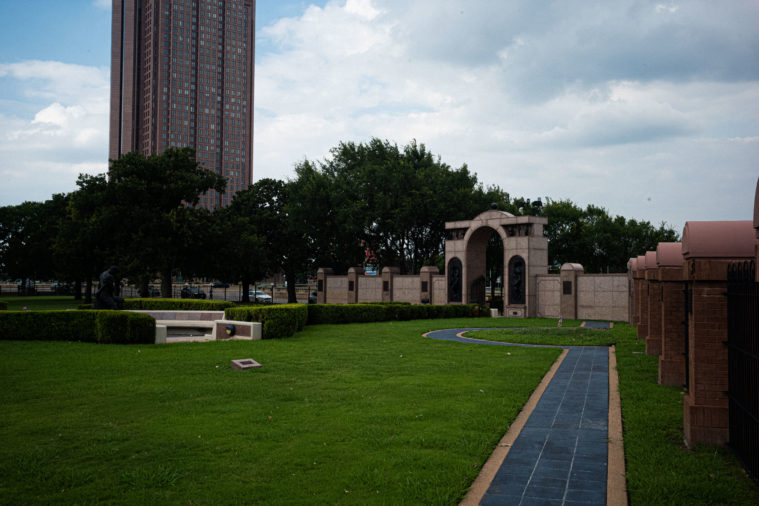
The Freedman’s Memorial Cemetery is empty on a sweltering weekday in June, the gated park tucked between Lemmon Avenue and Calvary Street contained by the three-lane frontage road that edges the moat of the North Central Expressway. The sound of traffic dominates the space—a dull, uneasy roar, the sound of an industrial fan, an airplane landing.
An arresting, life-size bronze sculpture of an African woman—the Prophetess, the keeper of memory—stands at the entrance. She holds a harp in her left hand, her right palm open and extended outward in invitation.
In 1869, a group of freed slaves purchased an acre of land on what was then the outskirts of Dallas for $25. The land included what had been a slave cemetery. As other Freedmen settled around the cemetery and purchased more land, they established a thriving community, one of numerous Freedmen’s Towns spread across Dallas. It was a place of hope and growth, counting seven churches, many of which hosted day schools and, later, a high school. Black doctors and dentists set up shop here. Black-owned grocers and movie theaters opened. And Black families interred their relatives at the cemetery, which eventually grew to cover 4 acres.
On August 12, 1946, the Dallas Morning News reported that the state highway department would embark on the city’s first freeway, “a project that promises much relief for Dallas’ traffic congestion.” The Central Expressway would be built along the original route of the Houston and Texas Pacific Railroad but would also be built over a large portion of the cemetery, along with more than 1,500 structures, most of them owned or occupied by Black families who were descendants of the original Freedmen. “It is hoped that no unwarranted delay in the removal of tenants and city-owned houses will upset the schedule in beginning this work,” the newspaper reported. It didn’t seem to matter that the cemetery was in the road’s path. “Black graves were simply paved over, headstones used as rubble to help fill ditches and low spots,” a Dallas Observer columnist wrote in 1999.
Tucked directly to the west of the Central Expressway are the graves of some 7,000 former slaves and Freedmen. The construction of the expressway paved over roughly a fourth of the original 4-acre cemetery. Ivan Armando Flores/Texas Observer
The new road opened in 1949. Within a decade, traffic congestion had returned. In 1987, after the state highway agency announced its intention to expand the 10-mile stretch of highway, an archaeologist working for the department did a survey in the neighborhood and noticed a sign for “Freedman’s Memorial Park.” The project was stopped and archaeologists started digging.
One body was found. Then 30. Then 1,157.
Eventually, the team concluded that the construction of the original expressway had paved over roughly a fourth of the cemetery that once held the remains of nearly 7,000 slaves and Freedmen and “virtually eliminated all physical above-ground reminders” of its presence. In 1993, the newly renamed Texas Department of Transportation painstakingly exhumed the remains from under the road and reinterred them at the park, alongside thousands of other unmarked graves.
While highway engineers drew up expansion plans for the road—proceeding over the former gravesites—the City of Dallas commissioned Black sculptor David Newton to build a memorial honoring the desecrated graves. “My primary theme for the project was telling the whole African American genesis, from freedom in Africa to enslavement and then to emancipation here in the United States,” said Newton at a virtual panel convened by Brown University this April titled “This Is America: Memorializing Black Death.”
Newton envisioned the memorial as a collective headstone for the thousands who had been lost to the highway’s construction. From a bird’s-eye view, it appears in the shape of a cross, etched across the cemetery in perpendicular black-tiled pathways. In the memorial’s sunken center, an emancipated couple embrace, kneeling with their heads together, their gazes downward, considering their uncertain future.
The memorial was dedicated in 1999. A year later, the highway expansion was completed. Today, 184,000 cars shuttle north and south along the highway daily, a monument to forward motion. Car travel has, since the beginning, been cast toward the future. Speed over stillness, expansion over reparation, breadth over depth. The cities that cars created become forgetful, too, ignorant of the lives that came before. Across the Central Expressway, visible to the Prophetess standing at the cemetery entrance, is the flat skyline of a strip mall crowded with big-box retailers—Ross Dress for Less, Famous Footwear, Target. Placeless convenience that can exist only by forgetting what came before, a kind of cultural clear-cutting.
Emma McCune was born enslaved on June 29, 1855, and died from breast cancer 48 years later, on May 5, 1903, as a free woman. Hers was one of two headstones that were excavated intact from the rubble under the road. It’s displayed, set in pink marble, in the center of the memorial, with the inscription: “Gone from our homes but not from our hearts.”
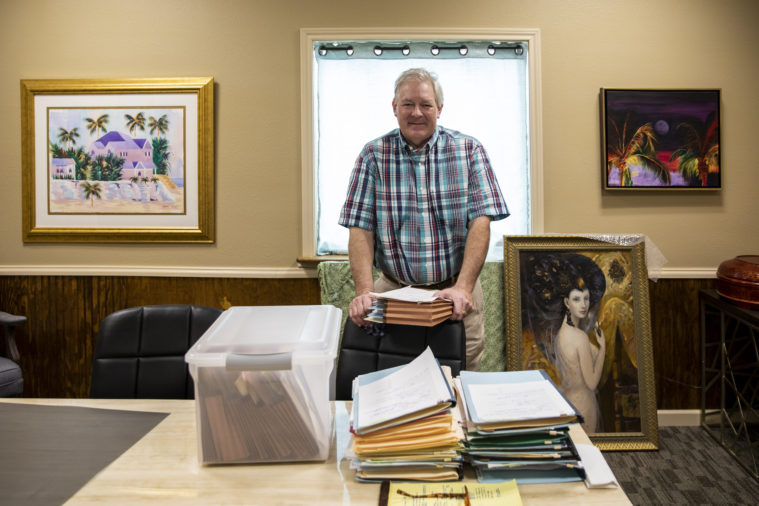
Paul Anderson’s red-brick law office faces North Street in Nacogdoches and fits right in with the rest of the offices and cafes along the small city’s main street. The interior reflects Anderson’s flamboyant personality: It’s painted scarlet and features abstract paintings by his law partner along with swords from his days competing internationally as a black belt in kendo, a Japanese martial art. For years, Anderson lived in Houston, where as a citizen he battled developers who had built homes atop toxic waste buried in his neighborhood. He owned a kendo studio and often bested sparring partners in competitions where opponents often leveled bamboo sticks at his throat. But then he went to law school and moved to the sleepy East Texas college town of Nacogdoches, where he expected a quieter life as a “country lawyer.”
That changed in 2020 when Anderson heard a bizarre rumor about Andrew Jones, a local prosecutor running to be the next district attorney. Jones, according to rumor, had practiced law without a license and illegally prosecuted dozens of people. Anderson feared local residents’ civil rights had been violated; he wanted the rumors investigated and Jones held accountable if they proved true. “I love the place. I love the people,” Anderson says. “But there’s corruption here that is protected by the East Texas piney curtain.”
He unearthed public records that revealed that in 2013, Jones, then a recent law school graduate, was hired by the Nacogdoches district attorney’s office as an assistant district attorney, despite the fact that he had a pending charge from November 2012 for driving under the influence in Bexar County. The State Bar of Texas listed him as ineligible to practice on November 4, 2013, around the time Jones passed the bar exam. Based on bar rules, which require background checks and evidence of good moral character for all prospective lawyers, Anderson argues in his complaint that the pending DWI charge, Jones’ second in Texas, is the most likely reason Jones was found ineligible. Somehow, instead of losing his job, Jones kept prosecuting people in Nacogdoches. Anderson claims that Jones signed charging documents and felony plea deals for at least 30 people between December 2013, when he was ineligible, and September 2014, when he was granted his law license. Jones pleaded no contest to DWI in June 2014, court records show, and also prosecuted people during his one-year probation under a deferred adjudication plea deal.
In the fall of 2020, Anderson contacted the Texas Rangers—the lead law enforcement agency for public integrity and public corruption investigations. His first request went unanswered; then he sent another, and another, and another. “Given the serious allegations and apparent disregard for the evidence available to the Texas Rangers,” Anderson wrote in one of the many emails he sent, “a formal response from [Department of Public Safety] would be appreciated.” Anderson got an email confirming that one Ranger had called the bar about Jones. But he later learned via other emails that his allegations were not investigated further because supervisors at the Department of Public Safety (DPS), which oversees the Rangers, had rejected a formal probe.
Since 2015, the Texas Rangers have taken the lead in public integrity cases involving illegal behavior by elected state government officials or employees in Texas, but those investigations require approval from DPS supervisors and, in most cases, from local district attorneys, a system that essentially allows DAs to block Rangers’ investigations. Statewide, Rangers conducted 600 preliminary probes, but only 55 became formal public integrity investigations, DPS said via email. In 2021, Andrew Jones was sworn in as Nacogdoches County DA, giving him the authority to approve such investigations.
Paul Anderson, a lawyer in Nacogdoches, has filed numerous complaints alleging the local DA illegally practiced law without a license. Scott Dalton
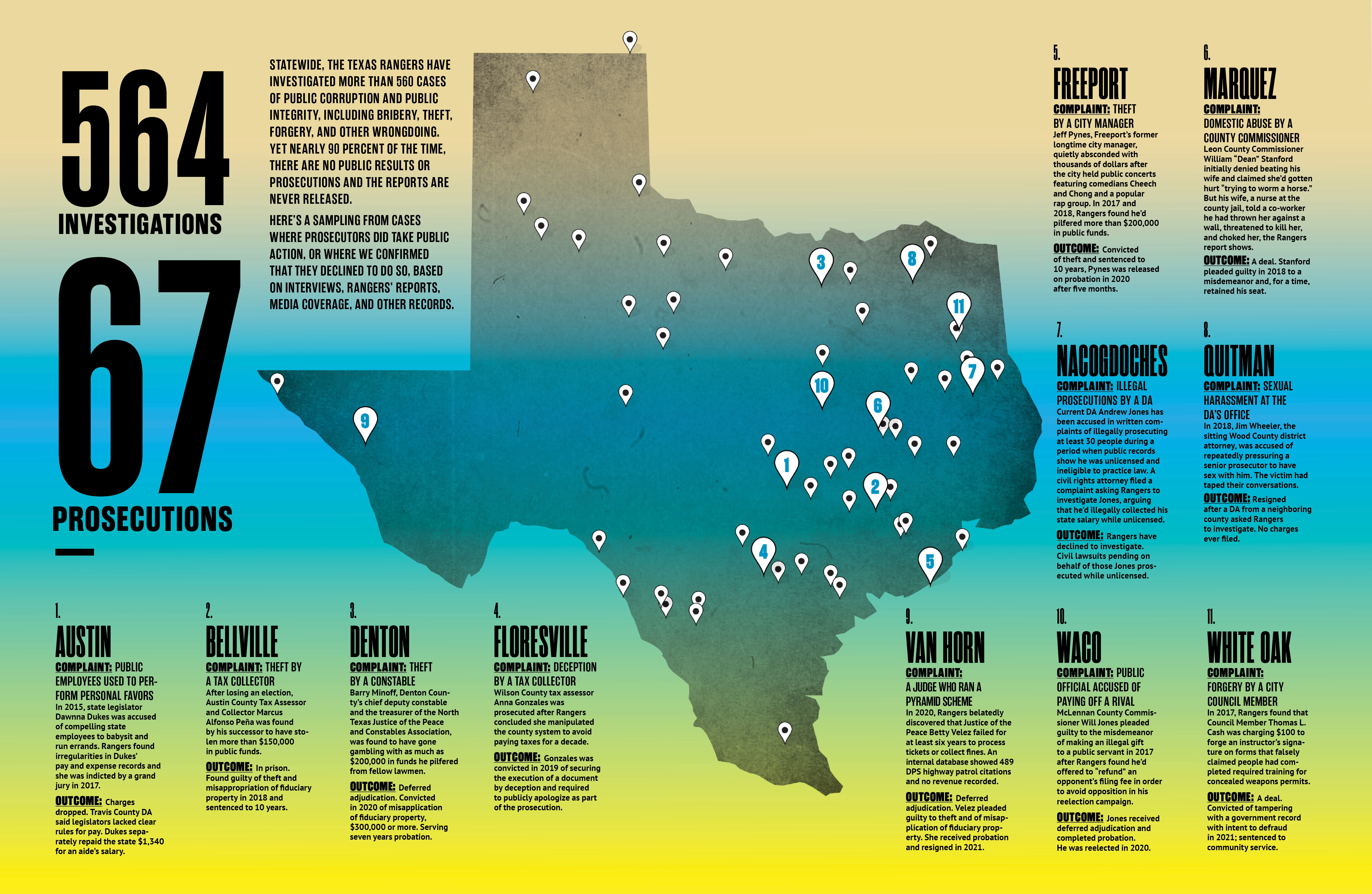
Between 2015 and 2021, the Texas Rangers completed investigations into more than 560 public integrity and corruption complaints, including allegations of theft, bribery, abuse of office, sexual harassment, and many other crimes. However, according to public records analyzed by the Observer, roughly 88 percent of those probes ended without any action at all. In the past five years, only 67 resulted in Texas prosecutions, and in most cases charges were ultimately pleaded down to misdemeanors or dropped, though many included allegations of corruption and large thefts of public funds.
Local DAs can block public integrity and corruption investigations in Texas, though no figures were available. That’s what happened in Archer County in North Texas in 2020 when the local leader of a citizens group suspected that a city official may have taken money from their small city’s coffers. She provided public records and an audit to the DPS and the county sheriff in 2020 but was told by the Rangers that they could not investigate because the local DA said no.
Nearly all of the Rangers’ 67 public integrity and corruption investigations since 2015 that did result in prosecutions targeted low-level officials—justices of the peace, police officers, DPS employees, or small-town and county leaders. The Rangers and prosecutors have revealed that they also investigated several legislators and statewide lawmakers between 2015 and 2020, but none of those probes resulted in any convictions in state courts, according to public records and interviews.
Even the prosecutions of lower-level public officials typically resulted in plea deals or probation. One county commissioner who allegedly strangled and threatened to kill his wife, according to the Rangers’ investigation, remained in office after avoiding a felony conviction and pleading to misdemeanor assault through a plea deal. He later resigned. The 2018 Ranger report reveals police learned of the incident only after his wife was unable to report to work as a nurse at a local jail. She’d been thrown against a wall, was covered in bruises, and feared her jaw was broken, the report alleges. In another case, the Rangers found that the former city manager of Freeport, Jeff Pynes, had stolen more than $200,000 in public funds, including proceeds of a concert and a Cheech and Chong comedy event. Pynes was convicted of felony theft and sentenced to 10 years, but he received probation in 2020 from a judge after spending only a few months in prison. It’s unclear whether he has ever repaid what he stole.
The records obtained from the Rangers showed that female public servants prompted fewer corruption charges than men, but women were convicted more often and received deferred adjudication deals less often.
The Rangers are divided into six companies that serve different regions. There are two investigators dedicated to public integrity at the headquarters in Austin, but most of the probes into public corruption are handled by Rangers juggling other duties. Some regions handled far fewer investigations than others. For example, Ranger Company E, based in El Paso and serving a swath of West Texas stretching from the border north just beyond Midland and Odessa, conducted 32 investigations in the past five years, which led to the prosecution of just four people. Three of their targets were women of color. One was a DPS employee in El Paso; another was a former jail inmate who’d tried to blow the whistle on a DPS agent but was jailed again after the Rangers determined she’d lied; the third was Betty Velez, a longtime justice of the peace based in Van Horn. Among other things, Velez failed to process hundreds of cases and fines involving state troopers for years, the Rangers’ report shows. When arrested, Rangers found her home was strewn with court documents. She eventually agreed to resign from office after being accused by the State Commission on Judicial Conduct of running a pyramid scheme.
Anderson says that while his experience with the Rangers has been profoundly disillusioning, it raises a deeper question: Are Texas authorities able, or willing, to root out corruption? When allegations implicate a local DA, who watches the watchdog?
“This is not about the blatant public corruption of bribes, extortion, and theft,” he says. “This is about the corruption of looking the other way.”
For nearly 40 years, Texas had an elite, centralized public integrity unit of prosecutors and investigators based in Austin. Created in the 1970s in the aftermath of a statewide corruption scandal, the unit was funded in part by the Legislature and overseen for decades by Travis County District Attorney Ronnie Earle, who developed a reputation as someone unafraid to indict the rich and the powerful. In 2009, a longtime prosecutor, Rosemary Lehmberg, replaced Earle as DA. Soon, Governor Rick Perry began feuding with Lehmberg. In 2013, he vetoed the $7.5 million funding for the public integrity unit. A grand jury later indicted the governor over the veto, calling it an illegal abuse of authority. But Perry called the prosecution a “baseless political attack.” The charges were later dropped.
As debate over the unit’s role continued in 2015, legislators argued that the Texas Rangers should be assigned to conduct public integrity probes and take their findings to local prosecutors. The Rangers, a 166-person outfit known for their oversize white cowboy hats, are responsible for border security, serial killer investigations, cold cases, in-custody deaths, and general corruption. But most had little to no experience investigating statewide elected officials.
Gregg Cox, the onetime head of the Travis County public integrity unit, testified in favor of establishing a unit with the Rangers to expand those investigations. But Cox argued against ending the statewide authority of Travis County prosecutors. He warned legislators that forcing local prosecutors to handle all public integrity cases—especially without additional funding or training—could be a disaster.
“I tried to explain to the Legislature why it was a dangerous thing,” he says. “Often the politician that might be under investigation helped get the DA elected in their home county. He’s usually going to be the most powerful political figure in that county, and you just can’t expect the prosecutor in that county to be willing to take that case on.”
His concerns came from experience. From 2006 to 2016, in his last decade as the head of Travis County public integrity unit, Cox had logged 1,600 convictions. But he struggled to prosecute people like Ismael “Kino” Flores, a powerful state legislator and chair of the Licensing and Administrative Procedures Committee who was accused by prosecutors of selling access to power. Most of the alleged illegal activities had occurred in Hidalgo County, Flores’ home county. If the Travis County unit had not existed, the prosecutor there likely wouldn’t have done anything about it because Flores was the most powerful person in that county, Cox says. Cox had pushed for jail time for Flores, whom he called “Mr. Ten Percent” because he allegedly demanded a 10 percent commission from state contractors, court records show. In 2010, Flores was convicted of perjury and of tampering with a public record after failing to properly disclose around $800,000 in income. He received probation and a $1,000 fine and did not seek reelection.
At first, Cox’s arguments seemed to win the day. But the legislators later sided with Perry. A new public integrity law required Rangers to coordinate with local prosecutors; under the law, local DAs could approve or block probes. But it was never clear how the system would work if local prosecutors—or the powerful state lawmakers with whom they were friendly—were themselves accused of criminal misconduct.
Right away, the system seemed to falter in its ability to address high-profile targets, according to Cox, who later left the DA’s office but kept in touch with investigators handling public integrity cases. “In my opinion, based on conversations I’ve had with people is [the Rangers] will put together very thorough investigations and then they just can’t get a very receptive audience in that person’s home county. The prosecutor is not going to be excited about that. The judges are not going to be excited.” And, he asks, “Can you even get a fair jury seated in that county where half the people there may have donated money to that candidate?”
Only one high-profile state official investigated by the Rangers’ public integrity unit is still being prosecuted: Attorney General Ken Paxton was charged in July 2015 with three counts of felony securities fraud in Collin County. But the local DA, Greg Willis, was not involved in that investigation—he recused himself because he had been Paxton’s business partner. The prosecution moved forward only after a private citizen—an attorney from another county—independently provided information to a grand jury about how Paxton, as a state senator, had peddled stocks without a required state license. Paxton has denied wrongdoing. Six years later, the charges are still pending.
“The way the whole process has been reconfigured is scary. It’s a process that has stopped accountability and protected the incumbents,” says Craig McDonald, director of the nonprofit Texans for Public Justice, the watchdog group that filed the public integrity complaint that sparked Paxton’s prosecution.
Since 2015, the Rangers have not had any successful prosecution in any public integrity investigation that targeted either a state legislator or a statewide officeholder.
In April 2016, the Rangers investigated complaints filed by Progress Texas that alleged Agriculture Commissioner Sid Miller misused about $3,000 in state travel money to get an experimental medical treatment in Oklahoma and to compete in a rodeo in Mississippi. No charges were ever filed, and no information has ever been released on what the Rangers found—or failed to find.
In August 2019, the Rangers investigated Dennis Bonnen, the then-speaker of the house, after a recorded conversation offered evidence that he’d conspired with a powerful PAC donor to oust his enemies from the Legislature. The case was overseen by the DA of Brazoria County, where Bonnen was a longtime political power broker and banker. She chose not to present the case to a grand jury, saying that Bonnen’s taped conversation, while “offensive and lacking character and integrity,” did not demonstrate that a crime had been committed. The Rangers’ report has never been released.
In yet another high-profile case, Dawnna Dukes, then a Democratic member of the Texas House, was investigated by the Rangers in 2016 after state employees complained that she had required them to work at a local nonprofit college and to supply regular nannying services. Their investigation found other issues with Dukes’ travel and expense records, and Dukes was indicted in January 2017 for tampering with a government record and for abuse of official capacity. But Dukes pleaded not guilty and negotiated with the Travis County DA; all charges were dropped.
Interactive Map
Click on a region to view the Texas Rangers public integrity cases spanning 2015-2020, broken up by county.
Good-government advocates like McDonald of Texans for Public Justice and Ty Clevenger, an attorney who runs a legal ethics blog, argue that the Lone Star State badly needs stronger ethics laws and a centralized prosecution unit with the funding, clout, and expertise to oversee complex public integrity cases. The Legislature has the power to re-create a central prosecution unit—but so far has refused to do so.
In many other states, public integrity prosecution units are overseen by the attorney general. But forming a special unit under Paxton seems inadvisable, McDonald says, given that the attorney general remains under indictment on securities fraud charges and also faces federal investigations for alleged bribery, misuse of power, and other misdeeds described in a whistleblower lawsuit filed by his former staff.
Both McDonald and Clevenger played a role in pushing for Paxton’s state prosecution. Still, Clevenger says he thinks a unit under the AG would be better than the current free-for-all. “I’m not a fan of Ken Paxton, but nonetheless, the AG has concurrent authority to prosecute crimes. I absolutely think we should do that in Texas,” he says. Without a central unit, local DAs have “unilateral say on what to prosecute—and that’s dangerous. You shouldn’t have that kind of power in the hands of one person.” Even when a DA has an obvious conflict of interest, there’s no uniform requirement for DAs to recuse themselves, he adds. “There really aren’t any safeguards. If you have a bad DA, you’re pretty much stuck.”
When the elected Wood County DA Jim Wheeler was accused by his first assistant district attorney of repeatedly pressuring her for sex in 2018, it wasn’t clear who could authorize the Rangers to launch a public integrity probe. Wood County is a quiet East Texas county of only 45,000 people, and the victim was reluctant to publicly accuse her former boss, even though the compromising conversations had been taped.
But Wheeler was more politically vulnerable than other prosecutors, having made enemies in East Texas legal circles.
When the chief administrative judge, a district judge based in another county, learned of the complaint against Wheeler, he stepped in to get the probe moving. The DA of another county, Bill Byrd, was soon tapped by judges to intervene. Byrd, the longtime Upshur County prosecutor, is also a part-time Baptist preacher and a unique character in East Texas who locals say could have earned a lot more money if he’d chosen private practice. Under Byrd’s authority, the Rangers were authorized to conduct a public integrity investigation.
Rangers obtained damning evidence by interviewing the victim and by reviewing recorded conversations. But ultimately the victim preferred not to testify against Wheeler, who was accused of the crime of official oppression. So Byrd secretly negotiated a deal in October 2018, and Wheeler resigned and was not prosecuted. That chain of events wasn’t made public until July 2019, when a local newspaper pushed for the Rangers’ report to be released. Wheeler is the only DA that the Rangers have investigated since 2015 who faced prosecution, based on reports that were provided in response to the Observer’s records requests.
Paul Anderson continues his lonely quest for a criminal investigation of Nacogdoches County DA Andrew Jones, though he says it’s costing him. After the Rangers continually declined to investigate, he filed civil lawsuits on behalf of 11 of the criminal defendants, arguing their convictions should be set aside even though most have already served their time.
George Hudson, an auto mechanic and a father of six, is one of Anderson’s clients. He pleaded guilty to theft of construction materials and criminal mischief in exchange for a two-year sentence as part of a plea deal that Jones signed while unlicensed. Like others, Hudson says, “I was never told he was not a real licensed attorney.” Hudson got out of prison in October 2016, but by then his father, who was terminally ill, had died. As a felon, he can no longer get work as a mechanic or carry a gun to go hunting.
The way Hudson sees it, he admitted to the crime and did his time. Meanwhile, the prosecutor violated the law, got away with it, and later got a promotion to elected DA. “How come I got held accountable and he did not? Because what he did was against the law, just like what I did was against the law,” he asks.
His attorney is continuing to speak out about injustice in Nacogdoches. But the warm welcome Anderson got when he first returned to the town where he’d once studied forestry has cooled. He’s still active in community groups, practicing law and teaching at Stephen F. Austin University, but some public officials and criminal defense attorneys have begun to shun or attack him.
Last December, Anderson says he was ambushed at his office by sheriff’s deputies with an arrest warrant. He went to attend a friend’s funeral, and then turned himself in. He was held for several hours in jail after being booked for misdemeanor harassment, records show. He was told the arrest was related to a billing dispute with a client, but no charges have ever been filed. Anderson says he sees the arrest as retaliation or intimidation because that same week he had already advised the county he planned to sue over the cases involving Jones.
Recently, Jones, using his power as DA, filed a complaint with the attorney general’s office, accusing Anderson of barratry, or illegally soliciting clients. The AG quickly dismissed it, finding no probable cause, records show.
Anderson said he was targeted after he had reached out to individuals who had been prosecuted by Jones while unlicensed, initially to question them as witnesses. Later, several signed on with Anderson to be added as plaintiffs in civil lawsuits challenging their convictions. “I have been arrested and not charged … grievanced, and threatened,” he said in an email. “This is what selective justice and systemic official oppression look like.”
Jones has never denied practicing law without a license, but the bar has taken no action against him. When Jones was first hired by Nacogdoches County in 2013, he was allowed to practice law “under supervision” as a student who had attended an accredited law school, but his status later changed to ineligible, records show. Jones declined to comment, but in an interview with Texas Lawyer, he said he believed the allegations against him were part of a political vendetta. He has argued his activities as a prosecutor, while he was ineligible to practice law, were legitimate because “everybody knew that I didn’t have a license at the time.”
Anderson argues in his complaint to the Rangers that Jones violated the law both by continuing to prosecute people after being declared ineligible and by collecting a government salary as a prosecuting attorney. Texas law, for example, prohibits a person from holding himself out to be a lawyer unless licensed to practice law if it is done with an intent to obtain an economic benefit.
Anderson says if local judges and defense lawyers knew Jones was illegally working as a lawyer after the bar found him ineligible, they too should be investigated or disciplined. Court records show the county’s two district judges, defense attorneys, and the former county DA were all involved in plea deals that Jones signed or negotiated in that period. Anderson says lawyers and judges had an ethical obligation to report Jones’ misbehavior. Worse, failing to report him, he says, could be considered evidence of a conspiracy.
Anderson has filed 11 civil lawsuits, arguing that at least 30 Nacogdoches County convictions should be declared invalid because Jones was not a licensed attorney and violated defendants’ civil rights; none of the defendants waived their rights to be prosecuted by someone who was unlicensed. All those cases remain pending.
Top image: Pictured are 12 of the 67 public officials who were investigated by the Texas Rangers from 2015 to 2020 and later prosecuted, though not all were convicted. In that time span, the Texas Rangers investigated more than 560 public integrity and public corruption cases. All were current or former county, city, or small-town officials.
Top row (left to right): Barry Minoff, deputy chief constable, Denton County, plea deal, convicted in 2020 of misapplication of fiduciary property; Paula Barnes, administrative assistant, Palestine ISD, sentenced in 2018 to 30 days in jail and 10 years probation for embezzlement; Jeff Pynes, city manager, Freeport, convicted of theft in 2020 and sentenced to 10 years, released after five months; Marcus Alfonso Peña, tax assessor/collector, Austin County, convicted of theft and misappropriation of fiduciary property in 2018 and sentenced to 10 years; William Dean Stanford, commissioner, Leon County, pleaded guilty in 2018 to misdemeanor assault (domestic violence); Rosena Becker-Ross, city administrator, Mount Enterprise, found guilty in 2019 of misdemeanor abuse of official capacity for ordering an officer to meet a traffic violation quota.
Bottom row (left to right): Anna Gonzales, tax assessor/collector, Wilson County, convicted in 2019 of securing the execution of a document by deception, sentenced to five years probation; John Mark Francis, mayor, Deport, received deferred adjudication after pleading no contest to abuse of official capacity in 2020, charge dismissed after probation; Will Jones, county commissioner, McLennan County, received deferred adjudication after pleading guilty to making an illegal gift to a public servant in 2017, charge dismissed after probation; Martin Tillman, city manager, Olton, fired after being indicted for theft of services, charges dismissed in 2018 after restitution paid; Shannon Denise Smith, city treasurer and clerk, Prairie View, convicted of theft by a public servant in 2019 and given probation; Billy Wayne Kilgore, police chief, Crandall, convicted of theft of a firearm by a public servant in 2020, sentenced to five years.