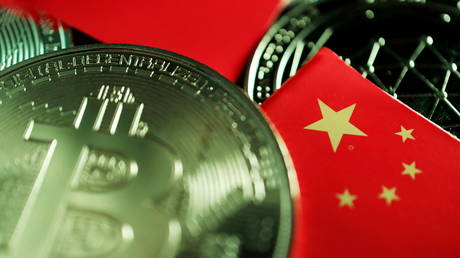
The People’s Bank of China revived its tough stance on digital currencies on Friday, ruling all crypto-related trading activities illegal and banning overseas crypto exchanges from providing services to mainland investors.
The regulator announced plans to bar financial institutions, payment companies and internet firms from facilitating cryptocurrency trading, as well as to strengthen monitoring of risks from such activities.
“Overseas virtual currency exchanges that use the internet to offer services to domestic residents is also considered illegal financial activity,” the PBOC said in a Q&A posted to its website.
“Financial institutions and non-bank payment institutions cannot offer services to activities and operations related to virtual currencies,” the central bank said.
The move sent bitcoin and other virtual currencies plummeting. The world’s number one digital asset by market capitalization dropped over 5% to below $42,000. Other cryptocurrencies followed the declining trend with ether dropping 10% to below $2,800, while dogecoin crashed over 8% to below $0.20, according to the Coinmarketcap website.
The latest ruling comes as part of a broader state-run campaign by Chinese regulators against cryptocurrencies. Earlier this year, Beijing banned mining in major bitcoin hubs, such as Sichuan, Xinjiang and Inner Mongolia, which led to a sharp drop in bitcoin’s processing power, as multiple miners took their equipment offline.
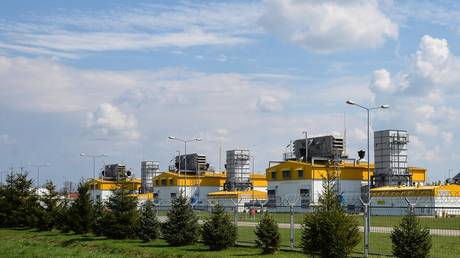
The head of Ukraine’s state-controlled energy corporation Naftogaz is calling on Washington and Berlin to take decisive action against Russia, accusing the country of using its natural gas as a geopolitical weapon.
The announcement comes amid a growing energy crisis in Europe ahead of the winter season, and shortly after the US and the International Energy Agency urged Russia to pump more gas to the region to ease the deepening supply crunch.
Benchmark European gas prices have soared by more than 250% since the beginning of the year, while benchmark power contracts in France and Germany have doubled.
“This is a very clear sign that they are using gas as a geopolitical weapon at the moment,” Naftogaz CEO Yuriy Vitrenko told CNBC, accusing Russian energy major Gazprom of deliberately withholding gas supplies from Europe.
The former energy minister also accused Gazprom of blocking access to the Ukrainian gas transmission system for other Russian companies, as well as cutting exports from Central Asia that could go to Ukraine via Russian territory.
Vitrenko expressed hope that the US will reinstate sanctions against Nord Stream 2 AG, Gazprom’s Swiss-registered subsidiary, which is working on the Nord Stream 2 pipeline.
Meanwhile, Germany’s Energy Ministry said that Russia is fully compliant with its gas supply obligations to Europe, stressing that there’s no need for the state to intervene in the situation with gas prices.
“According to our information, Russia is fulfilling the existing supply agreements… We do not know about the deliberate disregard of the existing contracts,” the ministry’s spokeswoman Suzanne Ungrad said earlier this week.
Gazprom previously announced it was ready to supply Europe with natural gas via the recently completed Nord Stream 2 pipeline. However, deliveries cannot begin before the project is certified by the EU regulators. The procedures could reportedly last into next year.
American companies operating in Russia have made direct investments amounting to a total of $96.05 billion, according to the sixth annual joint survey of the American Chamber of Commerce in Russia (AmCham) and Ernst & Young.
The survey, which focused on the prospects for direct investment and bilateral trade between Russia and the US, was based on data from 160 companies. According to its findings, US firms invested more than $2.2 billion in the Russian economy in 2020 alone, and plan to invest around $1.8 billion more in 2021. Over a half of this money will go to Russia’s energy and natural resources industry.
“Despite the decline in activity in 2020 … 84% of companies reported that they are planning to launch new projects in Russia in the near future. This is a record value during the time of our study. For 73.5% of [US] companies surveyed, Russia is a strategic market,” Ernst & Young partner Sophia Azizian said at the 21st AmCham Investment Conference on Thursday.
According to the survey, 78% of companies feel the negative impact of US sanctions on their Russian business, compared to 80% last year.
“The restrictions put American business at a disadvantage compared to companies from other countries and create reputational risk,” the survey says.
Also, as per AmCham findings, “official statistics underestimate the actual level of economic relations between Russia and the US,” with bilateral investment figures obtained by researchers as part of the survey being at least nine times higher than the official figures.
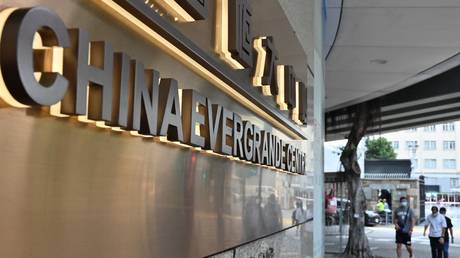
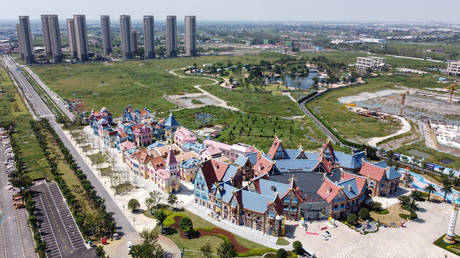
The electric car arm of China’s embattled property developer Evergrande said it faces an uncertain future unless it gets a swift injection of cash, sounding the alarm that the company’s liquidity crisis is mounting.
Evergrande New Energy Vehicle Group’s capability to pay its workers and suppliers, as well as to manufacture cars, will be in jeopardy without a strategic investment or the sale of assets.
The parent company, whose debts have exceeded $300 billion, has been running short of cash, making investors nervous that its potential bankruptcy could pose huge systemic risks to China’s financial system that would reverberate across the world.
Earlier this week, it missed a payment deadline on a dollar bond, providing no details as to the reason for that failure. That left investors anxious about incurring substantial losses when the cash-strapped company’s 30-day grace period ends.
Evergrande has made no comment about its $83.5 million interest payment, and its key property business had reportedly held private negotiations with on-shore bondholders to settle a separate coupon payment on a yuan-denominated bond.
Earlier this week, the People’s Bank of China once again injected capital into the country’s banking system to provide the necessary support for the markets. However, Beijing has still made no comment on Evergrande’s future. Its restructuring would be among the largest ever in China, with hopes for a swift resolution unlikely.
Last week, the real estate giant appointed financial advisers and warned of its impending default, sending global markets plummeting. If it collapses, it may well crush the property market, which accounts for 40% of household wealth in China.
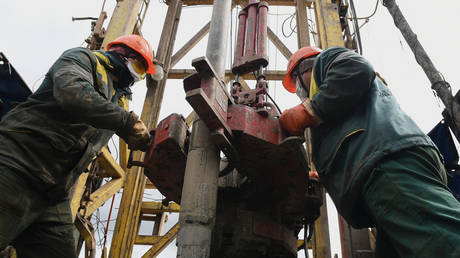
Russia’s reserves of natural gas could run low in 70 years at the current production level, while oil reserves should last about 30 years, geological firm Rosgeo estimates show.
“Over the past 25 years there have been ten times fewer new reserves discovered than in the previous 25 years, with many Soviet deposits being depleted,” the company said.
Besides oil and gas, the country’s other valuable reserves could also run low in a couple of decades, with the stock of diamonds and zinc sufficient for 20 years; gold and lead, for around a decade; and chromium reserves estimated to dry out in less than five years, Rosgeo warns.
The company’s data mirrors similar warnings from other sources. Last week, the acting head of Russia’s Federal Agency for Mineral Resources, Evgeny Petrov, said “profitable reserves [of oil] will last for around 20 or 21 years.” The official stressed that if Russia wants to retain its status as one of the world’s largest sellers of black gold, it will have to invest in new technologies to explore deposits that are harder to access, like those of Western Siberia.
The head of Russia’s state-run energy giant Gazprom, Alexey Miller, drew a more positive picture for the country’s natural gas reserves, predicting over a century of steady supplies, with some deposits capable of delivering fuel until 2132. However, he didn’t speculate on what would happen after that.