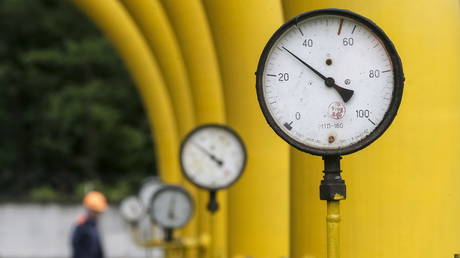
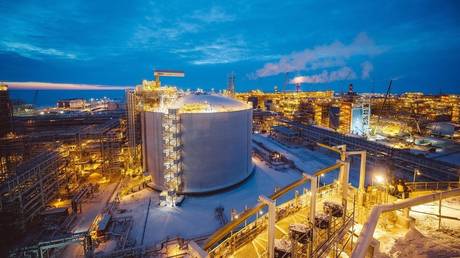
The US says Russia must increase supplies of natural gas to Europe through Ukraine to curb skyrocketing energy costs, sticking to its negative stance on the launch of Russia’s Nord Stream 2 pipeline.
“The reality is there are pipelines with enough capacity through Ukraine to supply Europe. Russia has consistently said it has enough gas supply to be able to do so, so if that is true, then they should, and they should do it quickly through Ukraine,” Amos Hochstein, senior adviser for energy security at the US State Department, said in an interview with Bloomberg TV.
Hochstein said supplies of gas from Russia to Europe are “inexplicably low compared to both previous years and to what they have the capacity to do.” He also said that Russia’s state energy giant Gazprom’s refusal to book additional gas transit through Ukrainian territory for October “increases the concern.”
The US official also accused Moscow of trying to use Europe’s energy crisis to speed up the launch of the newly constructed Nord Stream 2 pipeline, which runs from Russia to Germany through the Baltic Sea. Hochstein underlined that US President Joe Biden and his administration oppose the launch of the project.
Gas prices in Europe have been hitting records, with October futures on the Dutch TTF exchange reaching record $963.9 per 1,000 cubic meters this month, while on September 20 the estimated price was $911.2.
Russia’s Gazprom has repeatedly pointed to the connection between high gas prices and lower-than-needed reserves in European underground storage facilities ahead of the approaching winter. As of September 19, those reserves were only 72% full, TASS reported, which is nearly 14% lower than in the past five years.
However, Gazprom emphasized last week that its current volume of gas supplies to Europe is in full compliance with the existing contracts. The company has been uneager to book additional volumes in the pipelines running through Ukraine due to high fees.
Gazprom is also counting on the launch of Nord Stream 2, a pipeline capable of delivering 55 billion cubic meters of Russian natural gas annually. The pipeline’s daily capacity of gas supply is comparable to the entire volume of liquefied gas that is now supplied to Europe.
However, Russia may have to wait up to four months for EU certification required to start deliveries. The project has been repeatedly delayed under pressure from Washington and some Eastern European countries, which view increasing energy imports from Russia as a threat to Europe’s energy security.
Europe is being ravaged by an unprecedented energy crisis, and it may already be spreading. Asia, the world’s biggest buyer of gas and coal, may be next, with China particularly vulnerable because of the size of its economy.
Perhaps somewhat surprisingly, the big problem for China is not natural gas. It’s coal, which powers the majority of its power plants, Bloomberg reported this week, citing state-run outlet China Energy News.
According to a report in the news outlet, Chinese power plant operators are finding it hard to buy enough coal to keep their facilities running, which is raising the likelihood of an energy crunch when winter comes. Inventories are low because of the surge in coal prices this year, and some power plants have already had to turn off their boilers to save costs.
It appears that just like the gas crisis in Europe, this one was years in the making. The European energy crunch should not have come as a surprise given Europe’s decisive shift away from fossil fuels and the consequent underinvestment in local gas production, which made it almost entirely dependent on imports for its energy security.
Likewise, China – along with India – is about to become the victim of underinvestment too, in coal. The dirtiest fossil fuel and the target of much energy transition work has fallen out of favor with investors so badly as they seek investment opportunities in renewable energy that the coal price spike this year must have come as quite a shock.
As Nikkei Asia reported earlier this month, benchmark coal was trading at $177.50 per ton on September 10. This was a more than twofold increase since the start of the year and an even bigger increase from the $50 per ton that benchmark coal was trading at a year earlier.
“What we are seeing is a dilemma for investors, financiers as well as companies,” Shirley Zhang, principal analyst at Wood Mackenzie, told Nikkei Asia.
“Despite the effort of moving the whole region into a cleaner future, you still need coal for the next 10 years.”
There is, indeed, a dilemma, and it is between a green transition and energy security. The surge in coal and gas prices is proving that the energy transition will be neither smooth nor easy, and government decisiveness in net-zero goals will be nowhere near enough to effect it. But there are more immediate implications of an energy crisis in China. It will spill globally.
In the UK, industries are already feeling the pinch of soaring gas – and electricity – prices. There is talk about blackouts, although energy minister Kwasi Kwarteng has assured the public these will not happen. But if industries are struggling, that’s not good for inflation and economic growth. And China, while a much more centrally controlled economy than the UK, is not that different in the fundamentals. If electricity prices rise, the prices of everything else will rise, hitting growth.
What’s worse is that if there is not enough coal and gas for China, there will not be enough gas and coal for everyone else who needs to import it. Countries with local coal and gas production will rake in a fortune from energy exports. But the rest, having to pay through the nose for that energy, will see the same effects on their economic growth, namely a potentially severe stumping.
A lot has been said about the emission aspect of fossil fuels. The current crisis offers another angle: fossil fuels tend to get expensive, sometimes prohibitively so, when demand significantly exceeds supply. This is, in fact, one of the strongest practical arguments in favor of renewables: you may not have gas reserves, but every country has sunshine and wind. Renewables are good for energy independence. And the latest crisis in Europe and the risk of a crisis in China only shows that we are nowhere near this energy independence.
Another massive cyberattack on a major US agriculture group has forced the services provider’s systems to go offline. The attack is believed to have been carried out by a successor of the Colonial Pipeline hacker.
Boom Bust’s investigative journalist Ben Swann analyses the threat and explores whether the cyberattack could cause major disruptions to America’s food supply.
The world’s most popular cryptocurrency, bitcoin, continued trading in the red on Wednesday, after a day which saw it briefly drop below $40,000 for the first time since August. Other leading cryptos are also trading lower.
Bitcoin later recouped some of the losses, but it was still down 2.2% to $42,352 as of 9:30am GMT, according to the CoinDesk tracker.
Ether, the second-largest crypto, was down 4.5% to $2,929. Litecoin dropped 3.93% to $154.43, while dogecoin lost 0.6% to $0.21. Other digital tokens like XRP, Solana, Uniswap, Stellar, and Polkadot also lost value over the past 24 hours.
Bitcoin started its steep downfall on Monday, losing as much as 10% during the day’s trading and dropping below the $44,000 level. Experts attribute this decline to the broader sell-off in the global equity markets due to fears over mounting problems at Chinese property giant Evergrande. However, some say that the embattled firm is not the only driver of the crypto decline.
“Truth be told, the market rout we’re seeing is reflecting a wider set of risks than just Chinese property, and comes after increasing questions have been asked about whether current valuations could still be justified, with talk of a potential correction picking up,” Jim Reid, a strategist at Deutsche Bank, wrote in a note on Tuesday, as cited by Coindesk. According to the bank’s recent survey, 68% of investors expect at least a 5% correction in equity markets by 2022.
Carbon dioxide (CO2) prices could skyrocket by 500% in Britain, the government warned its food producers on Wednesday, after extending emergency state support in order to avert a food shortage.
The warning comes as surging gas prices in Europe have sent shockwaves through industries reliant on natural gas, forcing some fertilizer plants to shut down in recent weeks.
Fertilizer production is a major source of industrial CO2. As plants convert natural gas into fertilizer, they produce CO2 as a byproduct for industrial use. Carbon dioxide is used in several ways in food production, including to stun animals, as an alternative refrigerant, to cool meat and other foods during processing, and to replace oxygen in modified-atmosphere packaging. Slaughterhouses in the UK depend heavily on CO2.
As the situation with CO2 worsened, London struck a deal with US company CF Industries to restart production at two closed plants.
“We need the market to adjust, the food industry knows there’s going to be a sharp rise in the cost of carbon dioxide,” Environment Secretary George Eustice told Sky News, adding that the price of CO2 would rise sharply, from £200 ($272) a ton to around £1,000 ($1,365).
According to the official, the three-week support from CF, which supplies some 60% of Britain’s CO2, would cost “many millions, possibly tens of millions, but it’s to underpin some of those fixed costs.”
While the government and Prime Minister Boris Johnson have repeatedly denied concerns that there could be a shortage of traditional Christmas fare such as turkey, some say the temporary deal to supply carbon dioxide would not solve the food industry’s problems.
“A three-week deal won’t save Christmas,” Richard Walker, managing director for supermarket Iceland, told Reuters. “And certainly, won’t resolve the issue in the long term – we need a permanent solution to keep the wheels turning for fresh food supplies.”
Secretary Eustice says, “We know that if we did not act, then by this weekend or certainly by the early part of next week, some of the poultry processing plants would need to close.”
“And then we would have animal welfare issues, because you’d have lots of chickens on farms that couldn’t be slaughtered on time, and would have to be probably euthanized on farms, we’d have a similar situation with pigs.”
Meanwhile, according to the Nippon Gases corporation, “other countries in Europe will also suffer shortages” of CO2, as their supplies have tumbled 50% across the region.