Chinese vocabulary notes (April 2022)

This edition is (almost) all about the lockdown in Shanghai. Originally I had added and commented some audio recordings of desperate residents. However, these recordings disappeared again during the month, so unfortunately I had to delete them from the article.

I am of course not a journalist, but just an interested blogger. You hear and see many things from Shanghai these days. Some terrible, some things seem not too bad. The news reports from the mainstream media aren’t very helpful. What to believe? I see the most distressing scenes on Twitter, but does that mean whole Shanghai is like that? All in all, I prefer to hear the news directly from the people on the ground, so that I can gradually connect the dots and understand what’s happening.

China zero-covid meme - journey to the west - the monkey king and the buddha priest
Text from left to right: “Monk, have you come to set me free?” Answer: “I have come to take your covid-test”. If you didn’t get the joke, you can look here.

My first conclusion is that there is a little bit of everything. Human abysses with a touch of Orwell but also warmth, creativity and helpfulness. There’s no need denying that I fundamentally disagree with the idea of “zero-covid”, whether in China or elsewhere. Especially now that I see around me that the once dreaded disease is (at this point) for the most part no more than a cold. That is why the Chinese approach has a delusional character to me. And I don’t need to explain what an absolute “security need” means for individual freedom.

The whole thing has similarities with a mass movement where everyone has to prove that they are on the right side. For example, by putting on a white suit, doing a dance for the helpers or simply standing in line for your daily test. Anyone who does not wear a mask or leaves their home or neighborhood without permission will be called to order or worse. You have to obey and walk in line. Others would call it a cult.

Is all this necessary to prevent the spread of the disease? Can we prevent the spread at all in the long run? At what cost?

Afu: Shanghai Epidemic | Can you get food? What about pets? How are my family members?

A video update from Afu in Shanghai, showing how he is making the best out of the situation. Looking at his account of the lockdown, I more or less got the impression that the whole situation isn’t that bad. After all, if – like Afu- you have a pleasant apartment, plenty of supplies and connections to get more, it just means you have to stay at home and watch Netflix. He doesn’t mention anything about daily Covid-tests and the fear of being tested positive, but the fact that they temporarily sent their dog away does show this is a concern. He doesn’t go in to the Why of the lockdown. On the other hand, he does explicitly state that his lockdown experience isn’t very representative (“可能不是很有代表性”) and that this is purely his personal account (“我今天拍的内容是我个人的情况”).

封城的生活 Fēngchéng de shēnghuó life in lockdown
宠物的情况 chǒngwù de qíngkuàng pet situation
囤了什么货 dùnle shénme huò What are you stocking up
抢菜 qiǎng cài grab food
调侃 tiáokǎn ridicule
文化博主 wénhuà bó zhǔ cultural blogger
物资 wùzī supplies
郁闷 yùmèn depressed
足不出户 zú bù chū hù stay at home
要去方舱医院 yào qù fāng cāng yīyuàn go to the makeshift hospital
团购 tuángòu “group buy”
可能不是很有代表性 kěnéng bùshì hěn yǒu dàibiǎo xìng “probably not very representative”
我今天拍的内容是我个人的情况 wǒ jīntiān pāi de nèiróng shì wǒ gèrén de qíngkuàng What I’m filming today is my personal situation”

After more than a month of lockdown, how miserable are the entrepreneurs in Shanghai?

How do entrepreneurs in Shanghai experience the lockdown? How well prepared were they and how long will they last? In this compilation of conversations with local business leaders, we hear their side of the story. We learn that no one’s situation is quite the same.

停业 Tíngyè out of business
亏钱 kuī qián to lose money
创业者 chuàngyèzhě entrepreneur
裁员 cáiyuán to fire people
社保 shèbǎo social security
零收入 líng shōurù zero income
活下去 huó xiàqù to live / to survive
恢复 huīfù to recover
从零开始 cóng líng kāishǐ to start allover
面临挑战 miànlín tiǎozhàn to face challenges

Taiwanese girl studying at Fudan University shares her lockdown experience

Imagine: you are twenty and for the first time in your life you are going to study abroad. A new city, new friends, a completely new life. And just as you start to get used to your new surroundings, the hassle begins. First daily covid tests, then the campus is locked, then you are no longer allowed to leave your residential building, and again a few days later you have to stay in your room. That is in short what happened to this Taiwanese student.

封校 Fēng xiào school closure
发货 fā huò send goods
抗原自测 kàngyuán zì cè antigen self-test
封楼 fēng lóu sealed-off building
封户 fēng hù sealed-off room
阳性病例 yángxìng bìnglì positive case
恩赐 ēncì gift
无能为力 wúnéngwéilì powerless
匡谬 kuāng miù paradox
三餐的温饱 sān cān de wēnbǎo three meals a day

She first tells about the anti-covid policy measures chronologically, then she shares her personal feelings. Her initial goodwill soon turns into impotence (无能为力) and frustration. Her precious time, her quality of life are taken away from her. She didn’t even get to experience spring in Shanghai because she was locked inside. She does not only want to complain about herself and also understands that she’s not the only person suffering, but I can’t blame her for her honest words. And let’s not forget, studying costs money for which you want to get something in return. Not only in the form of good education together with your peers, but also in quality of life.

隔离 gélí isolation
核酸 (检测) hésuān nucleic acid (test)
阳性 yángxìng positive
阴性 yīnxìng negative
检测 jiǎncè detect, test

She does not speak freely, but reads her story. Of course with a slight Taiwanese accent as far as I can judge. The subtitles are in traditional characters.

Speak Chinese with Da Peng 大鹏说中文 – Chinese Expression #169

Da Peng explains the meaning of 过来人, as always with plenty of examples and short dialogues and most importantly, without using a single word of English.

过来人 guòláirén person with experience
资历更深的人 zīlì gēngshēn de rén more senior person
绝对的 juéduì de absolute
相对的 xiāngduì de relative
没有绝对的过来人,只有相对的过来人。 méiyǒu juéduì de guòláirén, zhǐyǒu xiāngduì de guòláirén To explain 过来人 is always relative
无从下手 wúcóng xiàshǒu No way to start
天外有天,人外有人 tiānwàiyǒutiān, rén wài yǒurén In the wider world there are people more talented than oneself (idiom)

10 Years of an Ordinary Chinese Girl’s Life

More people should make this kind of retrospective videos about themselves. It got me thinking about what I was like ten years ago. Ella tells her story of personal growth that include several stages: not finding her way as a student, first unsatisfying jobs, meeting new people, learning English, meeting her future husband, traveling and becoming a professional content maker. It’s an impressive story about courage that ultimately leads to finding confidence and meaning. Ella speaks quite fast though and uses some slang here and there, so I had to slow down the video to extract all the details of what she said.

腿不直 Tuǐ bù zhí legs not straight
福双眼皮 fú shuāng yǎnpí double eyelid
典型乖乖女 diǎnxíng guāiguāi nǚ typical good girl
时髦的人 shímáo de rén hipster & stylish person
浑浑噩噩的 húnhún’è’è de murky
第六年开始出现转机了 dì liù nián kāishǐ chūxiàn zhuǎnjīle Turnaround started in the sixth year
我不要再做咸鱼了,我可以翻身 wǒ bùyào zài zuò xián yúle, wǒ kěyǐ fānshēn “I don’t need to make salted fish anymore, I can turn over” (咸鱼翻身 – to experience a reversal of fortune, be back in the saddle)

狗血剧情 gǒu xuè jùqíng melodramatic plot / “dog blood plot”
带牙套 dài yátào wear braces
空虚的感觉 kōngxū de gǎnjué feeling of emptiness
我内心清楚 wǒ nèixīn qīngchǔ I know in my heart
都说时间会摆平一切 dōu shuō shíjiān huì bǎipíng yīqiè They say time will settle everything
做自媒体 zuò zì méitǐ do self-media (content published on independently operated social media account)

【电影】《朝鲜世界2019》(北韓世界 North Korea World)

How do the Chinese see North Korea? Does Kim’s Hermit Kingdom remind them of the days of Mao Zedong? This documentary made by a group of Chinese students couldn’t be further apart from the dreadful but honest picture shown in the legendary Vice movie about North Korea. The students arrive in Pyongyang by train and get the usual guided tour of North Korean splendor. Unlike the Vice doc where every aspect of the travel experience is questioned and a kind of behind-the-scenes North Korea is presented, our student travelers seem to take everything at face value, no questions asked. The welcome feast, the empty karaoke bar with every thinkable Chinese song, girls in traditional costumes dancing only for them, CCTV programs on the hotel room TV and everybody they meet speaks Chinese! It’s a bit pathetic really. The narration is very formal and unnatural and doesn’t match the students’ tone of voice. In short, it’s a propaganda piece.
朝鲜 Cháoxiǎn North Korea
平壤 píngrǎng Pyongyang
朝鲜劳动党 cháoxiǎn láodòng dǎng Workers’ Party of Korea
非军事区 fēi jūnshì qū demilitarized Zone
主体思想 zhǔtǐ sīxiǎng Juche idea, state ideology of North Korea
坚持社会主义的国家 jiānchí shèhuì zhǔyì a country that insists on socialism
金正恩 jīnzhèng’ēn Kim Jong Un

Let’s call it coincidence that we started this month in Shanghai and ended up in North-Korea. I hope you enjoyed the ride though. Let’s see what next month will bring!

Reading the Chinese news: less hard than you think!

It’s sometimes said that reading the Chinese news shouldn’t be your number one language goal, unless you are a journalist, diplomat, China scholar or a news junkie. If you happen to fall in ones of those categories or – like me – simply like to read news media in Chinese, you might be interested in this practical mini-guide.

I personally spend more time reading the news than I like to admit. I’m the last to deny that in many cases the benefits are doubtful, compared to reading a good book for example, but as a language learning activity it can be very rewarding. When you’re in to it, daily reading the Chinese news is a powerful way to grow your vocabulary in specific areas and increase your reading speed. There are some difficulties though, especially when starting out. In this article, I go into the benefits, challenges and different approaches to reading the news in Chinese.

Why read the Chinese news?

I’m not sure if this is the most original answer, but reading the news in Chinese is – just like learning Chinese itself – about changing perspectives and questioning your own. We live in a complex world and there is no single truth, only different angles and perspectives of “what is”.

Reading the news only from one source, from one country, in one language, is somewhat like staying in the same village for whole your life. Instead, my motto would be “read everything and question everything”. When you read the news in multiple languages, you start to see beyond black and white, incorporate different views and perspectives and appreciate the complexity of things. What’s the Chinese view on the war in Ukraine for example? How do their media cover the subject? Which wordings do they use? If you can’t read the Chinese news, you’ll probably never going to find out, but if you do, you’ll at least know there are different sides to this conflict. That’s where diplomacy starts. You might even discover that there are multiple Chinese perspectives on the matter.

What makes reading the news in Chinese difficult?

One major obstacle reading the Chinese news articles are proper nouns; in particular names of people, places, organizations, brands and institutions. Washington, for example, is 华盛顿, New York Times is 纽约时报 and Reuter’s News Agency is called 路透社. And let’s not forget 拜登, the current president of the United States. Nothing show-stopping, yet still a source of confusion that can slow you down.

Another difficulty – depending on your familiarity with the subject – is lack of context. If I were to read the Armenian news for example, a country I have very little knowledge of, I understand next to zero, not only because of the language barrier, but also since I have no frame of reference whatsoever. I simply don’t know enough about what is going on to make sense of what I’m reading.

You have to be prepared to encounter an unfamiliar discourse that embodies new narratives and contexts. This can be unsettling. Compare it to reading about the American elections through the lens of Russia Today: it’s different and often comes with a “that’s not how I see it” feeling. It’s that other, more distant perspective that makes things interesting though.

Strategies to start reading the news in Chinese

My strategy is simple. Its main components are repetition and focus. Stick with your interests and pick articles with a familiar topic or from your area of interest. Especially when starting out, I wouldn’t recommend reading about topics you’re not interested in or don’t understand well. Don’t read about the French elections if you couldn’t care less. Don’t read about the Chinese real estate market if you don’t know anything about the real estate market in your own country. Read about stuff you care about and keep returning to the same topics.

How you adept this strategy largely depends on which tools you use. Here are three of them:

1. The Chairman’s Bao

When it comes to news tailored for Mandarin learners, the Chairman’s Bao is the number one on the market. This news-based graded reader has been around since 2015 and has been very successful. According to their website, they publish more than 1,600 news-based lessons each year (six new lessons every day). The Chairman’s Bao library currently contains around 8.000 lessons, for beginners as well as intermediate and advanced learners. Quality does come with a price though:

Chairman's Bao news-based graded reader 2022 pricing

That being said, The Chairman’s Bao is an excellent starting point for regular news reading, allowing you to keep track of new vocabulary and what you’ve read. Every article comes with audio and an in-built dictionary. You can switch between simplified and traditional character reading mode. But the greatest advantage probably is that the news-based lessons are graded, meaning you can climb from HSK 2 all the way to HSK 6. This saves you the frustration of reading articles that turn out way beyond your level. Reducing the variety of topics to guarantee your comprehension is less of a necessity using The Chairman’s Bao.

2. DuShu

The low-budget reading tool DuShu

DuShu is the low-budget reading tool for autonomous learners. I’m a longtime fan as I like low-budget options for learning Mandarin, but most of all, it’s a super tool, because you can copy-paste any text in it and it will break it down for you in readable bits. The app comes with audio, pinyin, flashcards, difficulty rating and other useful features. The only thing it doesn’t do for you is find news articles that you want to read and suit your current level. That’s why it’s an excellent option for more advanced learners who want to choose their own reading diet.

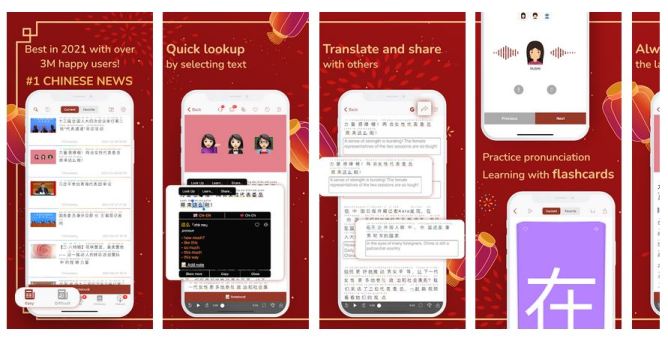
3. Easy Chinese News

Easy Chinese news

The app Easy Chinese News app does offer a daily updated news feed from Mainland Chinese sources. Be prepared to find a rather random mix of news content though, although the mostly short articles can be sorted by topic and difficulty level (easy or difficult). Easy Chinese News includes a multilingual dictionary with example sentences, a favorite word list and reading history. Also worth mentioning is that it supports traditional characters. To get rid of the ads you have to go premium. It’s still an interesting option though, it’s just more raw and random than The Chairman’s Bao.

Which Chinese news media to read?

What you like to read is completely up to you. I put up a short list in more or less random order, distinguishing Global Chinese, Mainland Chinese and Taiwanese news media. It’s worth noting that Mainland China has many, many more (regional) news media. I also find the Global Chinese news like the BBC and Deutsche Welle interesting. Although they’re not local sources, they do share the latest news from China, be it from a more or less western perspective.

Global Chinese news

Mainland Chinese news

Taiwanese news

Which tools and news papers you choose in the end, depends on your budget, taste and priorities. I hoped this article can offer some orientation. Feel free to leave a comment about your experiences reading the news in Chinese. Thanks for dropping by on Kaohongshu.

Chinese vocabulary notes (March 2022)

Gaming crackdown, war in Ukraine, badminton, Xi dada, freelance life in China and more. The good news: spring has finally arrived!

What the Chinese Think of the Gaming Crackdown in China | Street Interview

When I went to school (back in say 2007) I had a few friends who were heavily addicted to online gaming. It was beyond doubt that their school results and social life suffered from it. How their parents dealt with this behavior or how effective their countermeasures were, I can’t remember, but the thought that the government would step in to limit gaming time or prohibit certain online games would not only have been inconceivable to us, but also outrageous.

This is exactly what the Chinese government did however, to combat online gaming addiction among minors. Asian Boss writes in its video introduction: “China is the largest video game market in the world and its ongoing freeze on video game licenses is said to have shut down over 14,000 gaming-related companies.” In other words, a surprising step for China to take against its own booming gaming industry. The video reveals what Chinese people in Shanghai think about this government policy.

玩游戏 / 打游戏 Wán yóuxì / dǎ yóuxì play games
自控能力 zìkòng nénglì self-control ability
培养下一代 péiyǎng xià yīdài raise the next generation
上瘾 shàngyǐn addicted
网瘾 wǎngyǐn internet addiction
国家政策 guójiā zhèngcè national policy
限制游戏时间 xiànzhì yóuxì limit game time
刷抖音 shuā dǒuyīn to “swipe” Douyin
负面的效果 fùmiàn de xiàoguǒ negative effect

My thoughts: Especially the elder generation seems to approve government interference in this matter. The children’s parents might suffer from smartphone addiction themselves and might not be in the position to credibly correct their children’s behavior. They do perceive the problem though and might even welcome the support of the government, because they can’t do it themselves. China might be the first to drastically address this phenomenon, but they won’t be the last country to do so (if the measures prove effective).

What Do the Chinese Think of Russia? | Street Interview

Another great and important video about what Chinese people in Shanghai have to say about the war in Ukraine. Some commenters note a number of more serious translation issues that blur the meaning of the actual statements. Irony: The old man doesn’t like the USA and expresses sympathy for Putin, but wears an American cap. As to be expected lots of relevant political vocabulary here:

入侵 rùqīn Invasion
主权国家 zhǔquán guójiā Sovereign state
乌克兰 wūkèlán Ukraine
官方媒体 guānfāng méitǐ official media
干涉 gānshè to interfere
没有权利干涉 méiyǒu quánlì gānshè no right to interfere
表示痛心 biǎoshì tòngxīn express sadness
加入北约 jiārù běiyuē join NATO
盟友 méngyǒu ally
谈判 tánpàn to negotiate
中立的立场 zhōnglì de lìchǎng neutral position
共同体 gòngtóngtǐ community
国家的领导人 Guójiā de lǐngdǎo rén the leader(s) of a country
保护领土安全 bǎohù lǐngtǔ ānquán protect territorial security
捍卫国家和民族 hànwèi guójiā hé mínzú defend country and people
独裁 dúcái autocratic
世界大战 shìjiè dàzhàn world war
核弹 hédàn nuclear weapons

YoYo Chinese: 杨哥 The Badminton Master

This is a short clip from the YoYo Chinese YouTube channel about badminton, high quality content for Chinese learners as usual. The video contains authentic Beijing dialect from a amateur badminton player and includes explanations.

融洽 róngqià harmony, harmonious
团体 tuántǐ group
团体活动 tuántǐ huódòng group activity
羽毛球 yǔmáoqiú badminton
不分年龄的运动 bù fēn niánlíng de yùndòng a sport for all ages
一个关系融洽的地方 yīgè guānxì róngqià dì dìfāng a place where relations are harmonious / on good terms

【The New Taiwanese】Ep.3 Being Mixed Race and Dark Skinned in Taiwan 台灣混血兒皮膚黑的優缺點

In this episode of “The New Taiwanese”, Justin shares his experience as a person of mixed race in Taiwan. He has Philippine roots and speaks Mandarin fluently. The host asks about his experience of having a darker skin color in Taiwanese society. Highly interesting conversation and lots of new insights.

混血儿 hùnxiě’er “person of mixed race”
搭讪 dāshàn strike up a conversation
小鲜肉 xiǎo xiān ròu “young fresh meat”
结结巴巴 jié jiē bābā to stutter
困扰 kùnrǎo troubled
代沟 dàigōu generation gap
肤色 fūsè skin color
面孔 miànkǒng face

What do the Chinese Think of Xi Jinping?

Disclaimer: Teacher Li Can doesn’t answer the question, instead he shares his personal views about the Chairman. I might be wrong, but it seems to me that his opinions do reflect what “the majority” or a large portion of Chinese citizens think about their current leader – except for the historical comparisons he draws. On the other hand, we simply don’t know “what the Chinese think”. To me that is a reassuring thought.

政治体制 zhèngzhì tǐzhì political system
个人魅力 gèrén mèilì personal charisma
口才 kǒucái eloquence
内敛含蓄 nèiliǎn hánxù introverted and reserved
主席 zhǔxí chairman
指手画脚 zhǐshǒuhuàjiǎo finger pointing
敢说敢为的人 gǎn shuō gǎn wéi de rén somebody who dares to speak
隐没 yǐnmò disappear

Teacher Li uses plenty of difficult words, but I managed to filter out most of the key vocabulary. The occasional chengyu he throws in don’t make for easy listening.

执政能力 zhízhèng nénglì governing ability
仁者见仁智者见智 rénzhějiànrén zhìzhě jiàn zhì the benevolent see benevolence, the wise see wisdom
修养生息 xiūyǎng shēngxī recuperate
恢复元气 huīfù yuánqì rejuvenate
尖锐 jiānruì sharp
反腐堕落 fǎnfǔ duòluò anti-corruption
官员的力量 guānyuán de lìliàng power of officials
繁荣兴盛 fánróng xīngshèng prosperous
脱贫 tuōpín get rid of poverty

Daily Chinese Expression #168「摆设 | 摆设很好看,但却没什么用。」 Speak Chinese with Da Peng 大鹏说中文

A short podcast by Da Peng, one of the most productive and original content creators for Chinese learners. I don’t know much about him, but I reckon he’s a good teacher, judging from how smoothly he introduces vocabulary in his videos. The element of repetition also is useful. And I learned a new word to call people who aren’t of much value in a team situation.

摆设 bǎishè decorations
装饰品 zhuāngshì pǐn decoration
雕塑 diāosù sculpture
存在感 cúnzài gǎn presence
贡献 gòngxiàn contribute, contribution
比喻意义 bǐyù yìyì figurative meaning
用来比喻人 yòng lái bǐyù rén use a metaphor to describe a person
轻视 qīngshì to contempt
真正的实力 zhēnzhèng de shílì true strength
点缀的作用 diǎnzhuì de zuòyòng decorative function

Intermediate Chinese Listening Practice|freelance, work in café, Chinese vlog

I only recently discovered Shenglan’s YouTube channel. She is – among other things – a freelance Chinese teacher with her own podcast and video content for Chinese learners. In this vlog, she gives an impression of a normal working day, blogging at the local Starbucks. Big plus: she speaks slowly and clearly and highlights key vocabulary in her video.

充电线 Chōngdiàn xiàn charging cable
充电头 chōngdiàn tóu charger
自由职业者 zìyóu zhíyè zhě freelancer
博客 bókè blog
干扰 gānrǎo interference
传到YouTube上 chuán dào YouTube shàng upload to youtube
一份工作 yī fèn gōngzuò a job
维持开支 wéichí kāizhī to make ends meet
星巴克 xīngbākè Starbucks
自律 zìlǜ self-discipline
排斥 páichì to reject (here: not wanting to do sth.)
有意义的事 yǒu yìyì de shì a thing that means something
克服自己的懒惰 kèfú zìjǐ de lǎnduò overcome your laziness

That’s it for this month, folks. See you in the next!

Chinese vocabulary notes (June 2022)

In this month’s edition: Chinese as a global language, Chinese drinking culture, cat slaves, financial advise, computerized chopsticks and last but not least: finally understanding the Chinese news.

June has been a good month in terms of extensive listening for me. Recently I’ve been visiting Dong Chinese Media a lot to find interesting content for my Chinese vocabulary notes. Because their mostly short videos come with transcript, they make good study material. Even to practice pronunciation, since you can simply click on a sentence to repeat it. Their media feed is being updated regularly and offers a great variety of topics for almost all levels. Also, I’ve been listening to the German YouTuber 老雷’s fascinating story about his walking adventure from Beijing to Germany.

And I heard about the new Harry Potter Chinese audiobook, recorded by professional Chinese voice actors and available on Ximalaya. The first chapters are free of charge. Much better of course than the amateur recordings you find on YouTube.

Will Chinese Replace English as the Global Language?

Will Chinese replace English as a global language? And why did English become a global language, where as Chinese doesn’t have and never had this status? Li Can discusses these and other questions. This video got a HSK 3 classification by the Dong Chinese team, although HSK 5 is closer to the mark. There’s no way to discuss such a complex topic with a HSK 3 vocabulary, Li Can does a great job though.

全球性的语言 quánqiú xìng de yǔyán global language
霸主 bàzhǔ overlord
霸主语言地位 bàzhǔ yǔyán dìwèi language with a dominant position
文化输出了 wénhuà shūchūle cultural export / (American) culture has been “exported”
海外探索 hǎiwài tànsuǒ overseas exploration / to explore overseas
扩张 kuòzhāng to expand
一带一路 yīdài yīlù Belt and Road / historical silk road
取代英文 qǔdài yīngwén to replace English (as a global language)

Chinese University Girl Studying in US Shocked By American Culture!

If this is Chinese-American culture shock, I’m amused but far from flabbergasted. Americans drink tap water, Americans give tips in bars, Americans look very differently from each other, not all Americans streets are safe at night… Could it be that American culture is so present in China that this Chinese graduate student in the interview has been mentally prepared to such an extent that there are no real surprises left, apart from micro-level differences? She might even have a bigger culture shock moving to Inner Mongolia to live with local horse breeders. Nonetheless, ninety minutes of completely transcribed conversation about cultural differences between the US and China.

中美文化差异 Zhōng měi wénhuà chāyì cultural differences between China and the United States
学籍 xuéjí student status
申请 shēnqǐng application
录取 lùqǔ admission
间隔年 jiàngé nián gap year
衣着 yīzhuó clothes
多样性 duōyàng xìng diversity
给小费 gěi xiǎofèi to give tips
小费文化 xiǎofèi wénhuà tipping culture
烘干机 hōng gān jī dryer
杀菌 shājùn to sterilize
犯罪率 fànzuì lǜ crime rate
流浪汉 liúlàng hàn tramp
被震惊到 bèi zhènjīng dào to be shocked
水龙头的水 shuǐlóngtóu dé shuǐ water from the tap
过滤 guòlǜ filter

Learn Chinese Through News

Always when I felt confident about my level of “listening comprehension”, watching the CCTV news woke my from my dream, because it seemed like a related, yet different language than what I had been learning so far. If you have the same experience, this video might be helpful. It explains the CCTV news on a word by word basis in a way that even the tiniest details start making sense.

收看 shōukàn to watch
新闻联播 xīnwén liánbò Chinese news broadcast (network news broadcast)
本轮 běn lún this round
上海本轮疫情以来 shànghǎi běn lún yìqíng yǐlái Since the current round of epidemic in Shanghai
平凡 píngfán ordinary
行动 xíngdòng action
无私 wúsī selfless
奉献 fèngxiàn to dedicate
抗击疫情 kàngjí yìqíng fight against the epidemic
守护 shǒuhù to guard
共同 gòngtóng together

「 智能筷子 」 Speak Chinese with Da Peng

Japanese researchers have developed computerized chopsticks that enhance salty tastes. The idea is to help those who need to reduce sodium in their diets. Da Peng explains this new development in his clear and unique way.

智能 zhìnéng intelligent, smart
智能筷子 zhìnéng kuài zǐ smart chopsticks
清淡无味 qīngdàn wúwèi light and tasteless
装置 zhuāngzhì device
饮食习惯 yǐnshí xíguàn eating habits
一饱口福 yī bǎo kǒufú A real treat
魔法 mófǎ magic
犯困 fànkùn sleepy
口味 kǒuwèi taste

酒桌上的中国

Chinese drinking culture was the topic from my latest online Chinese lesson and we covered some common drinking vocab like 嗜酒如命 and 灌酒 or 喝趴下了. I had to slow down the video and repeat it several times to get all the details.

嗜酒如命 shì jiǔ rú mìng drink like a fish; alcoholic
劝酒 quànjiǔ Persuade to drink
灌酒 guàn jiǔ lit. to pour wine / alcohol, meaning “drinking fast and in large quantities”
给面子 gěi miànzi Give face
看不起 kànbùqǐ to look down on
干一杯 gàn yībēi to drink up
趴下 pā xià to fall; to get drunk
shāngchǎng business field
guānchǎng officialdom; official circles
尽情享受 jìnqíng xiǎngshòu to enjoy oneself to the full

Cat slave

Are you a 猫奴 or do you know people around you who are? Another short dialogue from the “课本上学不到的汉语” series by GoEast Mandarin. They are great at creating this kind of both original and “snackable” learning content.

猫奴 māonú cat slave
过敏 guòmǐn allergic
对 X 过敏 Duì X guòmǐn allergic to

如何在经济衰退中挣钱?

Did somebody say economic recession (经济衰退)? If the economic recession indeed is inevitable, then we might as well face the fitting Chinese vocabulary. This video covers how to deal with the new economic climate by taking a look at some “smart money” tactics and 暴富机会 in particular, because our optimistic friend Peng Peng believes that where others are losing money, you can get rich.

经济衰退 jīngjì shuāituì economic recession
财务 cáiwù finance
财务危机 cáiwù wéijī financial Crisis
失业 shīyè unemployment
房贷 fángdài mortgage
房贷断供 fángdài duàn gōng mortgage Suspension
暴富机会 bào fù jīhuì get rich opportunity
大佬们 dà lǎomen big guys
投资股市 tóuzī gǔshì to invest in the stock market
股票 gǔpiào stock
熊市 xióngshì bear market

That’s it for this month. Enjoy the summer, learn Chinese and see you in July!

Reading Chinese web novels with Readibu

Want to read more authentic content in Chinese? Chinese novels, short stories and children stories written for native readers? For more intermediate and advanced learners the app Readibu has plenty of good reads to offer.

In a previous post, I discussed Weixin DuShu which could be called Tencent’s version of Kindle. Great for reading all kinds of books in Chinese, yet lacking a Chinese-English pop-up dictionary and other simple features that support people like you and me in their endeavor to read “native” content. A real pity, because a potentially fantastic app becomes next to unusable for the vast majority of Chinese learners.

Then there’s also DuShu which I discussed at length on this blog. It has those extra language learning features, but since it works by copy-pasting content from websites, DuShu is not optimized for reading longer texts like novels or even long interviews or essays. The same goes for the Pleco clipboard reader, assuming you don’t want to be bothered to repeatedly select the text on your mobile device, copy it, open the app and load it. It’s simply not very practical – not only does it cost a lot of time, but you also tend to lose track of the last page you read.

Readibu – web reader for reading Chinese web novels

There is a solution though, since Readibu tackles all these deficiencies rather well. In short, Readibu is a reading app for Chinese web novels, short stories and children stories, specially designed for Chinese learners. No more, no less. It extracts the text from almost any given website and presents it in reader mode with a special pop-up dictionary.

The idea behind it is very clever, after all there’s an overwhelming quantity of Chinese online novels you can read for free. In a way, “all” that Readibu does, is sorting (a selection of) them by HSK level, giving a short introduction and present them in reader mode. At least, now you know where to start. If you don’t feel up to reading a complex novel with countless characters that all have their own Chinese names, you can give the short stories a try first. They too come in different genres like philosophy, relationships, work & career, life, horror, mystery, legends and history.

Main features

All the rest is sort of self-explaining: I randomly picked my first novel called “Romance on the Road of Officialdom”. (I was warned it was cliché-ridden and written by “students”. My main concern is it has more than 500 chapters.) With the support of the pop-up dictionary, I was able to read the first chapters fairly quickly, not catching everything, but enough to enjoy the story and go forward.

Page stats

The page stats give a more or less solid indication of the difficulty level, although familiar characters have a tendency to emerge in strange combinations and contexts, so you can’t be too sure about the actual readability. A “chengyu counter” would be appreciated as well. I encountered countless idioms, 98 % of which I couldn’t understand without tapping on them for their meaning. Nonetheless, these page stats are a welcome feature.

Dictionary history

The same can be said about the dictionary history, especially the frequent words, which allow you to keep track of the most difficult and relevant new words. You can also star special words and expressions to study them later. If you want, you can even export your vocabulary lists and use them in other apps like Pleco or Anki.

Simplified or traditional characters

Another big plus for serious learners is that Readibu allows you to read simplified as well as traditional characters. Other settings like showing or hiding pinyin and underlining words and phrases to make the text more readable are useful too. The pinyin feature could be even better if you could customize it to hide, say, HSK 1 – 5 vocabulary and other familiar words and characters.

  • Readibu: read Chinese novels
  • Readibu: reader mode
  • Readibu: page stats
  • Readibu: frequently tapped words
  • Readibu: reader settings
  • Readibu: premium subscription

Bugs – broken links?

One serious bug I encountered using the app is that some URL’s don’t work. This was mostly the case when opening one of the short stories from m.xiaogushi.com, a website that currently seems to be offline. In other words, some broken links need to be fixed to avoid disappointment from users.

Best feature: read from any custom website

A big plus on the other hand, is that you can read almost any Chinese text in Readibu by copy-pasting the URL and loading the page. Their FAQ explains how it works: “Yes, any content that is publicly accessible on the internet can be read on the app, assuming it is not blocked or obfuscated with anti-scraping code. Navigate to Bookmarks tab and select the plus icon (+) to add a custom site URL as a new bookmark.” The bookmark section is where you find your reading list with saved novels, stories and your own content.

Compared to DuShu and Pleco clipboard reader where you have to switch between apps to copy-paste the text you want to read, this is a real advantage. I tested it with some news articles and it works smoothly. This also allows you to read other works of literature, in case you’re not completely convinced by the literary quality of the web novels in Readibu or have your own reading list. Works like “To Live” by Yu Hua for example or “Stories of the Sahara” by Sanmao – to name two extremely interesting and readable books.

Premium features

Readibu is a freemium app. These extra features you get when you pay for subscription:

  • Smart name recognition – Detect likely names of people, places and organizations
  • Sentence Translation – Access unlimited translation with Google Translate
  • Image Search – See image search results for selected text
  • Offline Reading – Download pages for reading offline

In my opinion, they are welcome extra features, yet not essential to use and enjoy the app. At this point, I wouldn’t be willing to pay for them. Even better learner content, in-built audio to read texts out loud and flashcards functionality might convince me though.

Conclusion

Long story short: Readibu is great for those who’ve moved beyond HSK 4 and are hungry for longer, authentic content to read. The app is free, offers a variety of popular novels and stories, sorted by HSK level. If you’re the kind of autonomous language learner that enjoys a reading adventure to expand your vocabulary, increase your reading speed or simply “explore” the Chinese language, you should certainly give it a try.

What’s your favorite app to read Chinese texts? Have you tried Readibu? Let me know in the comments below!

Graded Chinese readers

Graded Chinese Reader 500 Words: Selected Abridged Chinese Contemporary Mini-stories
Graded Chinese Reader 1000 Words: Selected Abridged Chinese Contemporary Short Stories
The Rise of the Monkey King: A Story in Simplified Chinese and Pinyin 600 Word Vocabulary Level
The Sixty Year Dream: Mandarin Companion Graded Readers Level 1 (Chinese Edition)
The Dwarfs 小矮人 Xiǎo ǎi rén (HSK3+Reading): Chinese HSK Graded Reader
The Prince and the Pauper: Mandarin Companion Graded Readers Level 1,
Chinese Breeze Graded Reader Series Level 1(300-Word Level): Wrong, Wrong, Wrong!
Graded Chinese Reader 3000 Words: Selected Abridged Chinese Contemporary Short Stories

Disclosure: These are affiliate links. They help me to support this blog, meaning, at no additional cost to you, I will earn a small commission if you click through and make a purchase.