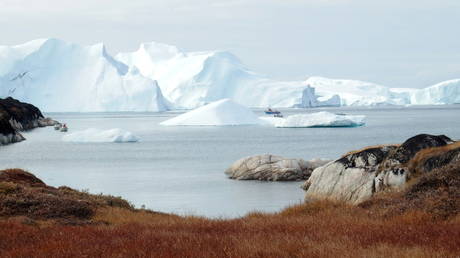
Global energy firms are expanding fossil-fuel production in the Arctic region, driven by boosting their profits and with no regard for the consequences, research by Paris-based climate watchdog Reclaim Finance claims.
According to the group’s data, there are currently 599 oil and gas fields in the resource-rich Arctic region, with some 220 sites already in production. Also, some 338 new fields have been discovered and may enter development at any time. This means that if the companies find the necessary financing to exploit all these deposits, the reserves in production could double in the near future. And the group believes financing will soon be found.
“The Arctic is a climate bomb, and our research shows that the oil and gas industry is hellbent on setting it off, thus blowing up our chances of avoiding runaway climate breakdown. But they aren’t the only culprits: financial institutions have bankrolled these companies, making a mockery of their own climate commitments,” Alix Mazounie, co-author of the report, claims, as cited by Bloomberg. According to the group’s estimations, some 120 major global banks provided more than $314 billion in investments for Arctic resource development from 2016 to 2020.
Researchers claim that Gazprom PJSC, ConocoPhillips, and TotalEnergies SE are the largest of the energy firms expanding their fossil-fuel extraction in the region, able to boost production of Arctic oil and gas by 20% over the next five years.
The report questions the intentions of financial institutions and energy companies that often declare green credentials but act contrary to them, investing in the development of fossil-fuel sites in the sensitive Arctic region. According to researchers, two-thirds of the top 30 banks that finance Arctic reserve exploration have so-called Arctic restriction policies.
Next month, the world’s leaders are scheduled to hold climate talks following a warning in August from the Intergovernmental Panel on Climate Change, which claimed that the goal for keeping global warming below 1.5 degrees Celsius is unreachable under current extraction levels. The new research adds that developing Arctic reserves could lead to a climate crisis.
“The more the ice melt accelerates in the Arctic, the more fossil fuel reserves become accessible. However, the more oil and gas projects there are in the Arctic, the less the Arctic can play its role as an air conditioner for the planet,” it states, suggesting that the region should be excluded from fossil-fuel production altogether.
“In order to truly protect the Arctic, financial players must apply their policy of exclusion to the Arctic perimeter, which makes the most sense from an environmental and climatic point of view,” the group concludes.
Natural gas prices on the European market surged by more than 5% on Monday, hitting nearly $900 per 1,000 cubic meters, according to ICE futures trading data.
The price tag for the October futures contract on the TTF hub in the Netherlands reached $895.30, marking a growth of 5.4% against the levels reached at the end of last week.
European gas prices have been hitting record highs over the past month with the estimated price of October futures reaching a decade high of $963.90 on September 15.
The spike is being attributed to the approaching winter season and economic rebound from Covid-19 lockdowns across the world. This has reportedly boosted demand from households and businesses, while lower investment by global drillers is constraining output.
Last week, the CEO of Ukrainian state-controlled energy corporation Naftogaz accused Russia’s Gazprom of deliberately withholding gas supplies from Europe, thus manipulating the markets.
The Russian energy corporation says the surge in gas prices are the result of low reserves in European underground storage facilities ahead of the winter season. As of September 19, those reserves were reportedly only 72% full, which is nearly 14% lower than in the past five years.
Earlier this month, Germany’s energy ministry said Russia is fully compliant with its gas supply obligations to Europe, stressing there was no need for the state to intervene in the situation with gas prices.
Major crypto coins started to recover on Monday, following last week’s massive sell-off in the wake of China’s blanket ban on virtual currency-related businesses.
Bitcoin has rallied to about $44,000 per coin, nearing the level it was trading on Friday before the People’s Bank of China announced that crypto transactions in the country are illegal. Meanwhile, ether broke above last week’s level, trading up by more than 5% at $3,110 as of 10:47 GMT.
“As the FUD (fear, uncertainty and doubt) around the cryptocurrency ban in China is slowly leaving the market, there is a sense of stability across the crypto spectrum. With bitcoin surpassing the $44,000 mark, most of the other top cryptocurrencies followed suit. The coming 24 hours could be a period of stability across the crypto spectrum,” Edul Patel, CEO and co-founder of Mudrex, told the Economic Times.
According to Jeffrey Halley, senior market analyst at Oanda Corporation, “Over the weekend sessions, bitcoin has shown some resilience and has now recovered the majority of those losses.”
“It may well be that China’s previously announced crackdowns had already been built into prices,” he said in a note seen by Bloomberg.
The People’s Bank of China revived its tough stance on digital currencies on Friday, ruling all crypto-related trading activities illegal and banning overseas cryptocurrency exchanges from providing services to mainland investors.
The regulator announced plans to bar financial institutions, payment companies and internet firms from facilitating cryptocurrency trading, as well as to strengthen monitoring of risks from such activities.
The ruling came as part of a broader state-run campaign by Chinese regulators against cryptocurrencies. Earlier this year, Beijing banned mining in major bitcoin hubs, such as Sichuan, Xinjiang and Inner Mongolia, which led to a sharp drop in bitcoin’s processing power, as multiple miners took their equipment offline.
Budapest signed a new long-term contract on Monday with Russia’s energy giant Gazprom for gas supplies bypassing Ukraine, Reuters reports.
The agreement was sealed by Gazprom CEO Aleksey Miller and Hungarian energy group MVM executives at the Hungarian Foreign Ministry.
The deal was signed after Hungarian Foreign Minister Peter Szijjarto announced last month that Budapest had agreed with Moscow on all the conditions for a new supply contract to take effect from October 1. The minister said that under the new deal, Hungary will buy gas “at a much better price than under the expiring contract,” which was signed in 2020.
According to Szijjarto, the duration of the new agreement with Gazprom would be 15 years, with a clause to change purchased quantities after 10 years. The price had also been agreed.
Gazprom would ship 4.5 billion cubic meters of natural gas to Hungary annually, Szijjarto said, adding that some 3.5 billion cubic meters will come via Serbia and 1 billion cubic meters via Austria.
The British government could deploy military personnel to deliver gasoline to services stations if the situation with fuel shortages shows no sign of improving, media reported.
A series of emergency measures were announced by the authorities over the weekend to address the fuel crisis, including issuing temporary work visas for up to 5,500 foreign truck drivers and suspending the competition law to allow suppliers to deliver fuel to rival operators.
This came as long queues of cars have been seen outside UK gas stations in recent days, with drivers attempting to fill up their vehicles amid media reports of an impending shortage.
According to Gordon Balmer, executive director of the UK’s Petrol Retailers Association, temporary visas would ease supply constraints to an extent, but that is not enough. He told LBC News on Monday that he hoped the government was indeed considering measures like bringing in the army. “A lot of people have filled up over the weekend, many people only fill up once a month,” he said, adding: “That might give us some respite to start to replenish stocks over the next few days.”
On Friday, the Automobile Association (AA) appealed for calm after oil giant BP said it had temporarily closed some of its gas stations due to shortages of unleaded and diesel petrol. “These have been caused by some delays in the supply chain which has been impacted by the industry-wide driver shortages across the UK and there are many actions being taken to address the issue,” BP’s spokesperson said.
Meanwhile, Business Minister Kwasi Kwarteng said on Sunday that he had exempted the fuel industry from UK competition laws, which he said would allow companies to “share information and prioritize the delivery of fuel to areas most in need.”