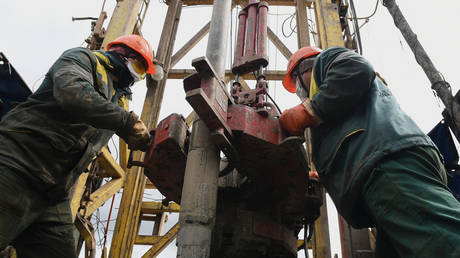
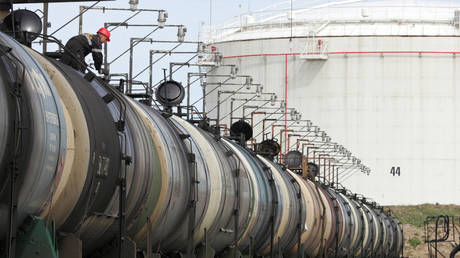
Russia’s reserves of natural gas could run low in 70 years at the current production level, while oil reserves should last about 30 years, geological firm Rosgeo estimates show.
“Over the past 25 years there have been ten times fewer new reserves discovered than in the previous 25 years, with many Soviet deposits being depleted,” the company said.
Besides oil and gas, the country’s other valuable reserves could also run low in a couple of decades, with the stock of diamonds and zinc sufficient for 20 years; gold and lead, for around a decade; and chromium reserves estimated to dry out in less than five years, Rosgeo warns.
The company’s data mirrors similar warnings from other sources. Last week, the acting head of Russia’s Federal Agency for Mineral Resources, Evgeny Petrov, said “profitable reserves [of oil] will last for around 20 or 21 years.” The official stressed that if Russia wants to retain its status as one of the world’s largest sellers of black gold, it will have to invest in new technologies to explore deposits that are harder to access, like those of Western Siberia.
The head of Russia’s state-run energy giant Gazprom, Alexey Miller, drew a more positive picture for the country’s natural gas reserves, predicting over a century of steady supplies, with some deposits capable of delivering fuel until 2132. However, he didn’t speculate on what would happen after that.
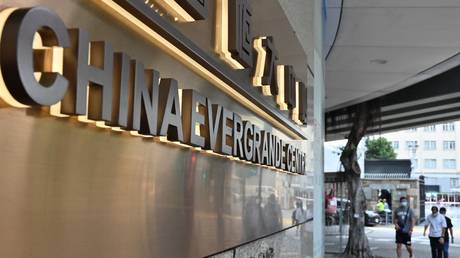
The electric car arm of China’s embattled property developer Evergrande said it faces an uncertain future unless it gets a swift injection of cash, sounding the alarm that the company’s liquidity crisis is mounting.
Evergrande New Energy Vehicle Group’s capability to pay its workers and suppliers, as well as to manufacture cars, will be in jeopardy without a strategic investment or the sale of assets.
The parent company, whose debts have exceeded $300 billion, has been running short of cash, making investors nervous that its potential bankruptcy could pose huge systemic risks to China’s financial system that would reverberate across the world.
Earlier this week, it missed a payment deadline on a dollar bond, providing no details as to the reason for that failure. That left investors anxious about incurring substantial losses when the cash-strapped company’s 30-day grace period ends.
Evergrande has made no comment about its $83.5 million interest payment, and its key property business had reportedly held private negotiations with on-shore bondholders to settle a separate coupon payment on a yuan-denominated bond.
Earlier this week, the People’s Bank of China once again injected capital into the country’s banking system to provide the necessary support for the markets. However, Beijing has still made no comment on Evergrande’s future. Its restructuring would be among the largest ever in China, with hopes for a swift resolution unlikely.
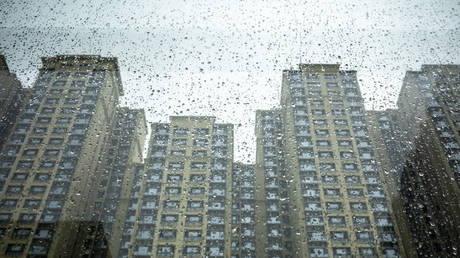
Last week, the real estate giant appointed financial advisers and warned of its impending default, sending global markets plummeting. If it collapses, it may well crush the property market, which accounts for 40% of household wealth in China.
American companies operating in Russia have made direct investments amounting to a total of $96.05 billion, according to the sixth annual joint survey of the American Chamber of Commerce in Russia (AmCham) and Ernst & Young.
The survey, which focused on the prospects for direct investment and bilateral trade between Russia and the US, was based on data from 160 companies. According to its findings, US firms invested more than $2.2 billion in the Russian economy in 2020 alone, and plan to invest around $1.8 billion more in 2021. Over a half of this money will go to Russia’s energy and natural resources industry.
“Despite the decline in activity in 2020 … 84% of companies reported that they are planning to launch new projects in Russia in the near future. This is a record value during the time of our study. For 73.5% of [US] companies surveyed, Russia is a strategic market,” Ernst & Young partner Sophia Azizian said at the 21st AmCham Investment Conference on Thursday.
According to the survey, 78% of companies feel the negative impact of US sanctions on their Russian business, compared to 80% last year.
“The restrictions put American business at a disadvantage compared to companies from other countries and create reputational risk,” the survey says.
Also, as per AmCham findings, “official statistics underestimate the actual level of economic relations between Russia and the US,” with bilateral investment figures obtained by researchers as part of the survey being at least nine times higher than the official figures.
A major allegation was made against the Federal Bureau of Investigation (FBI) earlier this week concerning the massive ransomware attacks that plagued the US this summer.
The agency reportedly obtained the digital key to decrypt malware on the computers of hundreds of businesses and institutions, but refused to use it for at least three weeks.
RT’s Boom Bust is joined by Todd Shipley, President of Dark Intel, to gain some expert insight into both the allegations and the wave of ransomware attacks hitting the nation.
An imminent power-supply shock is reportedly expected to hit China just as the world’s second-biggest economy is gripped with uncertainty over the probable bankruptcy of one of the country’s real estate majors, Evergrande.
The crackdown on power consumption has reportedly been triggered by surging demand for electricity, along with soaring prices for coal and gas that are exacerbated by strict targets set up by China’s authorities to cut emissions.
The country’s manufacturing sector with energy-intensive aluminum smelters, textiles factories and soybean processing plants became the first to get hit hard, as they had to curb activities or shut down.
“With market attention now laser-focused on Evergrande and Beijing’s unprecedented curbs on the property sector, another major supply-side shock may have been underestimated or even missed,” Nomura analysts said, as quoted by Bloomberg.
Nearly half of the country’s 23 provinces missed targets set by the government with Jiangsu, Zhejiang and Guangdong – China’s key industrial hubs that account for about a third of its economy – being among the worst, thus remaining under pressure to slash power use.
“The power curbs will ripple through and impact global markets,” Nomura’s Ting Lu said. “Very soon the global markets will feel the pinch of a shortage of supply from textiles, toys to machine parts.”
China’s energy crisis, which is partially attributed to Beijing’s decarbonization campaign, comes amid an extreme global shortage of energy supplies that has sent European markets into chaos. The power crunch may be overshadowed by current concerns over Evergrande, which could default on its massive debts.
The Chinese economy is reportedly at risk of a dire shortage of coal and gas during the upcoming winter, as the country has never had to deal with global prices for those fuels at their current levels.
“Policymakers seem to be willing to accept slower growth in the rest of this year in order to meet the carbon emissions target,” Larry Hu, head of China economics at Macquarie Group, told the agency. “The GDP goal of more than 6% is easily achievable, but emissions targets are not easy to hit given robust growth in the first half.”