‘Why film it?’ UFC star Conor McGregor splits opinion after showing himself getting shoeshine in Miami (VIDEO)

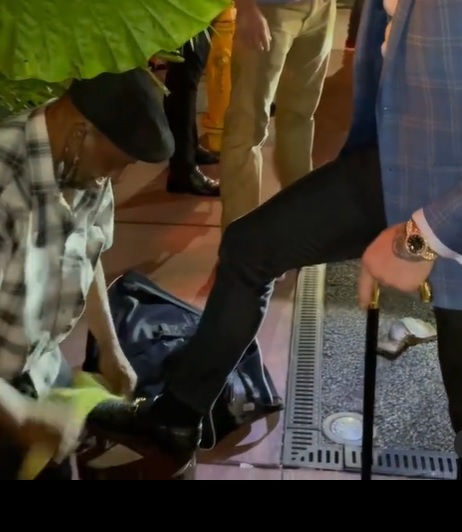
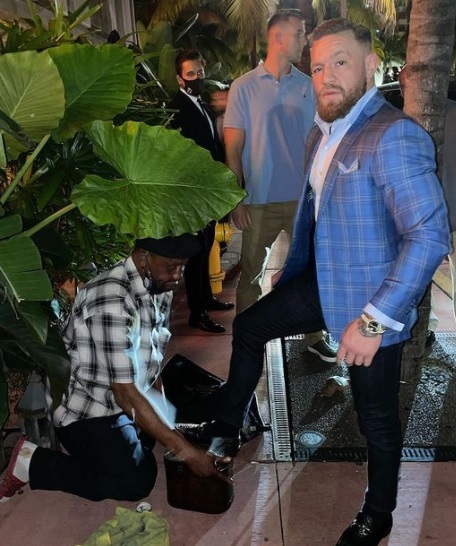
Polarizing UFC superstar Conor McGregor has divided opinion on social media yet again. Out in Miami, where he received the ‘Key to the City’, the star also uploaded a photo and video of himself getting a shoeshine.

Continuing to recover from a leg break suffered in his last outing in the octagon – a first round doctor stoppage loss to Dustin Poirier at UFC 264 – the Irishman has spent time in numerous big US destinations this year.

In Los Angeles over the summer, he headed to Chicago last week where his exploits throwing out the ceremonial first pitch at Wrigley Field for a Cubs baseball game were widely mocked.

READ MORE: Ridiculed Conor McGregor launches into bizarre rant about ‘smoking Messi & Ronaldo’ as he attempts to defend ‘worst pitch ever’

Putting that episode behind him, the 33-year-old has ventured south to the Sunshine State of Florida and its largest metropolis of Miami, where he enjoyed quality family time in a nice restaurant for “Sunday dinner” while also showing off a luxury timepiece.

Yet it is the last two slides of the post shared with his 42 million followers on Instagram that have caused the biggest stir.

Posing for one photo of the act, the snap is followed by a video of McGregor dressed up to the nines with a cane and receiving a shoe shine from a man on the streets of the Magic City.

© Instagram @thenotoriousmma


© Instagram @thenotoriousmma


The clips prompted uproar in some quarters, with observers accusing McGregor of unnecessarily uploading the clip. 

“An embarrassing video – wrong in so many ways,” balked one critic. 

“That video is disrespectful. How are there still people cleaning shoes? And especially in America,” claimed someone else.

“Something so Victorian about that. Why film it?” another party asked, and said McGregor was akin to “the guy that won the lottery and can’t keep it classy or quiet.”

Another comment from that line of thought came in the form of: “Hurry, record me giving money to someone so it looks like I’m a good person.” 

Not everyone was so up in arms, however, pointing to the fact that McGregor “made the shoeshiner’s night” with his $100 offering. 

“A good family outing filling up the bellies followed by a polished shoe shine with a grateful tip. That’s first class,” claimed one supporter.

“I was never a Conor fan but what he did is acceptable, paying money for people’s service is just normal,” started off one unoffended individual.

“Why are you all saying it’s disrespectful? It’s that man’s job and [there’s] nothing wrong with that. If he recorded while he ordered food and there was a waiter and he tipped $100, you wouldn’t all be saying that. And that man is fine when seeing the camera.”

“If this guy was white you wouldn’t raise so much of a stink about it,” it was said to the naysayers.

Yesterday, McGregor took to the same platform to post a photo of mayor Francis Suarez giving him freedom to his Latino-dominated hub.

“The Mac with The Key to The City of Miami!” began his caption.

“Thank you Mayor Suarez for bestowing this great honor upon me and with my family present to witness. A very proud moment for me in my life.

“Thank you! Your hospitality and care for my family and team will be forever remembered. God Bless you and this great city! May the spirit of Miami live within us all,” McGregor finished. 

Also on rt.com

Conor McGregor defended his woeful pitch by dragging in Messi and Ronaldo. © Instagram @thenotoriousmma / AP / Reuters
Ridiculed Conor McGregor launches into bizarre rant about ‘smoking Messi & Ronaldo’ as he attempts to defend ‘worst pitch ever’

So LeBron James got vaccinated after ‘doing his research’ – why should we care what he thinks?

NBA star LeBron James has finally confirmed he received his Covid vaccine after ‘doing his research’. But why should we care what he thinks, and do we really need to take our cue from him and other sports stars as vaccine sages?

The man has at long last spoken.

After being hounded by reporters since the spring, and refusing to come out explicitly to say whether he had or hadn’t, we can all sleep easy now knowing that LeBron James has indeed had his jabs to protect him against Covid with the new season fast approaching. 

“I know that I was very (skeptical) about it all but after doing my research. I felt like it was best suited for not only me but for my family and my friends,” James said at a media day on Tuesday. 

First of all, let’s cut James some slack for a change.

A divisive character who seemingly has an opinion on everything, James has promoted freedom of choice in a league where vaccination rates stand at 90% but getting jabbed technically isn’t mandatory (even though restrictions are tightening against the unvaccinated).

“Everyone has their own choice — to do what they feel is right for themselves and their family and things of that nature,” James said.

“We’re talking about individuals’ bodies.

“We’re not talking about something that’s, you know, political or racism or police brutality.

“So I don’t feel like, for me personally, I should get involved in what other people should do with their bodies and their livelihoods.”

Quite right. 

As preachy as he can get (and sometimes, ironically, he even seems to incite racial hatred rather than quell it), we can look to James to teach us about the black experience and what it is like to grow up as an African-American in the inner-city US.

But must we turn to him as an authority on a subject like Covid and taking the vaccine? What does James have to add to the argument on such an important issue? 

Have we learned nothing from the adoration of Bill Gates, who was seen as the all-knowing sage and whose words were imbued with all kinds of preposterous authority at the onset of the pandemic?

Even LeBron himself pretty much admits that people should make their own minds up and that he is out of his depth.

Why was he hounded to such an extent, as though his word would be make or break, and why are sports stars in general?

Furthermore, what possible research could LeBron have done himself which shifts people one way or another?

“Hey get the vaccine now!” as one punter on Twitter sarcastically pointed out.

“LeBron James announced today [that] he did his research and decided to get one. I know a lot of you didn’t ask your doctor eight months ago, you were waiting for a basketball player to do his ‘research’.”

The same logic could be applied to the two biggest stars in the world’s biggest sport, football icons Lionel Messi and Cristiano Ronaldo. 

Certain corners are clamoring for them to say something, to make a post to their hundreds of millions of followers on social media with their thumbs up and vaccine card in hand, accompanied by a carefully PR team-written caption.

Why should they push an agenda one way or the other?

Also on rt.com

NBA star LeBron James has discussed vaccines © Dado Ruvic / Reuters | © Jayne Kamin-Oncea / USA Today Sports via Reuters
‘I was very skeptical’: NBA icon James backs Covid jabs, shuns parallels with speaking out on politics, racism & police brutality

In football’s English Premier League, the authorities are apparently going to great pains (and unsurprisingly struggling) to get big names to sign up to campaigns that encourage fellow professionals to get their jabs done.

If like LeBron they are in favor of freedom of choice, just let them be.

Leave them to do what they do best.

And, again as with James, leave us to make our own choices and judge which genuine, qualified experts we should listen to.

If anyone, it is the latter party’s words that should take preference. Not those from moneyed stars of courts and pitches.

By Tom Sanderson 

The statements, views and opinions expressed in this column are solely those of the author and do not necessarily represent those of RT.

‘Are you stupid?’ Ukrainian UFC star Moroz rows with fan after latest bout falls through for fighter with sideline in racy photos

UFC flyweight Maryna Moroz has denied that she pulled out of a fourth scheduled fight in a row, with the Ukrainian declaring that she is “healthy” despite the news that she won’t be competing as planned on October 16.

Moroz was due to end her 19-month absence from the Octagon against Luana Carolina at UFC Vegas 40, but according to MMA Fighting the Brazilian will now face America’s Sijara Eubanks instead.

For Moroz, 30, it will be a fourth canceled bout since she last competed in March 2020, when the star earned a unanimous decision victory against Mayra Bueno Silva to improve her record to 10-3 overall.

In the ensuing period much of Moroz’s publicity has come through her personal OnlyFans-style website where she shares exclusive content with subscribers, as well as a public spat with fellow UFC star Mariya Agapova over claims of the Kazakh fighter’s wild behavior.

But in an attempt to clarify the latest failure in her efforts to get back to the cage, Moroz issued an Instagram message in which she said she was not to blame for the collapse in her bout with Carolina.  

“I am healthy and continue to prepare for the fight. I don’t care who my [opponent] will be. I just want to fight,” said the Miami-based fighter, sharing a clip of herself training at the fabled American Top Team gym. 

One unhappy fan took Moroz to task, replying: “Then why did you pull out of the second fight in a row? Something don’t make sense here…”

That touched a nerve with the Ukrainian however, who shot back: “Are you stupid I did not refuse, I am healthy and continue to train.”

“I’m not stupid. I’m a huge fan and want to see you fight. If you’re healthy, why not fight?” responded the fan.

Another chimed in: “You’ve pulled out of 4 fights in a row. Stop getting rude to people in your [Instagram] comments, this is why you’ve got no fans. You want some?”

“At what point do you cut Maryna Moroz due to her pulling out of so many fights?” argued one fan.

“Moroz hasn’t done anything memorable since her first UFC fight against Jojo [Calderwood]. She’s basically an Instagram ‘model’ now,” scorned another person.

Elsewhere, though, there were messages of support for a fighter who has had her hand raised in five of her eight outings in the UFC Octagon since making her debut with the promotion in April of 2015.

“I sympathize. You will prove yourself, we’re waiting for a new date!” read one message.  

Moroz is not the only casualty of UFC Vegas 40, set to take place at the promotion’s Apex facility in Las Vegas.

Recently-returned superstar Miesha Tate was forced out of her headliner with Ketlen Vieira after contracting Covid, and the bill will instead be topped by a showdown between Holly Holm and Norma Dumont.

Also on rt.com

UFC pair Mariya Agapova and Maryna Moroz. © Zuffa LLC via Getty Images / Instagram @maryna_moroz_ufc
‘There’s no drugs’: Manager defends UFC fighter Agapova after rival Moroz makes claims of abuse and wild behavior

In ‘Missing in Brooks County,’ The Missing Migrant Crisis Haunts South Texas

In the first few minutes of the new documentary Missing in Brooks County, Eddie Canales idles his truck along a long stretch of trees, brush, and barbed wire. A few steps away a plastic barrel marked “Agua” sits under a tattered Red Cross flag where Canales retrieves a few empty water jugs and replaces them with full ones. Here in Brooks County, a rural Texas community located near the U.S.-Mexico border, summertime temperatures regularly exceed 100 degrees. A person could easily die of thirst out here, and as Canales drives his truck down the road he halts when he sees buzzards nearby. “Whoa,” he says, watching the birds as they circle. “They’re here.” 

A grizzled, aging man, Canales gingerly climbs over barbed wire and hacks through tall grass to discover what the buzzards have already found. A migrant is lying on the ground, dead. The man faces the sky, his arms outstretched, his chest swollen. 

Hundreds die traversing this sweltering landscape every summer to evade the state’s largest border patrol checkpoint in nearby Falfurrias. There is no infrastructure to help them: Canales is the one-man engine behind the tiny South Texas Human Rights Center, providing humanitarian help where it can in Brooks County. Yet this unnamed soul is one of thousands of missing migrants whose families will never know what happened to them.

Missing in Brooks County, a documentary by Connecticut-based filmmakers Lisa Molomot and Jeff Bemiss screening periodically across Texas and currently streaming on Laemmle Virtual Cinema, zooms in on this immense issue in one particularly dangerous area: Brooks County, population 7,100, where more than 2,000 migrants are presumed to have died since 2008. An estimated four in five of them will never be found. Texas leads all U.S. states in migrant deaths, having now surpassed Arizona for the dubious distinction. This film follows the helpers, who have been clouded by controversies in other parts of the Southwest: In 2019, humanitarian volunteers outside Tucson were charged with felonies for providing water and shelter to two young men walking through the Sonoran Desert. Here, volunteers have avoided legal harassment, but are instead entirely invisible.

The film takes shape as a portrait of the few human beings who carry countless spirits on their shoulders, who take the dead under their wing. Canales is one of them, and when family members come to his humble office to ask for help, he sifts through binders of crime scene photographs. It is traumatizing, thankless work, but he keeps on, often sleeping on a cot in the office.

If a migrant is walking through the brush in Brooks County, they have already made it across the border in McAllen. Coyotes bring people north and, upon reaching the Brooks County seat of Falfurrias 70 miles from the border, face the largest border patrol checkpoint in Texas. The only way to circumvent the checkpoint is to hike 40 miles around it. The filmmakers excoriate both federal and state officials for the humanitarian crisis that has resulted. It is clear to the filmmakers that federal policies of deterrence, dating back to 1994 under the Clinton Administration, are to blame for the forging of these dangerous paths and the subsequent surge in deaths. Yet they also indict Texas’ systems, or lack thereof, for failing to keep track of migrant deaths in any meaningful way. 

Another of the movie’s main characters is anthropologist Kate Spradley, who leads a Texas State University project to exhume unmarked graves, conduct DNA testing, and reconnect the mourning families of missing migrants to their loved ones’ remains. We watch how Canales stays calm and keeps his head down in the work to cope, but Spradley’s response is one of building anger. She calls him about yet another funeral home that told her that, inundated with bodies, they just started burying people everywhere with no records. “These are people, these aren’t receipts you lose track of,” she vents.

The filmmakers do an expert job of humanizing Spradley and Canales, but they could have spent more time with the migrants’ grieving families. They follow the families of Homero Román Gómez and Juan Maceda Salazar, shedding light on their stories, but they don’t get quite as much screen time or exploration. Even so, Missing in Brooks County lingers with a quiet care on human moments. Four years of footage has been distilled into a thrumming, tense hour and twenty minutes, a collection of scenes that illuminate fleeting traces of pain and memory. Often, these scenes are mundane: we see Román Gómez’s brother and sister sit in a plain hotel room, waiting on the phone, transferred again and again to county offices that will lead them nowhere; we watch research students gently and silently handle the bones of migrants dug from unmarked graves. We learn that grave diggers and the folks who mow the cemetery lawn are frequently the only people who remember where the “unidentifieds” were buried. In one striking shot, Spradley shows us a room filled with small, cardboard boxes, so many that the camera’s frame can’t capture them all. “There is a person inside every one of these boxes. Everybody in here has a family that wonders what happened to them.”

Viewers also see local residents and officials who appear to view migrants as less than human. A Border Patrol agent says he doesn’t call the migrants “people” anymore; he calls them “bodies.” Ranchers, some of whom staunchly refuse Canales’ requests to set out water on their land, say shocking things on camera. “I’ve got my suspicions about Eddie Canales,” says one. “We’re just waiting to try to catch him loading some [people] up and sneaking them around the checkpoint.” He laughs at a Border Patrol photo in which three migrants hide in a tree from guard dogs. Another rancher, a veterinarian by day, eventually invites the filmmakers on a vigilante stakeout that he organizes with other elderly white men who are concerned about immigrants bringing “sleeper cells” and “cartel soldiers” to “overtake us internally.” He sits through the dead of night, wearing night vision goggles and full camo hunting gear, hoping to apprehend people he considers to be dangerous criminals.

Even in these bizarre, hostility-tinged moments, the film’s tone remains solemn. The ranches of Brooks County are haunted. By the movie’s conclusion, however, there’s still hope to be found. Kind people of faith in Falfurrias often pull over to wish the searching families well. Crosses and angel statues stand among flowers in the cemeteries. “God bless you” is a common refrain, the charm of small town Texas. At one point, a friendly couple delivers food for graduate students conducting an exhumation. “We call this working for the Lord,” the woman says. “No one sends us, we just go around town looking for things to do, see where God sends us, and he led us to the cemetery tonight.” Despite these acts of care, the film still ends on a quiet, despairing note, in Canales’ office. In the last shot, the Red Cross flag waves under a big moon, ripped apart by the wind, hanging on. 

The post In ‘Missing in Brooks County,’ The Missing Migrant Crisis Haunts South Texas appeared first on The Texas Observer.
Wastewater Threatens Texas Streams

Diane Causey is a 75-year-old antique shop manager in Utopia, a tiny town of 277 people located an hour-and-a-half northwest of San Antonio. Her favorite place in town is a swimming hole on the Sabinal River, accessed on land her family owns. This section of the Sabinal, a little-known Texas river fed by springs, is crystal-clear and chilly even in June. Each summer, Causey’s extended family of more than 100 people converge on the swimming hole for their annual family reunion; kids jump into the water from Cypress-lined banks and cannonball from a rope swing suspended above the river. They hold talent shows and worship services and music jams—Causey herself plays the keyboard but also dabbles in hammer dulcimer and banjo. “It’s always fun. It’s a beautiful place,” she says.

That’s why she was concerned when she learned this year that a property just upstream from her family campground had asked state regulators for permission to dump wastewater into the Sabinal. The plan was proposed by Young Life, a youth-oriented Christian organization that operated a ritzy summer camp for up to 500 people on the banks of the river. Now the camp sought its first discharge permit, which would have allowed it to eject up to 65,000 gallons of treated wastewater into the Sabinal each day. That didn’t sit well with Causey, whose land would be among the first sites to encounter the wastewater on its journey downstream. Causey and others sent upwards of 500 comments and letters to TCEQ to protest the plan. Young Life eventually dropped the discharge plan and agreed  to treat its wastewater onsite and reuse it. 

“That wasn’t what we wanted to happen to our little river,” Causey says. “Just to dump anything into the river … doesn’t seem like being good stewards of the land.”

Dumping wastewater into rivers and streams has been the modus operandi for cities and industries across the nation for well over a century. Comprehensive federal standards for treating that wastewater didn’t emerge until the passage of the Clean Water Act in 1972. Today, most of this wastewater is treated with filters, UV light, and other tools to remove the most dangerous components of human waste and to comply with federal rules. But treatment doesn’t filter out all contaminants, such as phosphorus, which feed algal blooms, nor does it always eliminate E. coli and other bacteria from the water. Experts say that the practice of discharging even treated wastewater is outdated and harmful. It can be especially disastrous in the environmentally sensitive Hill Country, where development is ratcheting up faster than almost anywhere else in the nation. In this part of Texas, more pristine waterways are being threatened than ever before.   

In the summer of 2019, the Blanco River, a 87-mile stretch of clear springs that carves a path between Austin and San Antonio, was transformed into a rank ribbon of green muck. Seemingly overnight, one of the state’s most pristine and celebrated rivers was blanketed by a goopy sheet of algae that cut off access to swimming holes and smothered the homes of sunfish, dragonflies, and aquatic plants. 

Residents pointed the finger at the City of Blanco, which operated a wastewater plant just upstream of the algal bloom. A year earlier, the city had gotten permission from state officials to discharge up to 225,000 gallons of treated wastewater into the Blanco River each day and was pursuing a plan that would allow it to quadruple its wastewater output. Locals were able to force a legal hearing on the permit application and the city abandoned the plan to quadruple its output. During the fight, the city also stopped discharging wastewater into the Blanco River, which eventually ran clear. The Texas Commission on Environmental Quality (TCEQ), the regulatory agency that gave the city of Blanco its permit, has no reported enforcement actions against the city for the event.

Cities have continued to dump wastewater containing phosphorus into Texas waterways because there’s no statewide rule regulating phosphorus in Texas streams and rivers, says Vanessa Puig-Williams, director of the Texas Water Program at the Environmental Defense Fund. With no numerical measurement of phosphorus levels in these waterways, it can be tough to keep it from getting in the water. “That’s an important piece of information,” she says.

Another of Puig-Williams’ concerns is about the unique relationship between Hill Country waterways and groundwater sources—surface water here seeps into karst aquifers, and vice versa. That means polluting rivers could mean polluting aquifers, a crucial source of drinking water for people and livestock. “The fact that these are sourced directly from groundwater [means] you’re essentially swimming in groundwater in a lot of these streams,” Puig-Williams says.   

Opponents of discharge plans elsewhere in the Hill Country have also managed to persuade applicants to reuse wastewater or apply it to areas surrounding the property, which they say is far less dangerous for the environment. Last year, Camp OTX, also a youth camp, applied for a permit to push treated wastewater into Commissioner’s Creek, near the Sabinal, drawing protest from nearby residents. The camp struck a deal in December not to discharge into the creek. North of San Antonio, a subdivision of 2,300 homes near Bulverde fought to discharge 500,000 gallons of water into Honey Creek, which rankled nearby residents and local officials. The subdivision has since agreed to apply the wastewater as fertilizer on surrounding land.

Still, some water pollution is already occurring in pristine waterways here. The City of Sabinal has been a frequent violator, racking up a litany of enforcement actions for failing to treat water to state standards. The city, whose discharge flows into the Sabinal River, has violated limits of ammonium nitrate, E. coli, and suspended solids, which cloud water, clog fish gills, and smother aquatic habitats by lowering oxygen levels. 

In neighboring Uvalde the city has violated rules regarding the discharge of nitrates and suspended solids into ponds that flow into the Leona River. The Leona River is now so polluted that it makes the list of TCEQ’s most impaired waterways in Texas. High levels of bacteria in the water discourage recreational use; low oxygen levels in the water are also a major problem. TCEQ has issued a few fines averaging $10,000 but continues to renew the cities’ discharge permits.

The cities of Sabinal and Utopia did not respond to requests for comment for this story.

There’s a better way to handle wastewater than simply pumping into rivers and streams, experts say. The “One Water” approach seeks to reuse treated wastewater for human consumption or other beneficial uses. And as shown in Honey Creek, land applications of wastewater can be a win-win for the environment, since plants are given a chance to suck up phosphorus from wastewater before it has a chance to seep into the water table. David Baker, executive director of the Wimberley Valley Watershed Association, says the current wastewater system “is a 19th century approach to water management.” 

“All this water has value. We need to treat it with respect to treat it properly at each stage of the water cycle,” Baker says. 

Legislation brought before the Texas Legislature in this year’s regular session could have halted discharges into such pristine streams. House Bill 4146 sought to ban effluent from entering stream segments that contain less than .06 milligrams of phosphorus per liter or drainage areas of those segments. Essentially, the bill would protect streams that had not already been polluted. It had widespread bipartisan support, along with the backing of environmentalists and traditionally conservative landowner groups. “We had broad support and it was well-founded in the in the science,” says Sky Lewey, a director of education and resource protection at the Nueces River Authority who helped spearhead the bill. The Texas Association of Builders opposed the legislation, which they called “unfair.” A group representing summer camps also registered its opposition with the measure. The bill passed through the House but died in the Senate.

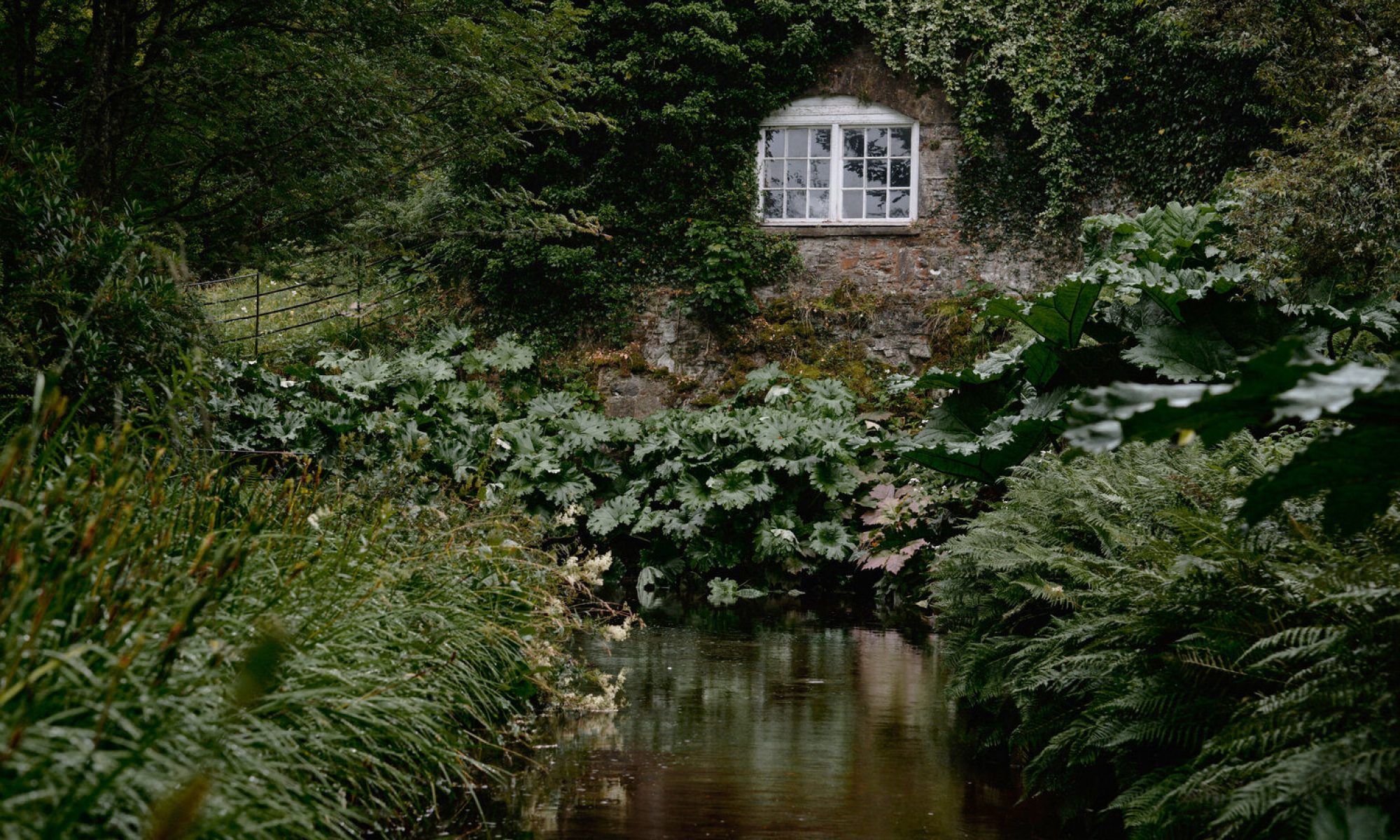
Opening image: The Blanco River from inside Blanco State Park.

The post Wastewater Threatens Texas Streams appeared first on The Texas Observer.