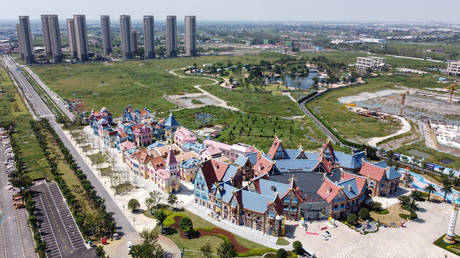
The electric car arm of China’s embattled property developer Evergrande said it faces an uncertain future unless it gets a swift injection of cash, sounding the alarm that the company’s liquidity crisis is mounting.
Evergrande New Energy Vehicle Group’s capability to pay its workers and suppliers, as well as to manufacture cars, will be in jeopardy without a strategic investment or the sale of assets.
The parent company, whose debts have exceeded $300 billion, has been running short of cash, making investors nervous that its potential bankruptcy could pose huge systemic risks to China’s financial system that would reverberate across the world.
Earlier this week, it missed a payment deadline on a dollar bond, providing no details as to the reason for that failure. That left investors anxious about incurring substantial losses when the cash-strapped company’s 30-day grace period ends.
Evergrande has made no comment about its $83.5 million interest payment, and its key property business had reportedly held private negotiations with on-shore bondholders to settle a separate coupon payment on a yuan-denominated bond.
Earlier this week, the People’s Bank of China once again injected capital into the country’s banking system to provide the necessary support for the markets. However, Beijing has still made no comment on Evergrande’s future. Its restructuring would be among the largest ever in China, with hopes for a swift resolution unlikely.
Last week, the real estate giant appointed financial advisers and warned of its impending default, sending global markets plummeting. If it collapses, it may well crush the property market, which accounts for 40% of household wealth in China.
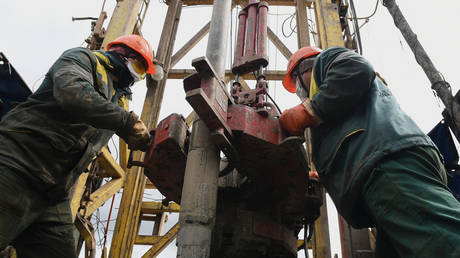
Russia’s reserves of natural gas could run low in 70 years at the current production level, while oil reserves should last about 30 years, geological firm Rosgeo estimates show.
“Over the past 25 years there have been ten times fewer new reserves discovered than in the previous 25 years, with many Soviet deposits being depleted,” the company said.
Besides oil and gas, the country’s other valuable reserves could also run low in a couple of decades, with the stock of diamonds and zinc sufficient for 20 years; gold and lead, for around a decade; and chromium reserves estimated to dry out in less than five years, Rosgeo warns.
The company’s data mirrors similar warnings from other sources. Last week, the acting head of Russia’s Federal Agency for Mineral Resources, Evgeny Petrov, said “profitable reserves [of oil] will last for around 20 or 21 years.” The official stressed that if Russia wants to retain its status as one of the world’s largest sellers of black gold, it will have to invest in new technologies to explore deposits that are harder to access, like those of Western Siberia.
The head of Russia’s state-run energy giant Gazprom, Alexey Miller, drew a more positive picture for the country’s natural gas reserves, predicting over a century of steady supplies, with some deposits capable of delivering fuel until 2132. However, he didn’t speculate on what would happen after that.
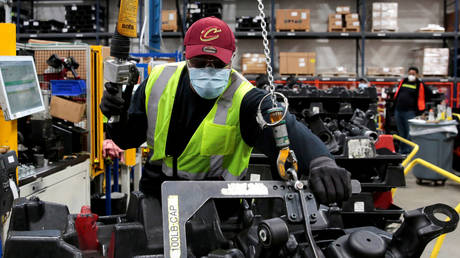
A new report by consulting firm AlixPartners has suggested the ongoing semiconductor chip shortage is expected to cost the global automotive industry an estimated $210 billion in revenue in 2021.
That’s almost double the company’s previous forecast, in May, of $110 billion. It had initially projected some $60.6 billion in lost revenues at the beginning of the year, when automakers started cutting production at plants.
“Of course, everyone had hoped that the chip crisis would have abated more by now, but unfortunate events such as the Covid-19 lockdowns in Malaysia and continued problems elsewhere have exacerbated things,” said Mark Wakefield, global co-leader of the automotive and industrial practice at AlixPartners.
AlixPartners forecasts that 7.7 million units of production will be lost in 2021 – up from 3.9 million in its May forecast.
The updated figures come as car manufacturers continue to struggle with the semiconductor chip shortage, which is causing a halt to production in plants across North America, Europe, and Asia.
The growing demand for consumer electronics has worsened the scarcity of the microchips used in vehicles, stalling production at factories worldwide and pushing auto prices ever higher. Semiconductor chips are vital components in new cars and widely used in infotainment systems, as well as in basic parts such as power steering and brakes. An average vehicle may have hundreds of semiconductor chips.
AlixPartners previously expected to see production improving in the third quarter of 2021, but now doesn’t expect to see that until at least the second quarter of 2022.
Dan Hearsch, a managing director in AlixPartners’ automotive and industrial practice, said, “There’s no cushion. There’s nothing to absorb the impacts anymore, so every little thing – a week of downtime – is now creating a month of downtime someplace else.”
Meanwhile, automakers across the globe, including Ford Motor and General Motors, have been warning of massive earnings cuts this year due to the chip shortage. General Motors President Mark Reuss said this week that the chip supply was coming from places where Covid-19 vaccination is low, “so there’s some volatility there … we really need to get the vaccination and protocols into those plants, which we’re working very hard on.”
A major allegation was made against the Federal Bureau of Investigation (FBI) earlier this week concerning the massive ransomware attacks that plagued the US this summer.
The agency reportedly obtained the digital key to decrypt malware on the computers of hundreds of businesses and institutions, but refused to use it for at least three weeks.
RT’s Boom Bust is joined by Todd Shipley, President of Dark Intel, to gain some expert insight into both the allegations and the wave of ransomware attacks hitting the nation.
The number of nuclear power units in Russia will be increased at most of the country’s operational nuclear power plants, according to Director General of the State Atomic Energy Corporation Rosatom, Aleksey Likhachev.
“We will be gradually decommissioning Soviet units built in the 1970s. They will be replaced with about 15 units by 2035,” Likhachev, who’s heading the Russian delegation at the 65th IAEA General Conference in Vienna, Austria told reporters.“Our task is to build them on the existing sites, to expand the existing plants with new units. All of them will be generations 3+, with a capacity of 1,200 MW,” he said.
Rosatom’s chief also talked about low-power nuclear power plants: “A relevant decision has been made, and we switched to its practical implementation, namely the construction of a flotilla of small nuclear power plants based on RITM reactors that will be used in the development of the Baimskoye ore deposit, as well as the land-based version of the RITM-200 for the Kyuchus gold deposit in Yakutia. That means that we have already started implementing low-capacity projects both in Chukotka and Yakutia.”