Global investors have been pouring money into the Russian stock market thanks to the country’s drive to curb inflation and conservative fiscal policy, rebounding commodity prices and the easing of US sanctions.
Data shows that foreign ownership of Russian bonds has surged to a five-month high (rising above 20% for the first time since April) while measures of credit risk have eased back to pre-Covid levels.
Analysts say that for investors who look for certainty, Russia has shown itself as a predictable environment with little risk of a sudden change or policy U-turns.
“Markets like the technocratic orientation of the Russian government,” Timothy Ash, an emerging-market strategist from BlueBay Asset Management, told Bloomberg. “It encourages them to look the other way when it comes to ESG [Environmental, Social, and (Corporate) Governance].”
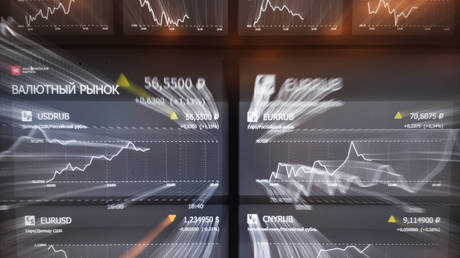
The Russian ruble is this year’s best performer among its emerging-market peers. It has also become one of the 20 most frequently used global currencies, according to the SWIFT interbank transfer system.
The ruble-denominated Moscow Stock Exchange Index (MOEX), which reflects the prices of the most liquid Russian stocks of the largest companies, has rallied 23% this year. The dollar-denominated RTS index has soared 26%.
With foreign-exchange reserves currently at a record-high of $621 billion, the Russian economy is expected to grow 3.9% this year.
Deliveries of pipeline gas from Russia to China in January-August 2021 jumped 2.7 times year on year to 4.73 million tons. According to Russia’s state energy giant Gazprom, China’s gas demand has “stunning” growth potential.
In the first eight months of the year, China spent some $837.32 million on Russian gas, which is a 98.94% increase compared to the corresponding period last year, the Chinese General Customs Administration said on Monday.
According to the ministry, Turkmenistan continues to be China’s top supplier of natural gas, delivering 15.95 million tons of gas for $4.2 billion this year. Russia is in second place in terms of supply volume, followed by Kazakhstan with 3.17 million tons for $723 million, and Myanmar with 2.01 million tons for $922 million.
China’s leading supplier of liquefied natural gas (LNG) in January-August was Australia (20.52 million tons for $8.47 billion), followed by Qatar, Malaysia, and United States. Russia ranked sixth in LNG imports, with 2.67 million tons for $1.23 billion.
According to Gazprom CEO Alexey Miller, gas consumption in China is growing faster than in any other country of the Asia-Pacific region.
“The Chinese market is the most dynamic and fastest in terms of growth. Every year it simply stuns us with the growth rate of consumption and 2021 is no exception. In the first half of the year, the volume of natural gas consumption in China increased by 15.5%, and the volume of imports by 23.8%. This means that by the end of 2021 the forecast estimates of consumption in China will amount to 360 billion cubic meters and the volume of imports will be 160 billion cubic meters,” Miller said last week.
He predicts China’s natural gas imports will reach 300 billion cubic meters per year by 2035 and sees gas consumption in the Asia-Pacific region growing by 1.5 trillion cubic meters by 2040, with 60% of the volume falling on imports.
“For the Asia-Pacific region, it is very important to ensure that the energy balance of these countries is environmentally friendly. This means that natural gas should play a significant role in it because it is natural gas that is the cleanest, most reliable and accessible natural resource. Most importantly, in terms of development of technological consumption, it is difficult to find an alternative to it,” Miller stressed.
Meanwhile, China has also imported $25.1 billion worth of Russian oil in January-August 2021, which is a 30.4% increase year-on-year. However, despite the growth of imports in value terms, the physical volume of crude imported from Russia to China decreased by 7.3%, to 52.92 million tons. Still, Russia retains its position as China’s second-biggest oil supplier after Saudi Arabia, which sold 58.49 million tons to China in January-August for $27.26 billion.
European gas prices surpassed $900 per 1,000 cubic meters on Monday, following reports about Gazprom’s decision not to book additional capacities for gas transit through Ukrainian territory.
The price of October futures on London’s ICE jumped to $908 per 1,000 cubic meters after falling below $800 on Friday.
The rally follows Russian energy giant Gazprom’s decision not to book additional capacity for the transit of natural gas through Ukraine for October. Ukraine’s gas transportation operator offered transit capacities amounting to 15 million cubic meters per day for October at an auction on Monday. But according to the auction results, they remained unclaimed, TASS reports. In September, Gazprom booked only 4.3% of the proposed capacity.
The gas market rally subsided later in the day, however, with the TTF hub in the Netherlands trading $881 per 1,000 cubic meters as of 11am GMT.
This change could stem from the news that Europe’s key gas supplier, Norwegian Equinor, received long-awaited permission to boost gas exports from its offshore Oseberg and Troll fields.
The world’s largest cryptocurrency, bitcoin, dropped below the $44,000 level on Monday as concerns over global equities spilled over into crypto markets.
The digital asset lost as much as 10% during the day’s trading, falling to $43,692.57, according to Coin Metrics. Other cryptocurrencies were also in the red, with ether losing 9% to $3,038.74 and XRP becoming the worst performer, down 14% on Monday.
“This sell-off is the continuation of a well-established pattern where traders cash in their riskier assets to cover margin calls or sit on the sidelines until markets calm down and they feel more comfortable going back into riskier positions,” Leah Wald, CEO at crypto asset manager Valkyrie Investments, told CNBC. “If ever bitcoin had the opportunity to establish itself as a safe haven or as digital gold, with US companies also signaling their earnings calls are going to reveal poor results, now feels like the time.”
The decline of cryptocurrencies comes amid a broader sell-off in the global equity markets due to fears from the mounting problems at China’s embattled property giant Evergrande.
“Investors look to be taking risk off the table on fears that [a] crisis at China Evergrande Group may become a systemic problem to global markets,” Pankaj Balani, CEO of Delta Exchange, told CoinDesk. “Markets will also be looking at the Fed commentary later this week to make sure that there are no changes in liquidity from the central bank.”
Speculation that the US government may declare stablecoins as a risk to the financial system could be adding to uncertainty in the cryptocurrency market, experts say. The president’s Working Group on Financial Markets is currently advancing a report on stablecoins. The Fed is also expected to issue a report on central bank digital currencies this month that could touch on stablecoin risks.
Meanwhile, El Salvador used the cryptocurrency slump and bought 150 additional bitcoins. “We just bought the dip. 150 new coins! El Salvador now holds 700 coins,” the country’s President Nayib Bukele tweeted on Monday.
Despite the slide, bitcoin has risen almost 50% so far in 2021.
With European natural gas prices hitting record highs in recent weeks, French consumer organization UFC-Que Choisir has warned of an unprecedented rise in electricity prices for the country.
On the basis of the official methodology for calculating the regulated tariff for the sale of electricity, UFC-Que Choisir has estimated electricity prices in France will increase by 10% at the start of 2022.
Data by Le Parisien shows that costs for a household of four using electric heating have already skyrocketed by almost 50% in the last decade, from €1,072 in the summer of 2011 to €1,553 in August 2021. With the projected 10% increase for 2022, it will represent a 25% increase in electricity bills since January 2019, according to UFC-Que Choisir.
Economy Minister Bruno Le Maire said last week that France is considering plans to offer subsidies to help minimize the impact of rising gas and electricity prices for low-income households. The minister said that while prices have increased steadily this year, they should stabilize in 2022. He added that there was no risk of “systematic inflation.”
Meanwhile, statistics showed that household gas prices in France grew by 8.7% so far in September, while fuel prices even reached €2 per litre in some French petrol stations.
UFC-Que Choisir has called on the government to lower consumer taxes on electricity.