China’s second-largest real estate developer by sales, Evergrande, admitted this week it is under “tremendous pressure” and may not be able to meet its crippling debt obligations.
The company’s share price has plunged nearly 80% so far this year, with trading of its bonds repeatedly halted by Chinese stock exchanges in recent weeks
The firm has been downgraded by rating agencies Fitch and Moody’s.“We view a default of some kind as probable,” said Fitch.
Meanwhile, some 1.5 million people have put deposits on new homes that have yet to be built.
On Tuesday, Evergrande said in a statement to the Hong Kong Stock Exchange that it had hired financial advisers to explore “all feasible solutions” to ease its cash crunch. The statement warned that there was no guarantee the company would meet its financial obligations. On Monday, the Shanghai Stock Exchange paused trading in Evergrande’s May 2023 bond after it dropped more than 30%.
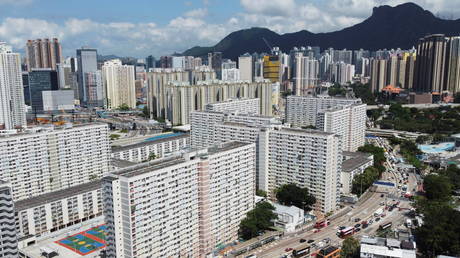
The property firm, which was started in 1997 and reportedly employs 200,000 people, has grown vastly due to a real estate boom in China. Evergrande sells apartments to upper- and middle-income property buyers, and has a presence in more than 280 cities, completing nearly 1,300 commercial, residential, and infrastructure projects. The company has expanded into other areas of the economy, including the food and beverage business, life insurance, TV, and leisure. It also bought the Guangzhou FC football club, formerly Guangzhou Evergrande.
However, after years of borrowing to fund rapid growth and various pursuits in recent years, Evergrande’s debts have ballooned to more than $300 billion.
Analysts warn that the conglomerate’s potential bankruptcy could not only hurt China’s financial system – real estate is responsible for 29% of the country’s economic output – but even spread to markets outside of China. Some experts say that Beijing is likely to step in.
“Evergrande is such an important real estate developer, and it would be a strong signal if anything happened to it,” Dan Wang, an economist at Hang Seng Bank, told CNBC. “I believe there will be some supporting measures from the central government, or even the central bank, trying to bail out Evergrande.”
Others point out that restructuring could be more likely, and that the government will prioritize homebuyers and banks over other parties.
“The most likely endgame is now a managed restructuring in which other developers take over Evergrande’s uncompleted projects in exchange for a share of its land bank,” said Mark Williams, chief Asia economist at Capital Economics.
Bloomberg reported on Tuesday, citing its sources, that regulators had enlisted international law firm King & Wood Mallesons, among other advisers, to examine Evergrande’s finances.
Construction of Russia’s Nord Stream 2 gas pipeline was completed a week ago. However, the US continues to pressure its European allies to delay the project’s certification.
RT DE talked to Folker Hellmeyer, chief analyst at Solvecon Invest GmbH, to discuss the importance of the pipeline supplying Germany with Russian natural gas, and explore why the energy project became political.
“The US turned economic policy into a political issue, although this economic project has nothing to do with politics. For me, as a German citizen, it is irritating that US law is apparently applied extra-territorially,” the economist said.
Hellmeyer says he was glad that construction works were completed with Berlin being able to resist the pressure and ignore unacceptable demands from Washington.
“Confusing is the fact that some European nations, which we are tied with the EU and the Eurozone, have taken the US stance concerning the issue,” he said, stressing that this narrative raises many questions.
The analyst added that the major goal of the project is provide diversification of gas supplies, as the reserves of the UK, Norway, and the Netherlands are dwindling.
“This is not about Germany’s egocentrism; the responsible approach of Germany and Europe as a whole is towards the future of bilateral relations with Russia, which are of great importance,” Hellmeyer said.
According to the expert, Washington just cannot accept the idea of a multipolar world, with Russia with its resources and China with its Belt and Road initiative turning into strong rivals.
“Imagine that Europe is developing together with Russia and the Euro-Asian space. It would be a success story that would ultimately lead to power sharing in the view of the US,” he said.
“That is crucial for the US in this proxy war, including the fight against the North Stream 2 project,” Hellmeyer concluded.
US planemaker Boeing has upgraded its long-term demand forecasts on the expectation that domestic travel will recover to pre-Covid crisis levels in 2022 and international flying will rebound in 2024.
The aerospace giant expects 43,610 commercial jet deliveries over the next 20 years, worth $7.2 trillion. That’s an increase of 500 units from the 43,110 projected a year ago. In its shorter 10-year view, which is more sensitive to the severe fallout for airlines from the coronavirus pandemic, Boeing sees 19,330 deliveries, up from last year’s forecast of 18,350.
“One of the strongest reasons for confidence is how quickly we have seen a bounce-back in domestic travel in the last 12 months,” said Marc Allen, Boeing’s chief strategy officer. Over the next decade, Boeing sees demand for $9 trillion of goods and services in all of the markets it operates.
The forecast for defense and space sectors is flat at $2.6 trillion. The company slightly increased its 20-year forecast for deliveries of twin-aisle models like its 787 Dreamliner to 7,670 jets. The segment remains the hardest hit by the coronavirus crisis, with analysts still seeing uncertainty due to new Covid-19 variants.
As for medium-haul single-aisle jets, like the 737 MAX, Boeing sees 32,660 deliveries over the next 20 years, up from the previous 32,270.The company cut its 20-year forecast for freighter demand to 890 jets from the 930 it projected a year ago.
Six top managers of Chinese real estate major Evergrande had redeemed some of its investment products in advance earlier this year, the company said on Saturday, a day after it admitted to a risk of going bankrupt.
Earlier this week, Evergrande said it was under “tremendous pressure” and may not be able to meet its crippling debt obligations.
The executives, who haven’t been named, made early redemptions of 12 investment products between May 1 and September 7, the heavily indebted property group said in a statement, providing no details on the nature of the products.
“Regarding the early redemption of Evergrande wealth investment products by some managers, the group company views the matter seriously,” the corporation said.
The group also warned of severe penalties in case the redeemed funds are not returned within a certain time frame.
Evergrande, China’s second-largest real estate developer by sales, is facing a mounting liquidity crisis, forcing it to raise extra funds to pay lenders and suppliers. The company’s debts have reportedly ballooned to more than $300 billion.
Evergrande’s case is the embodiment of China’s freewheeling epoch of borrowing and building. Uncertainty over the developer’s ability to meet its funding obligations, which is reportedly equal to 2% of China’s gross domestic product, has triggered market turbulence.
The corporation has been hit by ratings downgrades, with both S&P Global Ratings and Fitch Ratings warning of the risk of default. The company’s shares have plunged nearly 80% so far this year, with trading of its bonds repeatedly halted by Chinese stock exchanges in recent weeks.
Algeria has allowed Russian grain imports for the first time in more than five years. The first shipment of 30,000 tons of wheat is on its way to the North African nation.
According to Russian watchdog Rosselkhoznadzor, a second ship is currently being loaded in the Black Sea port of Taman, and will set sail in the near future.
The world’s largest wheat exporter has been lobbying for access to the Algerian market, and is planning to send two vessels with a total of 60,000 tons of wheat in September.
The shipments mark the first major supply of Russian wheat to Algeria since 2016, excluding a cargo of 28,500 tons shipped in June.
The Russian agriculture safety watchdog also said that Algeria’s export potential exceeds seven million tons.
“The quality characteristics of the grain, which fully meet the country’s requirements for imported products, were confirmed by specialists,” the regulator added.
Russian wheat producers had no access to Algeria, the world’s sixth-biggest wheat importer, until October last year. Back then, the North African country eased the sanitary terms regarding grains, which made it possible to offer wheat from the Black Sea with higher protein.
In total, Russia exported 79,000 tons of grain and its processed products to Algeria in the agricultural year 2020-2021. The shipments included wheat, chickpeas, flax seeds, oat and buckwheat flakes, and millet.