
AMC cinemas to accept other cryptocurrencies in addition to bitcoin

The world’s largest cinema chain AMC Entertainment has announced it is expanding the range of cryptocurrencies it will accept for online ticket and concession payments.

“Cryptocurrency enthusiasts: you likely know @AMCTheaters has announced we will accept Bitcoin for online ticket and concession payments by year-end 2021. I can confirm today that when we do so, we also expect that we similarly will accept Ethereum, Litecoin and Bitcoin Cash,” company CEO Adam Aron tweeted.

In August, AMC announced it would start accepting bitcoin by the end of the year at its US theaters, making it the first cinema chain to accept crypto as a payment option. The announcement came amid attempts by the world’s biggest cinema chain to boost revenue in order to bounce back from the Covid pandemic.

Earlier in January, shares in AMC Entertainment skyrocketed, becoming one of the most highly speculative assets amid the short squeeze triggered by retail traders on Reddit’s infamous WallStreetBets forum.

For more stories on economy & finance visit RT’s business section

Fitch downgrades global GDP forecast due to pandemic-related setbacks

Fitch Ratings has trimmed its outlook for global economic recovery for 2021, citing supply-chain disruptions caused by the Covid-19 pandemic that is still affecting many countries.

The world’s gross domestic product (GDP) is expected to grow by 6% in the current year, according to the agency’s Global Economic Outlook report for September. The new figure is down from Fitch’s 6.3% forecast made in June.

“Supply constraints are limiting the pace of recovery,” the report says. “A greater share of demand growth is being reflected in price increases and US inflation forecasts have been revised up again.”

Also on rt.com

Klerksdorp Hospital, SOUTH AFRICA. © AFP / Phill Magakoe
Global economy back in the saddle, but uneven recovery poses risks – Putin

Fitch lowered its forecast for the US economy to 6.2%, from 6.8% made in June, while China’s 2021 growth expectation was trimmed to 8.1%, from 8.4% amid a property-market slowdown that is weighing on domestic demand.

Meanwhile, the growth forecast for the Eurozone in the current year was revised up to 5.2%, from 5%.

“Progress with vaccine rollout is limiting the impact of renewed increases in coronavirus cases on economic activity in Europe and, to a slightly lesser extent, in the US,” the agency stated. “But virus dynamics are influencing growth more heavily where vaccination rates remain low. The pandemic is still constraining labor supply.”

Fitch analysts expect global supply constraints and inflation pressures to ease in 2022.

For more stories on economy & finance visit RT’s business section
China officially applies to join Asia-Pacific free-trade pact

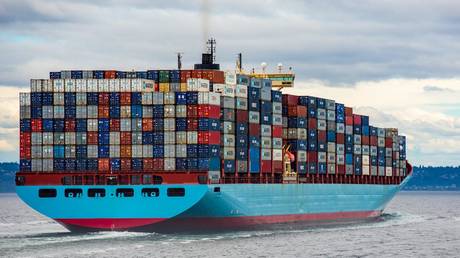
The world’s second-largest economy, China, has filed an application to enter the Comprehensive and Progressive Agreement for Trans-Pacific Partnership (CPTPP), which currently includes 11 nations.

According to the Chinese Commerce Ministry, it has submitted an application to join the free-trade agreement in a letter to New Zealand’s trade minister, Damien O’Connor.

The CPTPP was inked in 2018 by 11 countries including Australia, Canada, Chile, Japan and New Zealand. The economies included in the accord represent nearly half a billion consumers and account for 13.3% of global GDP.

The trade agreement is essentially an updated version of the ill-fated Trans-Pacific Partnership (TPP), which was seen as an important economic counterweight to China’s regional influence. That deal was negotiated by the Obama administration, but was not ratified by the US. When Donald Trump took office he pulled the US out of the trade pact.

Also on rt.com

© Unsplash.com / Ian Taylor
China ratifies world’s LARGEST free trade agreement

Japan, which is the CPTPP’s chair this year, said it will consult with member countries to respond to China’s request.

“Japan believes that it’s necessary to determine whether China, which submitted a request to join the TPP-11, is ready to meet its extremely high standards,” Japanese Economy Minister Yasutoshi Nishimura said on Friday.

The CPTPP could be another massive trade agreement for China and other regional economies that created the world’s biggest free trade zone last year with the Regional Comprehensive Economic Partnership (RCEP).

For more stories on economy & finance visit RT’s business section

US tech giants about to get their hands on India’s $24 billion worth of farm data

New Delhi has signed preliminary agreements with US tech giants to share farm statistics as part of an ambitious government-led productivity drive aimed at transforming the nation’s outdated agricultural industry.

According to a Bloomberg report, starting from April, Amazon, Microsoft and Cisco Systems will be able to harness farm data that Prime Minister Narendra Modi’s administration has been gathering since coming to power in 2014.

The government wants to ensure food security in the world’s second-most populous nation and is betting that the private sector could help farmers boost yields with apps and tools. This week the government said that Jio Platforms and tobacco giant ITC are among local powerhouses that have signed up for the program.

India’s $488 billion farm sector employs almost half of the nation’s 1.3 billion people and accounts for about 18% of the economy. With the new project the government aims to boost rural incomes, cut imports, and reduce food waste with better infrastructure. If that works out, India could also compete with exporters such as Brazil, the US and the European Union.

Also on rt.com

© Getty Images / davidevision
Indian economy on track for strong growth after second Covid wave, S&P says

Ernst & Young estimates that India’s agri-tech industry has the potential to reach some $24 billion in revenue by 2025, with the current penetration being only 1%. It has also a chance to deploy networks, artificial intelligence (AI) and machine learning.

“This is a high impact industry and private players are sensing the opportunity and want to be a large part of it,” Ankur Pahwa, a partner at consultancy EY India, told Bloomberg. “India has a very high amount of food wastage because of lack of technology and infrastructure. So, there’s a huge upside to the program.”

Under the agreement, the big tech companies can help the Indian government to offer tech solutions for farm-to-fork services, which farmers will be able to access at their doorstep. As part of a pilot program, Microsoft has selected 100 villages to deploy AI and machine learning and build a platform. Amazon, which has already started offering real-time advice and information to farmers through a mobile app, is offering cloud services to solution providers.

READ MORE: Russia & India have ‘tremendous potential’ in energy cooperation – India’s energy minister

Besides the tech giants, many smaller companies and startups are likely to join the program. Some critics, however, say the government is giving the private sector a greater sway, which could hurt small and vulnerable farmers.

For more stories on economy & finance visit RT’s business section

Russian natural gas reserves to last another century – Gazprom

Russia’s state-run energy giant Gazprom estimates the country’s reserves of natural gas will last 100 years with some deposits capable of delivering the fuel until 2132.

“Russia’s gas reserves, Gazprom’s gas reserves, are the largest in the world, and we won’t face supply problems during the next 100 years,” Gazprom CEO Alexey Miller said during the International Business Congress (IBC).

Miller said that Gazprom is the world’s most environmentally friendly energy corporation, adding that it is planning to retain this title.

Also on rt.com

RT
Natural gas price in Europe smashes historic high as EU debates limiting Russian imports

According to Miller, Gazprom’s surplus output capacities capable of meeting peak demand amount to 150 billion cubic meters of natural gas. An ability to dramatically increase production levels in response to surging demand is Gazprom’s competitive advantage, he added.

Miller also said that China’s gas consumption is currently the fastest growing in the Asia-Pacific region. He pointed out that, in the first half of the current year, the volume of natural gas consumption in China surged 15.5%, while the volume of imports saw an increase of 23.8%.

For more stories on economy & finance visit RT’s business section