Tech pioneer Steve Wozniak has become the latest newcomer to join the private space business. However, the Apple co-founder’s vision promises to be different than those of billionaires Elon Musk, Jeff Bezos, and Richard Branson.
Unlike Bezos and Musk, whose Blue Origin and SpaceX companies plan to set up cities on Mars or build colonies in Earth’s orbit, Wozniak’s Privateer appears to be focused on cleaning up space trash. A recent press release for an unrelated 3D titanium alloy printer described Privateer as a “new satellite company focused on monitoring and cleaning up objects in space.”
In 2019, NASA called low Earth orbit “the world’s largest garbage dump,” with nearly 6,000 tons of waste. The agency has warned that this debris threatens space-goers with garbage moving up to seven times faster than a bullet. Last year, former NASA administrator Jim Bridenstine urged Congress to fund a cleanup mission, saying that “Debris is getting worse!”
Called Privateer Space, the “private space company” that Wozniak is launching is “unlike the others,” according to a post by the businessman on Twitter. The company’s mission is to “keep space safe and accessible to all humankind,” says a YouTube promo video that Wozniak linked.
“It’s up to us to work together to do what is right and what is good,” the video says. “So, here’s to taking care of what we have so the next generation can be better together.”
No more details have been provided, aside from the Privateer’s website declaring that “The sky is no longer the limit,” and “We are in stealth mode.” According to the website, more information will be announced at the AMOS Tech 2021 conference, which kicks off on Tuesday in Hawaii.
Known as one of Apple’s founders and the designer of the Apple II computer, Steve Wozniak is widely recognized as one of the prominent pioneers of the personal-computer revolution.
Germany’s federal networks regulator BNA said on Monday it would decide no later than January 8, 2022 whether it will certify Nord Stream 2 and issue an operating license for the natural gas pipeline.
“The Federal Network Agency of Germany announced today that Nord Stream 2 AG has submitted all the documents required for verification by the agency. Thus, the Federal Network Agency has four months to prepare a draft decision and submit it to the European Commission,” the regulator, Bundesnetzagentur, told Russian news outlet Sputnik on Monday.
The documents were received on September 8, so the four-month deadline expires on January 8.
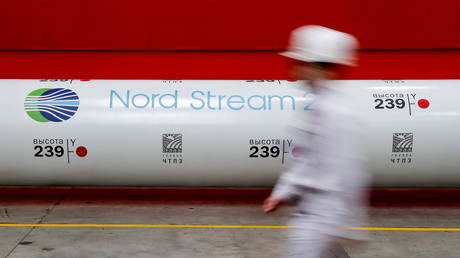
Last Friday, Gazprom said it had completed the construction of the Nord Stream 2 pipeline, although gas flows on the controversial Russia-led pipeline cannot begin until Germany grants an operating license to the project.
Earlier last week, Russia’s Foreign Minister Sergey Lavrov said that the Nord Stream 2 pipeline from Russia to Germany was set to be completed within days and come on stream.
But in order to begin shipping gas to Germany, Nord Stream 2 will need the go-ahead from the German regulator via an operational license.
Last month, a German court ruled that Nord Stream 2 will have to obey European Union regulations that separate owners of the pipelines from suppliers of gas, dealing a blow to Gazprom, who sought to have EU rules waived for the controversial pipeline.
Nord Stream 2 AG, the company behind the pipeline, said on Friday that after the mechanical completion of the construction, “the required pre-commissioning activities will be carried out with the goal to put the pipeline into operation before the end of this year.”
Gazprom hopes to start gas flows via the first leg of the pipeline as early as October 1, Bloomberg reported on Wednesday, citing sources with direct knowledge of the Russian gas giant’s plans.
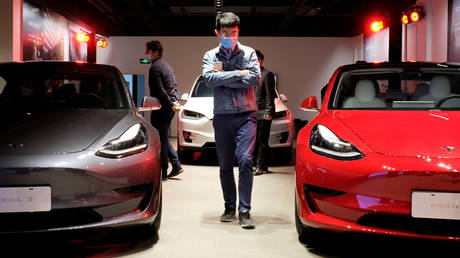
China has unveiled plans to consolidate the country’s electric vehicle (EV) industry, which Beijing believes is unable to evolve as it has far too many players.
“Looking forward, EV companies should grow bigger and stronger. We have too many EV firms on the market right now. The firms are mostly small and scattered,” Xiao Yaqing, China’s minister for industry and information technology, said at a press conference in Beijing, adding that authorities see merging and restructuring as ways to propel the industry to success.
“The role of the market should be fully utilized and we encourage merger and restructuring efforts in the EV sector to further increase market concentration,” the official stated.
A number of Chinese EV producers traded in red following the news, with Xpeng Inc. losing 2.3% in Hong Kong trading, and Li Auto Inc. dropping 1.4%. In mainland China, BYD Co. fell 1.8% and BAIC BluePark New Energy Technology Co. plunged even deeper, shedding 4.6%.
China’s electric car industry is one of the world’s biggest, with about 300 carmakers, which the government considers an overcapacity. Also, according to CNBC, the number of new Chinese businesses related to “new energy vehicles” jumped by a fourth in 2021, bringing the total to some 321,000. This is the result of Beijing’s own actions, as it increasingly subsidized the industry amid the agenda of turning to cleaner energy sources in the automotive sector to cut pollution.
Total government subsidies for new energy vehicle purchases amounted to 33 billion yuan ($5.1 billion) from 2015 to 2020, data from the Ministry for Industry and Information Technology shows.
Now, however, Beijing is drafting measures to rein in the bloated industry, considering options like setting a minimum production capacity utilization rate, Bloomberg reported, citing sources familiar with the matter. Last year the average production capacity utilization rate for automakers in China was little short of 53%, according to the National Development and Reform Commission.
“This has been a liability for the local players since the beginning: too many companies dividing the market, which fragments the supply chains for the core components. It’s imperative to concentrate on a few key manufacturers and suppliers of the ingredients of an EV,” Bill Russo, founder and CEO of Shanghai-based advisory firm Automobility Ltd, told the news outlet.Tu Le, founder of Beijing-based advisory firm Sino Auto Insights, says the government’s current move is just another way “to trim the [number] of [EV market] entrants.”
“They likely [saw] a buildup of overcapacity [and] too many brands that won’t be able to compete in the market with products. This has happened often in the Chinese market across sectors and leads to a race to the bottom where companies compete solely on price. It stresses the entire sector,” the expert stated, as cited by CNBC.
He also noted that China’s major EV business players – Nio, Xpeng Li Auto and BYD – may benefit from consolidation practices if they come to pass, “since it will eliminate potential competitors and perhaps allow them to acquire a team or technology to enhance their products.”
European gas prices have hit another record in Wednesday’s trading, exceeding $960 per 1,000 cubic meters, as EU countries continue to argue over boosting Russian gas supplies via the recently completed Nord Stream 2 pipeline.
The price of the October futures on the Dutch TTF exchange jumped by 20% in mere minutes, exceeding $875.84 by 8:00 GMT. Some time later, it exceeded $900 and, by 11:00 GMT, had reached $964.
Russian experts earlier this week predicted that gas prices could climb further, up to $1,000 under certain conditions. These include the situation in Asia’s gas market, the weather in Europe and the oncoming winter season, as well as the timing of the launch of Russia’s Nord Stream 2 pipeline. Low gas-storage volumes across the continent and unusually high demand for the current season also add to the prospect of new record highs on the European gas market.
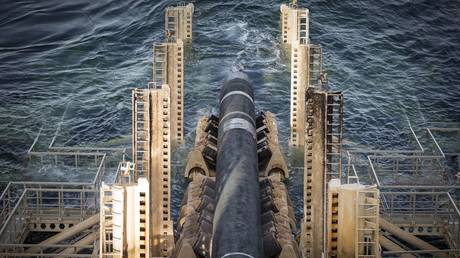
Despite the setbacks caused by relentless US sanctions, Russia’s newly-completed Nord Stream 2 pipeline could ease Europe’s gas shortages once it launches deliveries. Its daily capacity of gas supplies is comparable to the entire volume of liquefied gas that is now supplied to Europe. The 1,224 kilometer, $11-billion Nord Stream 2 project consists of two pipelines, collectively capable of delivering up to 55 billion cubic meters of natural gas annually from the Siberian fields in Russia directly to Europe via the Baltic Sea.
Russia’s Gazprom says it is ready to begin gas deliveries on October 1. All that remains is for the new pipeline to obtain all the required certification. However, this process could take up to four months, under EU rules.
Former Austrian minister of Foreign Affairs, Karin Kneissl, told RT that the current surge in gas prices could persuade regulators to speed up the certification process.
“The [gas] supply contracts are there. And we will see to what extent the German regulator will speed up the certification process for Nord Stream 2, which, construction-wise, is done. Some people say that it could take months. But maybe the current situation will speed things up,” Kneissl said.
Grain production in Russia is expected to reach 118 million tons this year, including more than 75 million tons of wheat, according to a Russian Grain Union forecast.
Data by the Ministry of Agriculture shows that production of grain and leguminous crops has amounted to 98.9 million tons as of September 14, against 113.6 million tons collected last year.
Some 70.7 million tons of wheat has been threshed from 24.4 million hectares of planted area. Russian farmers have also reaped 17.5 million tons of barley. Production of sunflower and soybeans reached 1.9 million tons and over 700,000 tons, respectively.
Russia’s booming agricultural production has surged by more than 20% over the last seven years. The country has managed to capture more than half of the global wheat market, becoming the world’s biggest exporter of grain, thanks to bumper harvests and attractive pricing. Since the early 2000s, Russia’s share of the global wheat market has quadrupled. In 2018-2019, Russia delivered 35.2 million tons of wheat to the global market.
The country is projected to retain its leadership in the world’s wheat market in the coming years.