Chris Callaway served as a Texas Ranger from 2012 to 2018 and worked on public integrity cases, including investigating both local officials and a legislator. Statewide, Rangers like him handled more than 560 cases involving corruption by local and state officials from 2015 to 2020. But few ended in prosecutions, a Texas Observerinvestigation found. Over the years, Callaway spotted problems in how some cases were handled. “I did the best I could, but a lot of obstacles were in the way,” he says. Callaway left DPS in 2020.
Texas Observer: In the last five years, more than 500 public corruption cases have been investigated by the Rangers all across Texas. How many Rangers and supervisors outside of the Rangers’ public integrity unit in Austin have expertise in these kinds of cases?
Callaway: Most don’t. The Rangers are a small group and the public integrity working group was even smaller. There’s three or four in Austin who do it full-time. The rest do it on an as-needed basis.
Why is a Ranger supervisor and often a district attorney asked to approve a public integrity or public corruption investigation before a Ranger can open one?
That policy was put into place by the Rangers division so we don’t find ourselves involved in taking out political adversaries. We’re not going to investigate an allegation of voter fraud in the middle of an election. They try on the investigative side to be objective. They’re ultimately concerned with their image—above all else. That’s the reason the [supervisors] started to vet some of those complaints.
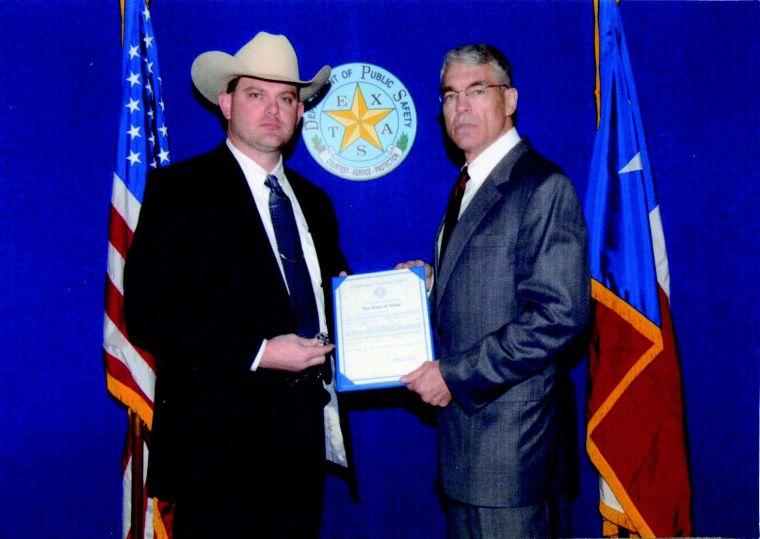
Chris Callaway (left) receiving his promotion to sergeant with the Texas Rangers in Austin in 2012.
Did you think sometimes that vetting process went too far? Did the screening by Rangers or DAs get in the way of legitimate complaints?
Yes. I remember one case involving an official in a little bitty podunk town. We knew a guy was stealing money and drugs. He was depositing stolen money in his personal bank account, but I couldn’t investigate that guy because he was an elected official. I had to go through a bureaucratic process. The answer I got was no. So the bureaucratic process sometimes prevented investigations in cases involving public officials.
What’s the role of a DA in screening public integrity investigations?
Once we got the blessing from the chain of command, then often we had to get a letter from a DA saying that if the investigation produced evidence of a prosecutable criminal act, he or she would proceed. The way the rangers look at it, if the DA doesn’t want to prosecute, we’re not going to waste our time investigating.
Isn’t that process backward? How do you know you’ll find a prosecutable offense if you can’t investigate?
That’s the part of the thing I struggled with. Because when we start looking at [a complaint] we don’t know what else we’re going to find.
In the last five years, public integrity complaints made against legislators and statewide office holders all seem to have died quietly—with the exception of the long-running prosecution of Attorney General Ken Paxton in Collin County. Did you think more public integrity reports should be released?
Yes. In high-profile cases, I think that all cases that are closed—even if no prosecution was ever done—the reports should be made public. You should be able to look at them. One prosecution [against Paxton] is ongoing, so that report should be withheld. But there have been other complaints made against him that were investigated, and those reports should be released.
I did an investigation into a legislator involving a business transaction that occurred between him and a family friend.It involved air conditioners and a hunting trip. I can tell you that what he did may have been unprofessional or even immoral. But it wasn’t illegal. I came to believe that the complaint against him had been motivated by political disagreements over border security initiatives. I think that report should be released.
In some public integrity cases, DAs have said Texas ethics laws are too weak. For example, a Kaufman County prosecutor declined to proceed on a Ranger’s investigation of how Paxton accepted $100,000 from a businessman whose company was simultaneously being investigated by the AG for Medicaid fraud. Texas law against giving an illegal gift to a public official is only a misdemeanor and she said that law has loopholes.
Look at the state statues—the statutes for the majority of those kinds of offenses are misdemeanors. So, you’ve got a bunch of attorneys writing laws in Austin and attaching punishments to them, so that in the event one of them violates the law, it’s a misdemeanor and it doesn’t keep him or her from practicing law… you just don’t get much results.
For example, you can violate the civil rights of a person in custody; that’s a Class A misdemeanor, as are other official oppression crimes. But if you falsify your school attendance records, that’s a third degree felony. What’s wrong with that picture?
If nothing changes in Kaufman County, that gift case will never be prosecuted and you’ll never even get to see the Ranger’s report.
Rangers are supposed to be investigating public integrity, public corruption, in-custody deaths, serial killers, cold cases, and conducting border security. Is it possible for the Rangers to carry out all of their missions with the number of officers they have?
It is completely impossible to carry those duties out effectively. One of my biggest regrets of my Ranger career is that my frustration and aggravation led to an alcohol addiction problem. That’s what started my descent into unemployment. The expectations placed on those guys and gals is just outrageous. It’s completely unsustainable for an extended period of time. How can you be a top-notch public integrity investigator or a top-notch murder investigator if you’re not allowed sufficient time to develop those skills?
Can you talk more about why you left DPS in 2020?
In law enforcement, there’s rampant alcohol and drug abuse, PTSD. It’s more widespread than anybody talks about. They don’t want those kinds of stories to be told. I went three times asking for help. I finally ended up in a treatment program specifically for first responders and veterans. It’s called the Warrior’s Heart. I talked about that publicly. After that, I got fired. I have a lawsuit in Hidalgo County court—a 2019 civil rights case that alleges that DPS discriminated against me because I admitted to a disability.
Can you get a copy of the report on the public integrity/internal affairs complaint that you made about your supervisor?
No. It’s not public. I made a public information act request and I was told by the AG that it’s not public because no disciplinary action was taken by DPS.
This interview has been edited for length and clarity.
Leonard N. Moore thinks every white person in America should be required to take a Black history class. That’s how Moore, a professor of Black history at the University of Texas, opens his new book, Teaching Black History to White People. In this timely book from the University of Texas Press, Moore guides readers—many of whom Moore, who is Black, presumes will be white—through Black history and his own personal experience in academia. Moore is a popular professor at the University of Texas at Austin, where he teaches a course called “Race in the Age of Trump.” He has also addressed racial tensions campuswide in his role as the university’s Vice President for Diversity and Community Engagement.
Moore offers six specific steps that white Americans (and other non-Black people) can take to improve America’s racial climate. Excerpted below are steps 4-6.
Check the Microaggressions
Microaggressions are similar to stereotypes; they are more subtle but equally painful. Recently, a colleague and I were in a meeting and the person we were waiting for walked in, looked at me, and said, “How you doing, Dr. Gordon?” I’ve been called Dr. Gordon, Dr. Harrison, and Dr. Smith. What do we all have in common? We are all Black men who are professors at the University of Texas at Austin. We look nothing alike. Do you know what it’s like to show up to an event and they give you the name badge of another Black person? Black people do not complain, because it doesn’t do any good, but we just need to share some of these stories.
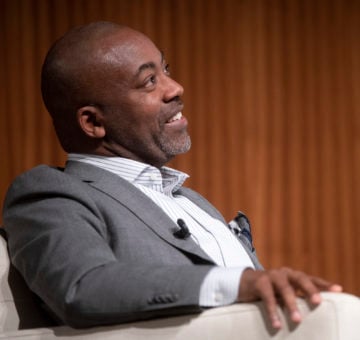
Dr. Leonard N. Moore at the LBJ Presidential Library in 2020. LBK Library/Jay Godwin
A lot of people who claim to be liberal are some of the biggest offenders when it comes to microaggressions and micro-invalidations. Don’t assume that all the Black women on campus are there to run track or that the Black men are there to play football or basketball. I had a student who was five-foot-five and he was still stereotyped as a football player. Now, some of you may think, “Well, that’s not a bad stereotype,” but to the student it is. Because what is being suggested is that the only reason they are on campus is because of their athletic ability.
When I tell white people that I work at the University of Texas at Austin, many of them instinctively think that I work in athletics. After flying in to San Francisco a couple of years ago, my son and I went to the rental car counter. The Avis guy pulled up my information, saw that I worked at the University of Texas at Austin, and said, “Oh, what are you doing out here? Recruiting athletes?”
I said, “No.”
“What do you do at UT?”
I said, “Why don’t you guess?”
“Well, I don’t know. I thought you were out here recruiting.”
On several occasions I have arrived at events where I’m the keynote speaker, and typically I’ll introduce myself to the organizer just to let them know that I’m there. I’ll typically say, “I’m Leonard Moore from the University of Texas.” They introduce themselves, and on more than one occasion they will say, “Good to meet you. What time is Dr. Moore coming?” I will say, “I don’t know. Hopefully he will be here soon.” These are real experiences. If I deal with these things as a Black man, what do my Black female counterparts often deal with? At times, microaggressions can become outright hostile for Black women. A Black female colleague was confronted by a white male colleague who stood in her office doorway shortly after she was hired and said, “I don’t understand why they’re paying you that much money!”
The constant stereotyping and microaggressions confirm what many Black people were told by their parents and grandparents: “You gotta work twice as hard to go half as far.” To get ahead in the workplace, we embrace John Henry–ism. “I’m going to just work harder, and harder, and harder, then I’ll get the promotion.” I was in full-blown John Henry–ism during my years at LSU. A lot of Black professionals take on extra assignments and duties without receiving adequate compensation. We do that because we feel that we have to prove ourselves. But in doing that we work ourselves to death, and we still don’t get promoted to the level of our abilities.
Get Uncomfortable
I want to talk about the importance of getting uncomfortable. Your political affiliation doesn’t matter. (You may say you’re a liberal, but I know a lot of liberals who value trees and the environment more than people.) Some of us are narrowly trained in our area of expertise but we need specific training around racial injustice. We don’t like to go to training because it makes us feel uncomfortable. The first time I went to an anti-sexism training, I was uncomfortable because I didn’t realize how a lot of my unconscious actions contributed to sexism. Similarly, many white people don’t understand how some of their unconscious actions contribute to an unhealthy racial climate. Anybody can handle budgets or create a strategic plan, but can you navigate the tricky waters of race and racial justice? Discomfort is the fertilizer for growth. If the lived experiences of Black people make you upset, then you need to sit with the discomfort and ask yourself why.
Whenever I teach my Black Power class I always have white alumni sit in on the class. One semester an older white gentleman in his early seventies came to every class. On the last day of class I had him stand up and the students gave him a standing ovation. He said, “Dr. Moore, this has been the greatest experience of my life.” In my Race in the Age of Trump class I often have many white students who enroll in the class, but their parents are reluctant to let them take it. One student told me that at the end of every class she would have to take a picture of her notes, email them to her mom, and at night they would discuss the notes as well as the class readings. Apparently, the mom did this because she didn’t want her daughter taking my class and “becoming a liberal.” By the end of the semester the mom had transformed from a helicopter parent to a convert. She sent me an email and thanked me for changing her perspective.
A way to ease yourself into the discomfort and to learn more about American history, the civil rights movement, and race relations is to do a civil rights tour throughout the great state of Mississippi. You can start in Jackson, Mississippi, at the new civil rights museum, which I think is one of the best museums in the country, and then you can work your way up north through the Mississippi Delta, ending at Memphis, Tennessee. It will be worth your time and money.
“What Can I Help You Fight For?”
Many well-meaning white people are often curious about what they can do to help calm racial tensions. Instead of asking, “What can I do?” I recommend you ask a more profound question, “What can I help you fight for?”
About ten years ago, I took a group of students from my church to East Austin, which at the time was predominantly African American and low-income. Our intent was to canvas the neighborhood and ask residents what issues were important to them. Prior to the outing I asked the students what they thought the community needed. They talked about after-school programs, high-quality childcare, job training programs, a grocery store, more recreational opportunities, and a litany of social programs. They were wrong. The residents of the community wanted speed bumps. Yes, speed bumps. Why? Because a lot of kids in the neighborhood were getting hit by cars during rush hour as commuters used the side streets in East Austin to avoid traffic jams. This was a profound experience for my students, who learned that you must allow a community to tell you what their needs are instead of just assuming you know.
Around the country right now there’s a lot of energy on college campuses directed toward taking down Confederate statues and changing building names. But some of that stuff is so woven into the bricks and mortar of an institution that you may never be able to get rid of it all. While I think the typical Black student would agree that these symbolic gestures are important, I believe that they would see other issues as more of a priority. Many of them would like to see an increase in Black enrollment, more Black faculty and staff, and a significant increase in scholarship money for African American students. But many white liberals have co-opted Black activism on America’s college campuses to such an extent that the actual demands of Black students aren’t even heard. So we have white liberals expressing what they think is best for Black students without even consulting them.
A few years ago, I was asked to mediate a dispute between a Black law school professor and his disgruntled students, who were upset about a question on an exam. On the exam the professor asked the students to provide a legal defense of school segregation. I thought it was a brilliant question. Before I arrived at the meeting I predicted that the group of angry students were largely white liberals. I was correct. In the group of students I met with, only one was Black. The spokesperson for the group was a white male student who seemed rather happy that he was able to call out his Black professor. The students were up in arms. During our meeting they said the question was “traumatizing” and “triggering” and that they should not be forced to answer it. But it went further. They wanted the professor disciplined. They also demanded that the professor be banned from teaching first-year students and that a committee of faculty approve all of his exam questions moving forward. After listening to their complaints, I said, “This has y’all really upset, huh?” They said, “Yes.” Then I asked the following question that changed the entire trajectory of the conversation: “How come you all aren’t equally upset that this law school enrolled only ten Black students this year out of an entire class of three hundred?” The room fell silent. In defense of the law students, I believe they meant well. But they were misguided. They got caught up in symbolism and not substance. This is what happens when you assume you know what Black people really want. If you want to really be an ally, to do something radical, ask Black people a simple question: “What can I help you fight for?”
According to authorities, Shamoule J. Bridges, 28, of Apopka, was arrested early this morning in Orange County and is being held on charges out of Volusia and Lake County, where he’s the suspect in yet another burglary and theft case, also while wearing his court-ordered ankle monitor.
DELTONA, FL – A burglary suspect wearing an ankle monitor following his arrest for a past Seminole County burglary was tracked down and arrested after he committed another burglary in Deltona – stealing guns, ammunition, electronics, cash and the victim’s car while his ankle monitor tracked his location all along the way.
Shamoule J. Bridges, 28, of Apopka, was arrested early this morning in Orange County and is being held on charges out of Volusia and Lake County, where he’s the suspect in yet another burglary and theft case, also while wearing his court-ordered ankle monitor. His criminal history includes 41 prior felony charges with four convictions and nine misdemeanor charges with four convictions.
“Ankle monitors are nice, but obviously they won’t stop a prolific criminal from breaking into your home, stealing your guns and taking off in your car,” Sheriff Mike Chitwood said Thursday of Bridges’ arrest. “I hope the next judge who sees him thinks twice before setting him loose on all of us in Central Florida yet again.”
The Deltona burglary happened last Friday, September 17, on Kingsdale Drive, where the victim came home in the afternoon to find his garage door wide open and his Honda Accord missing. The victim found his door was broken in, saw drawers ajar throughout the house, and discovered 6 handguns missing along with six boxes of ammunition, two 55-inch televisions, other electronics and cash.
Using surveillance cameras and tag readers, detectives were able to track the stolen Accord to Orange and Polk counties. A second vehicle, a blue 2002 Toyota Corolla, was also seen leaving the residence after the burglary. Working with a Seminole County Sheriff’s Office crime analyst, detectives were able to establish Bridges as a possible suspect in that vehicle.
When Seminole’s crime analyst checked the GPS coordinates from Bridges’ ankle monitor, it placed him at the exact location of the burglary on that afternoon.
Detectives contacted the registered owner of the Corolla, a Deltona woman whose 17-year-old daughter who admitted she drove Bridges to a house in Deltona, where he went inside for about 20 minutes before coming out driving the victim’s car.
Detectives later recovered the victim’s photo scanner/printer from the 17-year-old’s home, where the mother told detectives her daughter gifted it to her, claiming she got it from a friend.
The victim’s Honda Accord was recovered in Apopka on Tuesday night when Orange County deputies tracked it down and arrested a 20-year-old suspect, Paul Perkins at the wheel. None of the guns, ammunition, TVs, cash or other electronics were recovered. A search warrant is pending on the Corolla to determine if any stolen items are in it.
In addition to his pending charges in other counties, Volusia detectives charged Bridges with armed burglary, six counts of grand theft of a firearm, grand theft of a motor vehicle, grand theft and possession of a firearm by a convicted felon.
Bridges’ ankle monitor was a condition of his release in a pending 2018 burglary case in Seminole County. In addition to that case, Bridges was charged with carjacking in Orange County, where he was in jail until his release earlier this year.
Three women from Texas attacked a hostess at an Upper West Side Italian restaurant after being asked to prove they were vaccinated, police said.
TIMES SQUARE, NYC – Few news stories are packed with as much going on as the latest incident in Carmine’s. It’s kind of like a medley of greatest hits of the issues du jour. Kind of like a Queen’s “Bohemian Rhapsody” or Guns N’ Roses’ “November Rain” or deciphering Mariah Carey’s heritage. Or for the foodies out there, a 150 item mega buffet with everything from hibachi grill to spaghetti to tacos. In the news world, it checks every box. Race war? Check. Vaccine mandates? Check. Texas vs. New York? Check. BLM and Stop Asian hate? Check. Restaurants subject to government mandates? Check
As usual, right on cue, every interest group is now trying to make their spin out of it, from the parties affected to everyone in the periphery. The black customers that are now defendants are crying foul because according to them it was racially motivated. The restaurant had to backtrack their vaccine regulation story, saying they did let the initial three women in, but not their two friends later on because they lacked vaccination proof. Now, Black Lives Matter has boldly come out with a statement against mandatory vaccines – are they backing Nicki Minaj? Unique times we live in. Here are some of my observations from the Carmine’s incident, starting with taking my own race to task.
Asians can be overzealous about their jobs, with no understanding of the big picture. The 24 year old hostess who is now fired and had the added responsibility of being a COVID czar at the restaurant, was probably given specific instructions and was executing as instructed. I guess Asians make good worker bees? She was probably overwhelmed and cranky. We don’t know that she said the ‘n’ word, but she was clearly taking her job to check the vaccination cards way too seriously. And I’m going to call this out: many younger Asian Americans have no clue about the big picture. They are busy focusing on minute details that they don’t realize the real world is a lot messier and not so easily put in organized boxes and being kind and flexible, especially in customer service, goes a long way especially if you’re representing a business. Only if you grow up in a sheltered affluenza lifestyle, can you sweat these small details with such fervor. She was probably copping an attitude because the black patrons from Texas were annoyed at the circumstance of being checked, something they are not used to back home. That negativity then compounded on itself. On the same token, I also cannot believe she “lunged’ at three black women unprovoked, as is being claimed by the defense. Young Asian girls given a little power can be extremely catty, but physically violent? I don’t think so.
Blacks tend to get swept away with emotion and escalate a situation, but walking away is a viable, and sometimes a better, option. Trust me, I was prone to this in my younger years too, so I get the emotion of rage and the desire to fight back to save face, especially if I feel disrespected. But the black patrons could have just left the restaurant and taken their valuable dollars elsewhere. Apparently, they heard the hostess say, “Yeah, you guys can leave my restaurant,”and considered this “very aggressive”. The reality is the statement itself is not aggressive and is basically a statement of fact. Sure, it was probably said in a harsh tone, but the bottom line is the statement itself is not aggressive. And in the end, the restaurant would be the ultimate loser, if they left and channeled their frustration into a scathing social media review. Instead, the black patrons went nuclear and took it to a stratospheric level, and then got backup from their friends, then BLM. Ultimately, it became a public safety issue. Was it really worth it? Trust me I understand this emotion when someone asks for vaccine papers. In a society that claims they are for immigrants, this is akin to asking for citizenship papers. Aren’t we rejecting this as a society? Wasn’t the last president not re-elected because of this, the left says? I’m not saying the black patrons’ actions were justified but I get the emotion behind a snooty hostess ruining the joy of the day, especially when you’re on vacation and to add to it, the overall frustration with this invasion of privacy.
Of all the things that are about race out there, this is surprisingly not about race. By throwing out the race card like supermarket coupons, BLM has once again distracted from the real issue. No, Carmine’s isn’t racist. They’re probably too busy to be racist. I encourage people to operate with a little more stoicism and an attempt to understand another’s point of view, and to simultaneously hold back the desire to make everything some grand, sweeping existential statement about racism. Many people aren’t even thinking on those terms. I believe the restaurant when they say that the hostess and other employees complained about the unruly patrons and race was never even mentioned. Sometimes, people are just stressed out and annoyed. I would be annoyed if I were in New York with hot muggy weather and having to deal with people all day long. Maybe the hostess was just having a bad day and had the patrons met in another circumstance, they would be best of friends.
New York restaurants would rather alienate their customers than to defy the government and that’s the sad part of affluenza in cities. This has always been my issue with restaurants in the city. Because business is overflowing, they take customers for granted. The restaurant probably has forgotten that customer is king, and these days, with Yelp and Tripadvisor, a bad review could kill your business. Carmine’s is showing that they are more concerned about government compliance than valuing their customers. This is why I love the suburbs where restaurants actually care to thank you for their business. Stress, pollution, respiratory issues, aside, that simple fact alone, makes the suburbs a way better and happier place to live than a New York City or Los Angeles.
Black people apparently are the most negative towards vaccines. There has been an embattled history with vaccines in the black community. I was taken aback by but I simultaneously commend BLM organizer Kimberly Bernard’s statement, “The vaccination card mandate to create more Sandra Blands, and more Breonna Taylors, it ends here”. This is powerful and so true. Looks like the far left and the far right have a lot more in common than people think. Most importantly, black Americans should never forget“The Tuskegee Study of Untreated Syphilis in the Negro Male”which was an ethically abusive study conducted from 1932 to 1972. That frustration, fear and anger around forced needles is real and is rooted from much more recent history than slavery. This study shows how the black community was used as guinea pigs for medical testing. Clearly, big government, supported by the Democrats’ privacy-invading and minority-targeting mandates, doesn’t care about black lives in actuality and BLM and Nicki Minaj are waking up to this as they protest forced vaccinations.
College-educated liberals love to “whitesplain” to the black community, saying they just need to be “educated” on matters they disagree with, especially around vaccines. The big government types want to say that the black community needs to be “educated’ and that mentality is totally condescending and rude. I thought we were progressive in 2021 and we are respecting people’s lived experiences. I don’t claim to know what another person has gone through and why they don’t want to take the jab but I respect everyone’s right to make that personal choice, even if it means they could be spreading a disease. There is a lost art of just accepting another person’s personal health choices and focusing on our own and what we can control. Can we bring back that art of laissez faire?
Clearly, there are two Americas and these people from Texas are functionally black conservatives on the vaccine issue experiencing harassment (or what they claim is racism) from a functional Asian liberal urbanite.. And that is the funniest part of 2021. We can’t just generalize with racial lines anymore. The divide is more loosely urban vs. suburban/rural and also shows that we don’t fall neatly into boxes. Can we discuss things, issue by issue and stop vilifying people if they’re part of a perceived tribe? It would go a long way in preventing unnecessary brawls.