
Why You Should Buy A 2021 Mercedes Benz GLC Instead of a GLA

When car shopping, you’re always going to hear from friends, coworkers, or automotive journalists that going upmarket and spending extra on a luxury compact crossover is a great decision. Yet, you’re rarely given logical or legitimate reasons why, other than subcompacts are cheaply made and not as refined as the more expensive vehicles in the lineup, despite the fact that they offer practicality, an entry level luxury experience, and a relatively affordable price tag that won’t break the bank. However, there is some truth to overlooking these crossovers and going with something bigger, and for Mercedes Benz, purchasing a GLC instead of a GLA is going to make you a happier customer in the long run. So here is a short list of reasons why you should spend the extra $6k and buy a 2021 Mercedes Benz GLC 300.

More Spacious Interior

Starting off with the most obvious is the improved practicality, as the GLC is 9 inches longer and 2 inches wider than the GLA, which is going to have a profound effect on the interior room of the cabin. While you’re not going to feel as claustrophobic in a subcompact crossover as you would in a sedan, for a family of three or four, you’ll quickly outgrow this vehicle and find yourself in need of upgrading rather quickly. With the GLC, all occupants will have plenty of leg and head room, and for the 2nd row, it is possible to fit a third person in the center, which is less likely in the GLA.

For rear cargo space, the GLC will initially have 19.5 cubic ft of room behind the 2nd row seats, but keep in mind this is not class leading by any means. However, there is a bit of deception as there’s plenty of room in terms of width and we believe you could fit multiple bags of luggage if you’re going on a road trip with the family. The GLA on the other hand, will have 15.4 cubic ft of cargo space which is also nowhere close to being the most practical in it’s segment and actually falls short of what most hatchbacks offer. Where the GLA becomes a viable option is if you don’t have a family and live in the city, as it’s perfectly sized and provides enough space for quick trips to the grocery store.

Better Performance

Crossovers have never really been known to offer the most exhilarating driving experiences, especially for non performance models, but where the GLC differs from the GLA isn’t limited to the horsepower and lb ft of torque figures we see on paper, but rather how both vehicles manage that power through different drive modes and whether they provide a plush and comfortable ride during your weekday commutes or weekend road trips.

After recently featuring both, the GLC is far and a way smoother, with a more linear acceleration and meaningful sport plus mode that actually provides great driver feedback, which is something we couldn’t say with the GLA. If you insist on going with the subcompact crossover because a vehicle the size of a GLC isn’t necessary, we recommend upgrading to the GLA35 AMG for better overall performance. Otherwise, when driving on back roads, the highway, or even in urban area, the GLA struggles to really impress in any mode besides comfort and eco, as the 2 liter 4 cylinder engine leaves much more to be desired, even if you don’t intend on accelerating aggressively.

This is where the GLC comes in to steal the show, as no matter what condition or environment you face when traveling, this crossover is going to provide one of the smoothest driving experiences in this segment without question, and we believe there’s better refinement when it comes to the luxury aspect when compared to the Audi Q5 and BMW X3. The turbocharged 4 cylinder under the hood pairs very well with the 9 speed automatic transmission, and when shifting through gears it’s seamless and pleasant, reflecting the overall sophisticated stature of this crossover. While sport plus mode effects throttle response and steering input, it’s not so aggressive where drivers looking for something more relaxed and serene won’t be disturbed when desiring to get up to speed in a quicker manner.

However, we can’t overlook the GLA’s driving dynamics, as it’s on par with it’s closest rivals and doesn’t disappoint in the overall grand scheme of things. It meets the expectations of many consumers and is going to offer a superior ride quality to non German competitors, but if you’re looking for a healthy dose of performance to match the entry level luxury feel, that’s where you may want to upgrade to either the GLC or GLA35 AMG.

More Refined and Luxurious

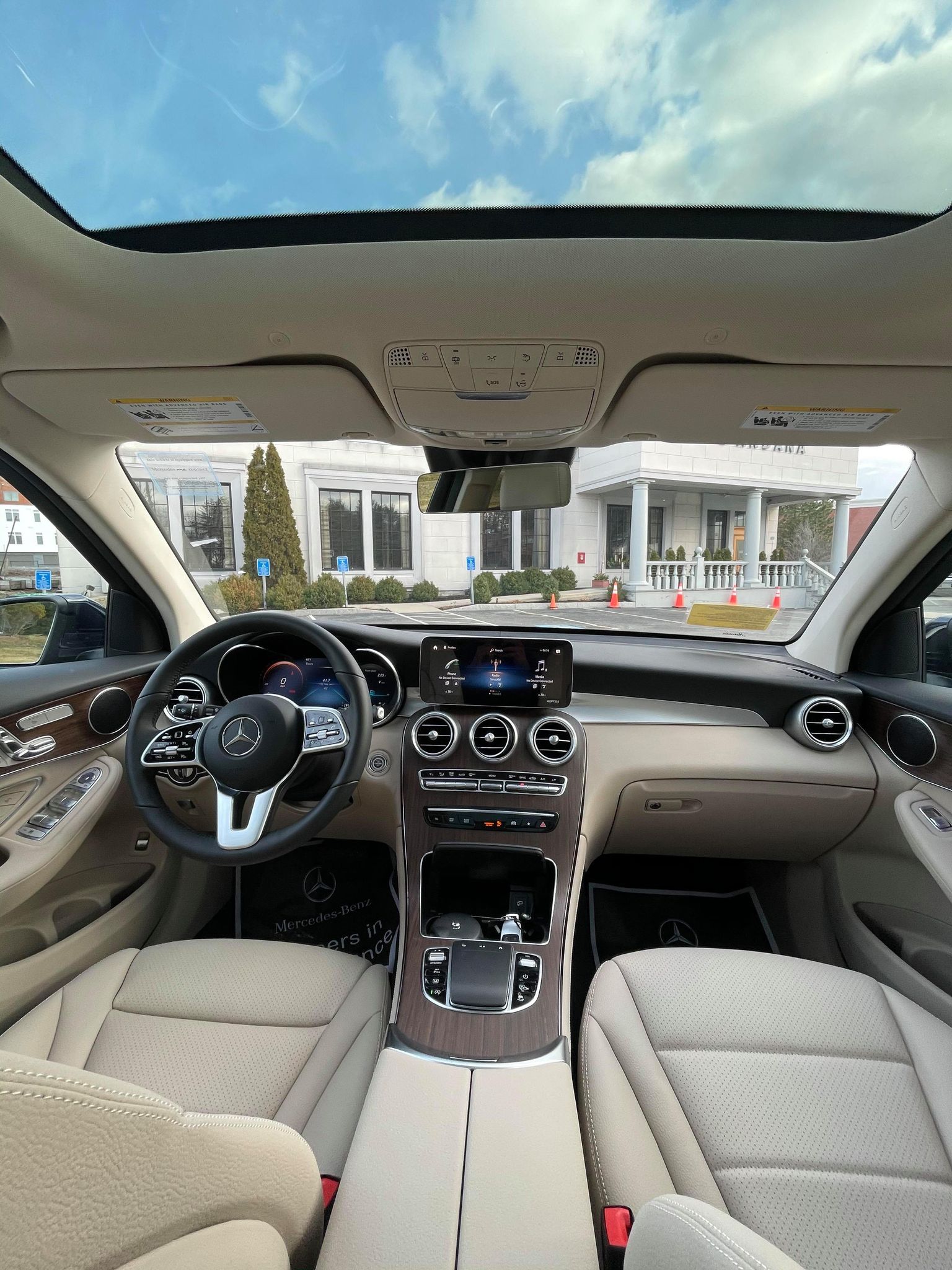
If you were to test drive both the GLC and GLA back to back, before even driving off the lot you’re going to notice the significant difference in terms of interior quality. While Mercedes Benz has made great strides to offering an upscale cabin with their 4 models priced below $40k that we’d argue is currently better than BMW and Audi’s interior layout in this segment, the GLC even in it’s current state and in need of a refresh, is miles ahead when it comes to interior design. You feel as though you’re sitting in a cockpit, with the dashboard and center console wrapping around you to provide a safe and secure feeling, while also having higher quality materials to give you a true sense of luxury and craftsmanship.
2021 Mercedes Benz GLC Interior

Despite not having the same digital gauge cluster and infotainment system layout that we saw in the GLA and GLB, functionality remains the same and in true Mercedes Benz fashion is still going offer an in-depth user interface that’s responsive and high quality. The digital gauge cluster is certainly on par with Audi’s virtual cockpit, and even better it’s fully customizable.

Yet for buyers who are emphatic about purchasing a GLA, Mercedes Benz hasn’t forgotten about you, and in fact is one of the few brands that will go above and beyond it’s rivals when it comes to optional features and packages. This includes contoured leather seats, that are heated and ventilated, 3 position memory for both the driver and passenger, augmented reality for the navigation system, adjustable 2nd row seats, ambient lighting, and a panoramic moonroof. Do keep in mind that as you start adding those features, you’re now entering the same price range as the GLC, which even in base form is a more polished crossover.

Overall

At the end of the day, is the GLC worth paying the extra $6000? Absolutely. It’s not just the perception of going upscale with a compact crossover rather than subcompact, which shouldn’t be a primary motivational factor when car shopping, but it’s the extra practicality, better performance, and interior comfort that makes owning the GLC worth it, especially if you have a growing family. The refinement and overall quality is going to ease any buyers remorse after passing on the GLA, and we believe is the better long term buying decision if you are cross shopping both vehicles. Whichever you choose, Mercedes Benz will still impress in both segments when it comes to optional packages, features, and technology and should be at the op of your list of considerations when looking for a subcompact or compact crossover.

_________________

2021 Mercedes Benz GLA Review – Start Up, Revs, Walk Around and Test Drive

2020 Mercedes Benz GLB Review – Walk Around and Test Drive

2021 Mercedes Benz GLC Review – Start Up, Revs, Walk Around, and Test Drive

The post Why You Should Buy A 2021 Mercedes Benz GLC Instead of a GLA appeared first on Boston Auto Blog.
5 Reasons Why You Should Buy A Mazda CX-30 – Quick Buyer’s Guide

Subcompact crossovers are a dime a dozen, and so common in fact, that they’re replacing small sedans and hatchbacks in the price range between $20k – $30k. However, consumers have had a love/hate relationship with these vehicles as they’re practical and affordable, but often fall short in comfort, styling, driving dynamics, and technology. Despite many of these aspects beginning to trickle down to more affordable segments, sub compact crossovers are still lacking in many areas these leaves much more to be desired. The Mazda CX-30 is here to change all that, with an aggressive road presence, upscale interior, a more than adequate amount of performance, and a price tag that suits the lives of everyday Americans. So here are 5 reasons why you should buy a 2021 Mazda CX-30.

5) Versatility

Starting off at number 5 is the versatility and year round drivability that the Mazda CX-30 provides, especially for consumers who are a bit more adventurous or need a capable crossover to take on the winter. It’s become a preconceived notion that the CX-30 is really just a lifted Mazda3 hatchback, and whether there’s any truth to that or not, this subcompact crossover is going to be more suitable for the tinmes you go off-road or encounter snowy conditions, and that’s really due in part to the CX-30’s 7 inches of ground clearance in conjunction with the optional AWD system.

It’s no secret or surprise that Americans are gravitating towards crossovers because of the perception that they’re more practical and capable. With rivals such as the Subaru Crosstrek, Kia Seltos, and Chevy Trailblazer all appealing to buyers with a more active lifestyle, the CX-30 fits right in, but where it differentiates itself will lead us to the 4th reason why this sub compact crossover should be the newest addition to your driveway.

4) Interior Refinement

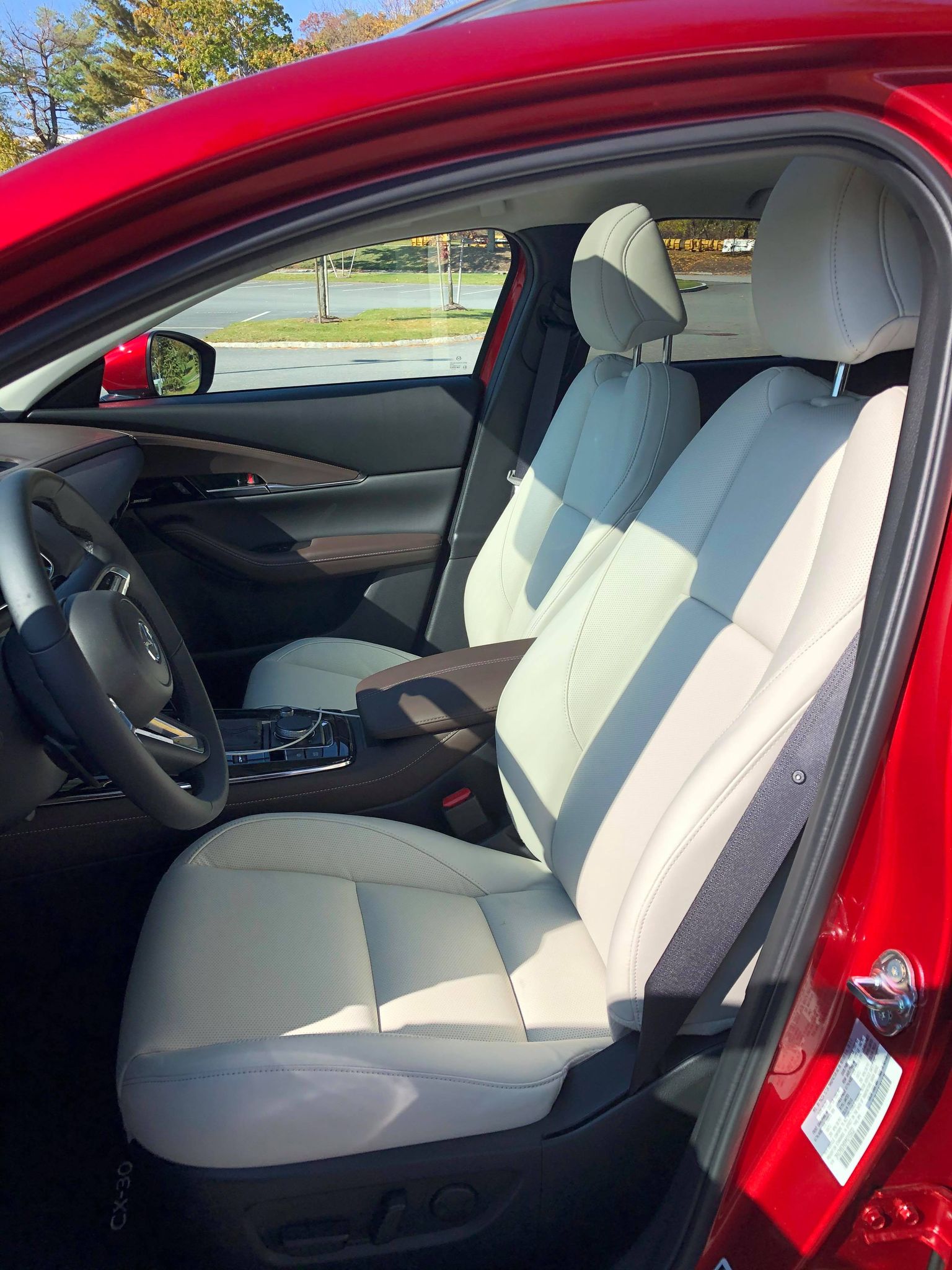
Often lacking in this price range and segment is interior refinement and an entry level luxury feel, as most manufacturers cut corners in quality, resulting in cheaper materials and a lack of soft touch padding. The Mazda CX-30 Premium bucks this trend, by captivating you with a comfortable two-toned leather trimmed cabin, that includes heated leather seats for both the driver and passenger, a leather stitched dashboard, and an adjustable leather center armrest. Controversial by some journalists, the gloss black trim pieces add a nice contrast while also providing a more upscale design, despite being very difficult to keep clean. The CX-30’s refinement when compared to many rivals in this segment isn’t just exclusive to comfort, as technology also impresses for a vehicle priced around $30k.

Mazda CX-30 Premium
Mazda CX-30 Premium

Once you step inside you’re greeted by a digital display in the center of your analogue gauges, which provides fuel efficiency numbers such as estimated range, and while this screen is very minimalistic, quality and resolution is what you’d expect in a Lexus or Acura. Not common for a sub compact crossover is a head up display, with traffic sign recognition, and blindspot detection to help keep your eyes on the road, rather than looking down at the gauge cluster. Also helping you stay focused on the road ahead, the 8.8 inch screen that pairs up well with the rotary dial, touchpad, and quick access buttons is placed closer to eye level and once you get acclimated with this user interface, rarely will you be looking down at the center console to find the right button to choose. Arguably the interior layout of the CX-30 is remisceient to what we see in current BMW models and older Audi’s, adding to the luxury appeal, but from a design perspective is certainly more simplistic.

3) Driving and Handling

Subcompact crossovers are notorious for their numb, boring, and uninspiring driving dynamics that usually bring a negative connotation to this segment. The Mazda CX-30 for what it is, differs in that regard and feels more planted and car like than competitors. Without a sports tuned suspension you’re obviously going to feel body roll and it won’t necessarily hug the road, but steering input gives you confidence when traveling on winding backroads. Working in it’s favor, the CX-30 is built on the same platform as the Mazda3 hatchback and you feel it, as there’s a firmness to the steering that we just don’t see with vehicles in this segment. It should also be noted that during our time with this sub compact crossover, driving was actually quite enjoyable even after a 2 hour cruise making this vehicle suitable for road trips when you want to getaway from the city.

2) Performance

Where Mazda stands out among a sea of cookie cutter competitors is the standard performance you’ll receive whether you spend $22k for a Select or $31k for a Premium, Under the hood the CX-30 is powered by a 2.5 liter 4 cylinder engine that puts out 186 hp and 186 lb ft of torque and is paired with a 6-Speed automatic transmission. By no means is this impressive, however it’s one of the more powerful options available in this class, as it’s common for sub compact crossovers to range anywhere from 150-170 hp. Also when factoring in the transmission, brands such as Toyota and Honda use a CVT which has been subject to criticism by both consumers and enthusiasts alike, whereas as Mazda has a conventional automatic that might not be the best on the market, but certainly inspires more excitement behind the wheel. For the 2021 model year, Mazda will take things one step further by dropping a turbo under the hood to give us an eye opening 250 hp and 320 lb ft of torque to outperform every vehicle in this segment.

It wouldn’t be far fetched to say that this will be a game change for the entire automotive industry, as the CX-30 sets the bar higher for this class. Depending on what you’re priorities are, whether you prefer comfort and affordability or performance and entry level luxury, we recommend waiting for the turbo to arrive as the horsepower to price ration will certainly make this sub compact crossover very appealing.

1) Value For The Price

And finally at number 1 is the value for the price you receive by going with the Mazda CX-30, specifically the Premium trim which comes in just under $31k. While it’s not the most spacious or practical, it surprises and impresses in other ways that to us makes the CX-30 the gold standard of the sub compact crossover segment. For buyers on a budget who don’t necessarily need a compact crossover and just desire a taste of luxury, good performance, versatility, and enough cargo space for groceries and daily tasks, the CX-30 checks off all those boxes. To find the amount of refinement and comfort you experience when you step inside, you’ll likely be paying $5k – $10k more by going with an Audi Q3 or BMW X2 because competitors such as Honda, Toyota, and Chevy just aren’t going to match what Mazda is providing.

Then when you take into account the performance, not only for current CX-30 models but also the turbo that will be arriving soon, it becomes more difficult to find a worthy rival. To us, Mazda found a way to package everything consumers want while also retaining a price tag around $30k, and that’s why if you’re in the market for a sub compact crossover, we highly recommend at least test driving one for yourself because it will surely impress the minute you leave the dealer.

The post 5 Reasons Why You Should Buy A Mazda CX-30 – Quick Buyer’s Guide appeared first on Boston Auto Blog.

Business confidence dips but staff shortages show signs of easing

Business confidence fell in October but was still at its second highest level since the start of the pandemic.

Business confidence fell in October but was still at its second highest level since the start of the pandemic.

Sentiment dipped last month to 43 per cent from 46 per cent in September, mainly because of a fall in optimism about the wider economy, although it remains considerably higher than the long-term average of 28 per cent, according to the latest Lloyds Bank Business Barometer.

Despite rising energy costs and supply chain woes, the survey also found that the net balance for firms’ own annual trading outlook was down by only one point to 42 per cent.

The survey also suggested that staff shortages in some sectors may ease, with 60 per cent of companies that have furloughed staff planning to bring them all back and a further 30 per cent expecting more than half of their furloughed workers to return.

Hann-Ju Ho, a senior economist at Lloyds Bank Commercial Banking, said that “it should bode well for the labour market as we head into the winter”.

However, pricing expectations among businesses continued to rise because of increasing input costs, including raw materials and staffing, with 45 per cent expecting to increase their prices, up from 37 per cent. The level outstripped the previous high of 44 per cent in March and April 2018. Lloyds said it indicated that firms continue to consider passing costs on to customers.

The monthly survey, which started in 2002, was conducted before last week’s autumn budget, involving 1,200 companies between October 1 and 15 across all sectors and regions.

Five out of the 12 UK regions and nations registered an increase in business confidence last month but it also fell in five. London, which rose 65 per cent, and the northeast, which was unchanged at 61 per cent, remained the most positive regions. Employment expectations are particularly high in the capital, the survey found.

Confidence remained highest in the manufacturing sector, where it rose to a five-month high of 51 per cent, up from 49 per cent. Sentiment in retail and services fell slightly to 37 per cent and 43 per cent, respectively, although they remain higher than three months ago.

Official data last month showed that retail sales fell unexpectedly in September, dipping by 0.2 per cent, according to the Office for National Statistics.

The survey, which provides an early signal of economic trends, comes as the Bank of England’s monetary policy committee prepares to meet on Thursday. Expectations are rising that it will increase interest rates amid inflationary pressures.

Read more:
Business confidence dips but staff shortages show signs of easing

Why you should invest in India

As world economies recover from the effects of the COVID-19 pandemic, investors all over the globe are more willing than ever to part with their cash.

As world economies recover from the effects of the COVID-19 pandemic, investors all over the globe are more willing than ever to part with their cash.

When scouring countries for investment opportunities, they should look no further than India.

According to data published by NASDAQ this year, India is the world’s fifth fastest-growing economy and has already had a considerable bounce back from the pandemic. There are prime opportunities for investment that could deliver attractive returns across a huge range of sectors.

There are a number of reasons why investors should focus their capital on India. For one, in the 2021 financial year, the country received its highest ever inflow of foreign direct investment of over $81 billion. This was due to a backdrop of policy steps that have improved the ease of doing business in the country, attracting investment into projects focused on manufacturing capacity and new infrastructure developments.

The largest investors in India in the past year were Singapore, the USA, and Mauritius, but the rest of the West stands to gain a lot if they follow suit. India’s GDP is forecasted to grow by 11 per cent in the next financial year, the highest since their independence in 1947, and is estimated to become a $5 trillion economy by the same year.

This large, expanding size of the market makes India an attractive prospect for foreign investors, with easy access to other emerging markets such as Bangladesh, Nepal, Pakistan, Sri Lanka and Myanmar.

Many of the world’s most prominent investors and venture capital funds have already succumbed to the allure of investing in India. Warburg Pincus and Prosus Ventures recently backed the Good Glamm Group in a $150 million funding round, making it the latest Indian startup to become a so-called ‘unicorn’ company, with a value of over $1 billion. Similarly, last month General Catalyst led a $160m investment round in Mumbai-based Dhani Services, founded by Sameer Gehlaut.

Given the current geopolitical climate and how western nations are reacting to China’s foreign policy decisions, many investors see India as a safer alternative. Tensions in the South China Sea are scaring away the big corporates, especially those based in the US, for fear friction between the two countries could affect their bottom line.

Many companies also made moves to prevent their supply chains being so reliant on China following the coronavirus pandemic, instead focusing on domestic production. By comparison, India has relatively good relations with most of the nations in the west, and many companies have decided to shift their manufacturing bases from China and into India.

The Indian government has recently taken the policy decision to encourage digital transformation across the country. This is another reason why it is becoming increasingly attractive for investors. For a long time, many companies have chosen to outsource their IT departments and call centres to India, but with digital technology expanding across the country, it will soon become more than just that.

We are seeing a huge tech boom across India, which is revolutionising industries such as finance, e-commerce, agriculture and medicine. This leads to increased investor confidence as the economy becomes more developed on the whole, and venture capitalists who have found success in these industries in other countries will view India as an even more attractive place to invest.

It is reforms like this that increase investor confidence. India’s government is keen to get other countries doing business here. The country regularly ranks in the top 10 improvers in the World Bank’s “Ease of Doing Business” rankings, which is in part due to the actions of the government.

India is undoubtedly an attractive place to invest, and it’s time more firms and individuals in the west recognised this. The growth of the country’s already significant economy can’t be downplayed, and the emergence of more and more unicorns by the year, as well as its geopolitical benefits compared with China, all make India an ideal place to shell out capital.

Read more:
Why you should invest in India

123 swap. What’s possible with Avalanche?

supply chain

Developing an ecosystem requires excellent collaboration and partnerships.

According to 123swap, the collaboration with the particular project helps the ecosystem’s growth and facilitates crypto adoption.

The objective of the 123swap is to reintroduce the core concepts of cross-chain, to understand the latest breakthroughs, and to collaborate with the best and most reliable cross-chain approach.

The 123swap platform leverages smart contracts to automate and speed up the swap process. The platform utilizes its smart contracts to facilitate distributed finance management. Critical Solutions has an easy-to-use and straightforward interface, a non-volatile rate during transactions, no hidden fees, a wide range of assets, security, and cross-chain one-window platforms.

Main Goal of 123swap

Through cross-chain intelligent contracts, intelligent and autonomous financial management can be realized in one place. 123swap has invented a technology that will help you overcome competition and become the fastest and best swap platform in the world.

What is Avalanche?

Avalanche is a layer-one blockchain that is the foundation for decentralized apps and custom blockchain networks. It is one of Ethereum’s rivals and aims to defeat Ethereum as the most popular blockchain in smart contracts. We’re trying to do this by outputting up to 6,500 transactions per second while maintaining scalability.

Unique Architecture

The Avalanche network consists of three blockchains: X-Chain, C-Chain, and P-Chain. Each chain performs a specific function and is significantly different from the approach used by Bitcoin and Ethereum, where all nodes must verify all transactions. Avalanche’s blockchain utilizes various consensus technologies depending on the use case.

Avalanche has been working to establish its ecosystem with DApps and DeFi since deploying in 2020. Avalanche is integrated with multiple Ethereum-based projects such as SushiSwap and TrueUSD. In addition, the platform continues to attempt to improve interoperability between its ecosystem and Ethereum through the installation of bridges, etc.

Why is it unique?

Avalanche is trying to solve the trilemma of blockchain. The trilemma is that the blockchain is too large to achieve sufficient decentralization. As a result, high gas rates are becoming common in Ethereum.

  • To solve this problem, Avalanche has created three interoperable blockchains.
  • Exchange Chain (X-Chain) is used to generate and exchange native AVAX tokens and other assets. These tokens adhere to a set of established standards, like the Ethereum ERC-20 standard. It adopts the Avalanche consensus technology.
  • Contract Chain (C-Chain) is a platform for smart contracts and decentralized applications. It has its avalanche virtual machine, comparable to Ethereum’s virtual machine, and can develop DApps for EVM. We also use the Snowman consensus process.
  • Platform Chain (P-Chain) organizes network validators, monitors current subnets, and allows the creation of new subnets. A subnet is a collection of validators, similar to a Validator cartel. Each subnet can validate multiple blockchains simultaneously, but only one subnet can validate a single Blockchain. In addition, the Snowman consensus system is adopted.

Verdict

Cryptocurrencies that include Abbas are speculative, complex, and carry significant risks – highly volatile and susceptible to secondary activity. Performance is unpredictable, and AVAX’s past performance does not guarantee future performance.

Visit

Naujas pagrindinis

https://exchange.123swap.finance/


Read more:
123 swap. What’s possible with Avalanche?