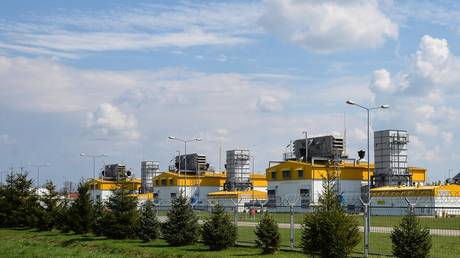
Poland’s energy company PGNiG will not have the right to veto the certification of Russia’s Nord Stream 2 gas pipeline, says German energy regulator Bundesnetzagentur (BNetzA).
The Warsaw-based firm, however, will get an opportunity to muster the arguments during certification proceedings of the widely-debated pipeline, the watchdog said as quoted by TASS.
“The Federal Network Agency gave a positive response to the applications of PGNiG SA and PST GmbH over their participating in the certification process,” head of the regulator’s media and public relations department Fiete Wulff told the agency.
“The parties involved can participate in the administrative process, in particular, they have the right to state their point of view. The parties involved do not have the right to veto,” Wulff added.
The Polish state-controlled energy company submitted a request for participation in the certification procedure for the Gazprom-run enterprise in August, claiming that the Russian energy giant didn’t want to comply with the EU energy regulations. PGNiG accuses Gazprom of avoiding “application of requirements concerning ownership unbundling”, thus jeopardizing the competitive environment in the EU energy market.
Earlier this month, Gazprom announced the completion of construction works on the Nord Stream 2 pipeline, running from Russia to Germany through the Baltic Sea. However, the company is still awaiting European certification confirming that the pipeline meets EU technical regulations to start gas deliveries.
The pipeline is also to be registered as an ITO with Germany’s federal network agency (Bundesnetzagentur), which has until January 8, 2022 to issue certification.
According to EU law, the agency cannot officially ban gas pumping, but if it starts before the necessary registration procedures are completed, the operator of Nord Stream 2 AG would face fines.
The Nord Stream 2 pipeline, which is set to boost annual deliveries of Russian natural gas to Germany by up to 55 billion cubic meters, has encountered numerous roadblocks with Poland standing as one its most vociferous opponents.
The People’s Bank of China revived its tough stance on digital currencies on Friday, ruling all crypto-related trading activities illegal and banning overseas crypto exchanges from providing services to mainland investors.
The regulator announced plans to bar financial institutions, payment companies and internet firms from facilitating cryptocurrency trading, as well as to strengthen monitoring of risks from such activities.
“Overseas virtual currency exchanges that use the internet to offer services to domestic residents is also considered illegal financial activity,” the PBOC said in a Q&A posted to its website.
“Financial institutions and non-bank payment institutions cannot offer services to activities and operations related to virtual currencies,” the central bank said.
The move sent bitcoin and other virtual currencies plummeting. The world’s number one digital asset by market capitalization dropped over 5% to below $42,000. Other cryptocurrencies followed the declining trend with ether dropping 10% to below $2,800, while dogecoin crashed over 8% to below $0.20, according to the Coinmarketcap website.
The latest ruling comes as part of a broader state-run campaign by Chinese regulators against cryptocurrencies. Earlier this year, Beijing banned mining in major bitcoin hubs, such as Sichuan, Xinjiang and Inner Mongolia, which led to a sharp drop in bitcoin’s processing power, as multiple miners took their equipment offline.
The head of Ukraine’s state-controlled energy corporation Naftogaz is calling on Washington and Berlin to take decisive action against Russia, accusing the country of using its natural gas as a geopolitical weapon.
The announcement comes amid a growing energy crisis in Europe ahead of the winter season, and shortly after the US and the International Energy Agency urged Russia to pump more gas to the region to ease the deepening supply crunch.
Benchmark European gas prices have soared by more than 250% since the beginning of the year, while benchmark power contracts in France and Germany have doubled.
“This is a very clear sign that they are using gas as a geopolitical weapon at the moment,” Naftogaz CEO Yuriy Vitrenko told CNBC, accusing Russian energy major Gazprom of deliberately withholding gas supplies from Europe.
The former energy minister also accused Gazprom of blocking access to the Ukrainian gas transmission system for other Russian companies, as well as cutting exports from Central Asia that could go to Ukraine via Russian territory.
Vitrenko expressed hope that the US will reinstate sanctions against Nord Stream 2 AG, Gazprom’s Swiss-registered subsidiary, which is working on the Nord Stream 2 pipeline.
Meanwhile, Germany’s Energy Ministry said that Russia is fully compliant with its gas supply obligations to Europe, stressing that there’s no need for the state to intervene in the situation with gas prices.
“According to our information, Russia is fulfilling the existing supply agreements… We do not know about the deliberate disregard of the existing contracts,” the ministry’s spokeswoman Suzanne Ungrad said earlier this week.
Gazprom previously announced it was ready to supply Europe with natural gas via the recently completed Nord Stream 2 pipeline. However, deliveries cannot begin before the project is certified by the EU regulators. The procedures could reportedly last into next year.
American companies operating in Russia have made direct investments amounting to a total of $96.05 billion, according to the sixth annual joint survey of the American Chamber of Commerce in Russia (AmCham) and Ernst & Young.
The survey, which focused on the prospects for direct investment and bilateral trade between Russia and the US, was based on data from 160 companies. According to its findings, US firms invested more than $2.2 billion in the Russian economy in 2020 alone, and plan to invest around $1.8 billion more in 2021. Over a half of this money will go to Russia’s energy and natural resources industry.
“Despite the decline in activity in 2020 … 84% of companies reported that they are planning to launch new projects in Russia in the near future. This is a record value during the time of our study. For 73.5% of [US] companies surveyed, Russia is a strategic market,” Ernst & Young partner Sophia Azizian said at the 21st AmCham Investment Conference on Thursday.
According to the survey, 78% of companies feel the negative impact of US sanctions on their Russian business, compared to 80% last year.
“The restrictions put American business at a disadvantage compared to companies from other countries and create reputational risk,” the survey says.
Also, as per AmCham findings, “official statistics underestimate the actual level of economic relations between Russia and the US,” with bilateral investment figures obtained by researchers as part of the survey being at least nine times higher than the official figures.