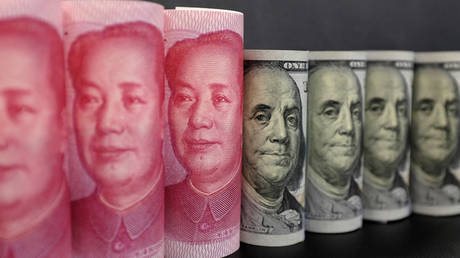
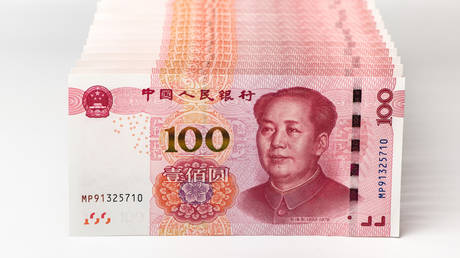
China is planning to “steadily and prudently” promote internationalization of its currency, the yuan, the country’s central bank said, pledging to strengthen the monitoring of cross-border capital flows and prevent systemic risks.
According to the regulator, the Regional Comprehensive Economic Partnership (RCEP) agreement is expected to further boost trade ties between the nations in the Asia-Pacific region, thus promoting more opportunities for the use of the yuan in mutual settlements and investment activities.
The pact was clinched in late 2020 at a virtual summit of the Association of Southeast Asian Nations hosted by Vietnam.Based on rapidly developing yuan-denominated commodity trade settlements, the Chinese government is reportedly seeking to increase the use of the currency in cross-border e-commerce.
The People’s Bank of China added that it is planning to explore more options for yuan-denominated investment and financing. The regulator will also step up currency settlement cooperation with other countries, and improve the infrastructure for settlement and clearing.
International payments made in the local currency amounted to 28.39 trillion yuan ($4.39 trillion) in 2020, surging 44.3% compared to the previous year, the regulator said. Meanwhile, cross-border settlements made in yuan reportedly accounted for 46.2% of overall international payments, hitting an all-time high.
Beijing has been trying to expand the influence of the yuan across the globe since 2009 to eliminate the reliance on the US dollar in trade and investment settlements, as well as to challenge the greenback’s status as the world’s major reserve currency.
Russia and the Association of Southeast Asian Nations (ASEAN) have adopted a roadmap for boosting mutual trade and investment cooperation for the next five years, Russia’s Ministry of Economic Development announced.
“The pandemic has demonstrated that we can overcome the crisis only by means of scaling up cooperation in three key areas – trade and investment, digital economy, and sustainable development,” the ministry’s press service reported, citing Deputy Minister Vladimir Ilyichev.
According to the official, despite the Covid-19 pandemic, investments in joint Russia-ASEAN projects saw more than a threefold increase in 2020 compared to 2019, reaching $8.8 billion.
Ilyichev said that both ASEAN member states and Russia need to modernize their respective economic models to ensure more efficient cooperation. Also, he stressed that Russia sees great potential in joint work on climate-related projects under the plan.
According to the ministry, cooperation between the Eurasian Economic Union (EAEU), of which Russia is a member state, and ASEAN will also see changes in the near future.
“The sides (ASEAN and EAEU) agreed to draft a number of initiatives in the areas of the development of the single-window systems, e-trade, intellectual property protection, as well as the use of sanitary and phytosanitary measures,” the ministry said.
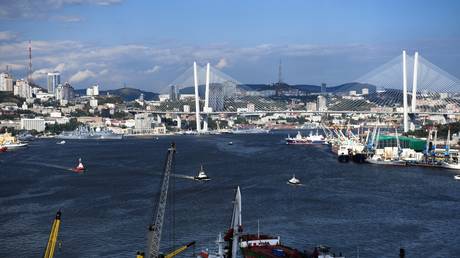
At the Eastern Economic Forum in Russia’s Vladivostok earlier this month, a proposal was unveiled to establish a free-trade zone between ASEAN and the EAEU in order to boost regional cooperation further.
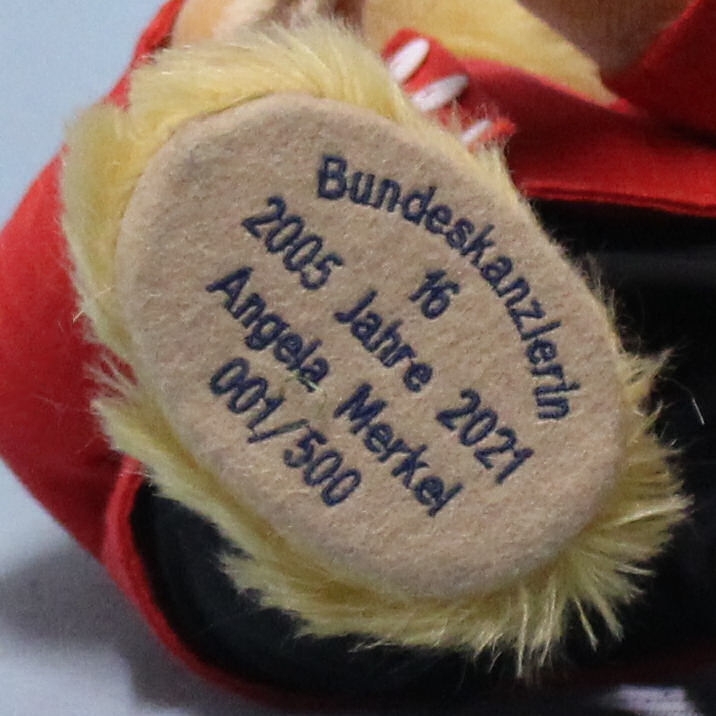
A German toy manufacturer has introduced a teddy bear created in tribute to Angela Merkel’s time in office as the chancellor steps down at the end of this year after serving 16 years as the head of Germany’s government.
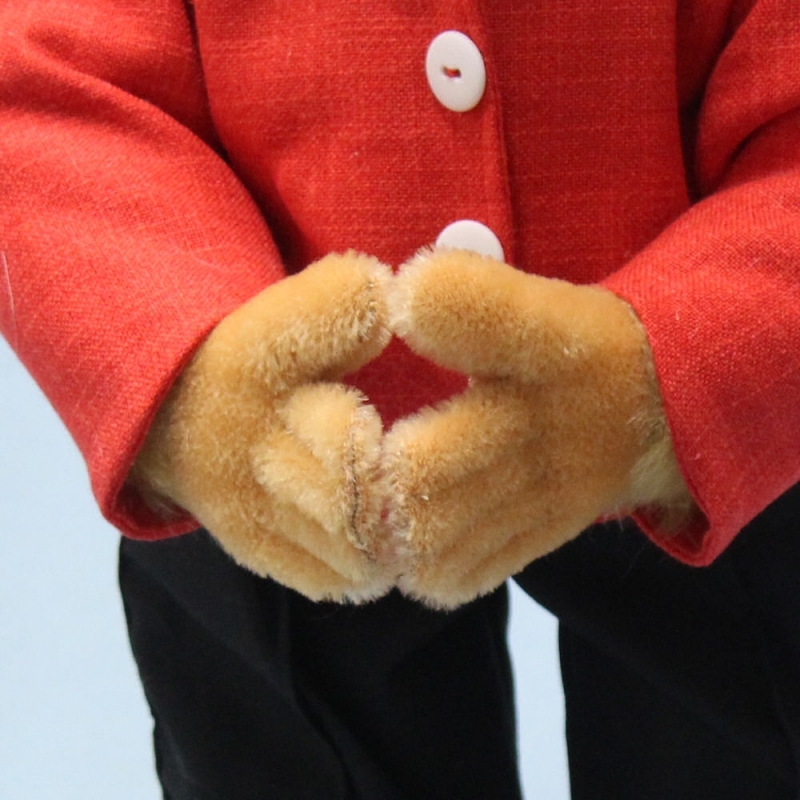
Hermann-Spielwaren, located in the Bavarian city of Coburg, revealed the 40-centimeter tall toy bearing a certain resemblance to the chancellor.
The teddy bear is sporting a hairstyle similar to Frau Merkel, while the paws can be folded to replicate the legendary hand gesture known as the ‘Merkel rhombus’.
“We try to express moments of contemporary history in teddy bears as a form of art,” said Martin Hermann, the managing director of one of the world’s oldest still-existing teddy bear factories, as quoted by Germany’s Bild newspaper.
Among the other outstanding figures who have appeared as teddy bears are former US President Barack Obama, former Chancellor of Germany Helmut Schmidt and Britain’s Queen Elizabeth II.
The 101-year-old family enterprise will produce 500 limited-edition Merkel teddy bears, priced at €189 with the 16th one to be sent to Merkel as a reference to the number of years she spent at the helm of Germany.
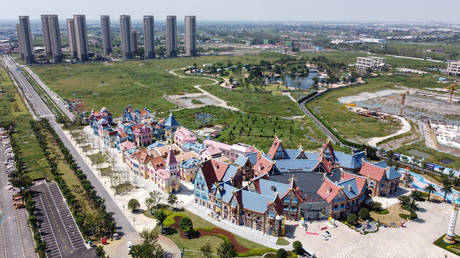
Major stock indices in the Asia-Pacific region (APR) are mostly declining on Monday on fears around Chinese property developer Evergrande’s looming bankruptcy.
As of 5am GMT, the Chinese Hang Seng Index dropped 3.23% on the Hong Kong stock exchange, while the Australian S&P/ASX 200 lost 1.91%, with shares of major miners declining the most, trading data shows.
The Hang Seng Properties index plunged 7% to a 52-week low, while shares of insurers listed in Hong Kong also fell, with AIA dropping about 5.2% and Ping An Insurance losing 7.43%.
MSCI’s broadest index of Asia-Pacific shares outside Japan fell 1.63%. Markets in mainland China, Japan and South Korea are closed on Monday due to public holidays.
The downward market trend comes as investors assess the financial position of the Chinese real estate developer Evergrande Group, whose debt of $300 billion could lead to the company’s bankruptcy.
The company’s shares in Hong Kong on Monday were down nearly 15%. The company is expected to default later this week. Markets will be affected by whether Evergrande is restructured or completely shut down, according to UBS analysts quoted by the Wall Street Journal.
Europe is bracing for a difficult winter, having turned to weather-dependent sources of energy like wind and solar power over fossil fuels while natural gas storages have run low.
“It could get very ugly unless we act quickly to try to fill every inch of storage. You can survive a week without electricity, but you can’t survive without gas,” Marco Alvera, CEO of Italian energy infrastructure company Snam SpA, told Bloomberg.
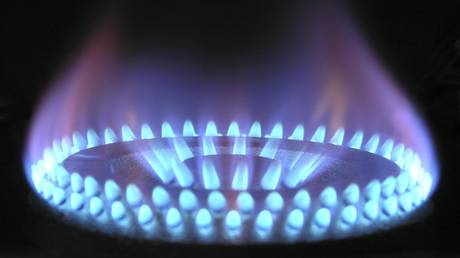
European gas prices broke historic records this month, edging close to an unprecedented $1,000 per 1,000 cubic meters. The price spike can be partly blamed on supply chains being unable to meet the rising energy demand in both the household and industry sectors as the global economy gets back on the rails after the global Covid-19 crisis. However, experts say major Western economies have become too dependent on renewable energy sources, such as wind and solar power. And this doesn’t seem to pay off, with the Wall Street Journal reporting last week that low winds in the North Sea were brewing chaos for energy networks.
“The sudden slowdown in wind-driven electricity production off the coast of the UK in recent weeks whipsawed through regional energy markets. Gas and coal-fired electricity plants were called in to make up the shortfall from wind,” the outlet reported. As a result, electricity prices have also been on the rise.
“Electricity and gas prices are going to be higher at home than everybody would want and they are going to be higher than they have been for about 12 years,” Dermot Nolan, a former CEO of UK energy regulator Ofgem, told Bloomberg in an interview.
Rising gas prices may also force European countries to pause their ambitions to turn to green energy sources, returning back to the dirtiest of them all – coal.
“Underfilled storage facilities continue to push the price of gas higher. If the facilities are not refilled now, and the winter turns out to be rather severe, EU nations may be forced to reactivate thermal power plants operating on other types of fuel, including coal, to compensate for the lack of electricity,” EU energy markets expert Simonas Vileikis told TASS.
Europe’s major gas supplier, Norway, has been unable to meet the demand with North Sea fields undergoing heavy maintenance after pandemic-induced delays. And amid all of this, European gas inventories are at their lowest level in more than a decade for this time of year. Given the rise in natural gas demand in Asia, which could force suppliers to turn their attention there, experts say the situation in Europe will get worse before it gets better.
“Gas supply is short, coal supply is short and renewables aren’t going great, so we are now in this crazy situation,” Dale Hazelton, head of thermal coal at Wood Mackenzie Ltd told Bloomberg.
“With natural gas prices already hitting record highs in Europe ahead of rising winter demand, prices could move even higher in the coming months… There is a potential it can get worse,” said Stacey Morris, director of research at index provider Alerian in Dallas.
According to Goldman Sachs, Europe will need to curb energy demand if the winter is cold, otherwise it may face outages. Rising energy prices are already putting some industries under stress, with fertilizer plants in the UK and Norway closing or curbing output. This puts at risk the EU’s food-supply chain, which uses natural gas in the heating of greenhouses and requires carbon dioxide gas, a byproduct of fertilizer production, in everything from meat processing to the beer and drinks industries.
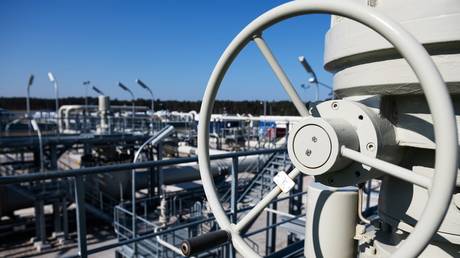
Russian gas giant Gazprom’s CEO Alexey Miller recently said the EU will enter winter in about a month without having fully replenished its stockpiles. However, this could all change if Brussels stops stalling the launch of Russia’s Nord Stream 2 gas pipeline, which is capable of restocking European storages to the brim. The pipeline’s daily capacity of gas supply is comparable to the entire volume of liquefied gas that is now supplied to Europe.
Nord Stream 2 consists of two pipelines with a collective capacity to deliver as many as 55 billion cubic meters of natural gas annually from the Siberian fields in Russia directly to Europe via the Baltic Sea. The pipeline’s construction was completed earlier this month; however, Europe has been reluctant to speed up the certification process needed to launch deliveries. The project has been delayed under pressure from Washington and some Eastern European countries, which are opposed to increasing energy imports from Russia.