The 30-year agreement will boost gas supplies by 10 billion cubic meters and will be settled in euros
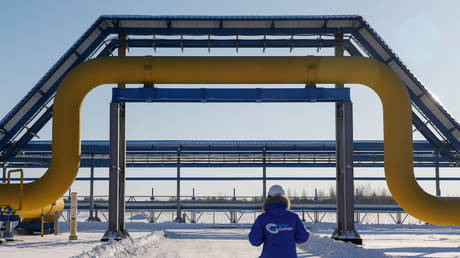
Russia’s Gazprom and the China National Petroleum Corporation (CNPC) signed a second long-term contract on Friday for the supply of 10 billion cubic meters (bcm) of natural gas from the Russian Far East. The agreement comes as Russian President Vladimir Putin is in China on an official visit.
According to Gazprom, the agreement is “an important step in further strengthening mutually beneficial cooperation between Russia and China in the gas sector.” After the project reaches its full capacity, the volume of Russian pipeline gas supplies to China via the Far East route will reach 48 billion cubic meters per year (including deliveries via the Power of Siberia gas pipeline).
Gazprom’s largest natural gas deposit in the Far East is the Yuzhno-Kirinskoye field, where production is due to begin in 2023.
“The signing of the second contract for the supply of Russian gas to China testifies to the highest level of mutual trust and partnership between our countries and companies. Our Chinese partners from CNPC confirm that Gazprom is a reliable gas supplier,” the head of Gazprom, Alexey Miller, said. Russian energy supplies to China have reached record highs, according to Kremlin aide Yury Ushakov.
Gazprom and the CNPC signed their first 30-year contract on gas supplies via the Power of Siberia pipeline in 2014. The 3,000km (1,864 mile) cross-border pipeline, the first natural gas pipeline between Russia and China, started deliveries three years ago.
In 2015, the sides agreed on gas supplies via the western route, or the Power of Siberia 2, which will deliver gas from Siberia’s Yamal Peninsula, where Russia’s biggest gas reserves are. The new pipeline will be able to transfer up to 50 bcm more gas through Mongolia to China annually.
In January, Gazprom completed an analysis of the project to build the Soyuz Vostok gas pipeline through Mongolia to China, which will make it possible to supply up to 50 billion cubic meters of gas per year to China.
Analysts say Moscow’s ‘gas pivot’ to China poses a challenge for Europe, which has been struggling with skyrocketing energy prices in recent months. Russia remains Europe’s main gas supplier, but the changes it is currently making to its energy transport infrastructure should be taken seriously, analysts note.
Europe’s 541 bcm of annual gas consumption is more than China’s 331 bcm, but the latter is expected to rise to 526 bcm by 2030 as Beijing reduces its dependence on coal. Consulting firm McKinsey estimates that China’s demand for gas will double by 2035. Its annual gas consumption is expected to reach 620 bcm by 2040 and overtake oil as the leading fuel source by 2050, according to data made public in September by Chinese energy giant Sinopec.
The risk lies in an explosive mix of large deficits, high taxes, inflation, and a wealth gap, Ray Dalio warns
The founder of the world’s largest hedge fund Bridgewater Associates, Ray Dalio, has warned on Thursday that the US is on a “classic path” toward “some form” of a civil war.
The current financial conditions and irreconcilable differences in desires and values are consistent with the ingredients leading to civil strife, according to him.
“Not knowing what is true because of distortions in the media and propaganda increases as people become more polarized, emotional, and politically motivated,” Dalio wrote on LinkedIn.
He pointed to a number of factors that led him to this notion, including large deficits, high taxes, inflation, and wealth disparity that bring about political polarization.
“When that happens at the same time as there are foreign powers that are becoming strong enough to challenge the leading world power that is encountering this civil war dynamic, it is an especially risky period. That is the period I believe we are now in,” Dalio stressed, adding that “the biggest question is how much the system will bend before it breaks.”
He noted that political powers from opposing sides are “fighting to win at all costs,” making it impossible to compromise and leaving many “too afraid” to speak up or run for public office.
“History shows that the biggest risk to democracies is that they produce such fragmented and antagonistic decision-making that they are ineffective and disorderly, which leads to bad results and revolutions.”
Dalio predicts that this year’s elections will become the turning point for US internal politics.
“In the 2022 elections we will see losses by moderates and gains by extremists/populists […] because each side wants fighters not compromisers. The Supreme Court will make decisions on contentious issues that people are willing to fight over. There is a big risk that each side will view the decisions as unfairly made by the other side and not accept them, which will lead to tests of power,” he predicts.
This is not the first time Dalio voiced such dire forecasts. In November last year he published a book ‘Principles for Dealing with the Changing World Order: Why Nations Succeed and Fail’, where he also warned of a “dangerously high risk” of a civil war in the US within the next 10 years due to the “exceptional amount of polarization.”
India has turned down Tesla’s request to lower import taxes on electric cars, encouraging Elon Musk’s company to produce locally instead
New Delhi has refused to provide the US-based electric car maker Tesla with tax breaks, the chairman of India’s Central Board of Indirect Taxes and Customs, Vivek Johri, confirmed in an interview on Thursday.
“We looked at whether the duties need to be rejigged, but some domestic production is happening and some investments have come in with the current tariff structure,” Johri stated.
India levies extremely high import duties on complete vehicles, ranging from 60 to 100% depending on a car’s characteristics and price. The threshold for imposing the maximum possible tax is set at $40,000, which effectively makes all the electric cars produced by Tesla fall under that category. The existing tariffs structure has not deterred other companies from importing, so no exceptions will be made, Johri pointed out.
“Some investment has already come in with the current tariff structure. So why can’t others also come in?” the official stated. “There are other foreign brands also that are being sold in the country with the current tariff structure.”
While Tesla announced its intent to enter India’s market as early as 2019, the electric car giant has still not been able to do so. The Indian government has been encouraging the company to establish local production, pointing out that importing partially-built cars and assembling them locally would mean significantly lower levies. The car maker urged New Delhi to reduce the tariff rates on high-end cars to 40% instead, branding the standing rules “prohibitive” for the import of pricey vehicles.
Asked on Twitter in mid-January when Tesla cars would be available in India, the company’s CEO Elon Musk said he has been “still working through a lot of challenges with the government” to make the possible launch happen.
The energy agency projects demand for natural gas falling 4% on the continent in 2022
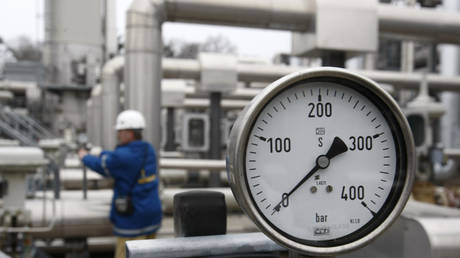
Europe’s natural gas demand is set to decline this year as buyers begin to favor lower-priced coal, the International Energy Agency said in the latest edition of its quarterly gas market report.
According to the IEA, gas demand on the continent is seen declining by 4% this year, after rising by more than 5% last year. The decline will be partially driven by a reduction in gas burning in the power sector, the agency said, which is seen declining by 6% this year.
The decline will be partially compensated by renewables, according to the IEA, which should see a “strong expansion” this year, but also “high gas prices continue to weigh on its competitiveness vis-à-vis coal-fired generation.”
“Exceptionally high gas – and by extension electricity – prices have hurt consumers, utilities and wholesalers, and are likely to have a lasting negative impact beyond the current seasonal tension,” the agency warned, adding that the adverse effects of the gas shortage were not limited to Europe.
The report noted that developing markets were particularly vulnerable to energy supply shocks that they were already experiencing. On top of this, there was also concern for food supply due to tighter availability of gas-based fertilizers, the International Energy Agency also said.
Global gas supply is seen remaining tight, the IEA also said, citing production outages, project delays, and a slow pace of new investment decisions on new production capacity.
“In the absence of strong policies to curb demand growth to achieve net zero emission targets, gas supply adequacy could emerge as a concern for the medium term on a combination of recent LNG project delays, the relatively small number of new LNG final investment decisions (FIDs) in 2020-2021 and a structural decline in upstream spending since the early 2010s,” the IEA said in the report.
Consumers may have to pay more for everything from candy to Kleenex amid soaring inflation
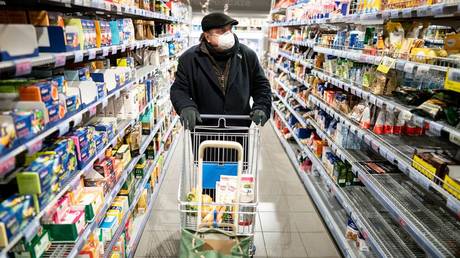
Major consumer product makers in the US announced this week they will raise prices more than previously proposed in 2022, announcing the news during post-earnings calls on fourth quarter results.
Household chemicals maker Clorox said on Thursday it would hike prices on 85% of its products by mid-year, planning multiple price increases on a number of products. The company previously planned to hike the costs of only 70% of products.
“We stand prepared to take more pricing [action] if necessary. We want to see how inflation will play out this fiscal year [which ends on June 30],” CFO Kevin Jacobsen said, as cited by Reuters. He added that Clorox is in active talks with retailers regarding the size and frequency of the price hikes, and pointed to an “extreme level of cost inflation” as the reason for the price boost. The firm also cut its full-year earnings forecast, with Jacobsen noting that “it’s going to take several years for us to rebuild margin [to pre-pandemic levels].”
Tide maker Procter & Gamble also plans price hikes on detergents, possibly by the end of the month, the company said this week. In the spring, price hikes on some personal healthcare products will follow.
Chocolate producer Hershey signaled further price increases in the first half of the year, while previously adopted price hikes are to go into effect before March 31. The firm unveiled a somewhat pessimistic forecast for 2022, with executives expecting gross profit margins to drop despite the price increases.
Kleenex maker Kimberly-Clark said last week it will also hike prices amid pulp, labor, and transportation costs increases. The company raised prices four times in 2021. Moreover, a number of consumer-packaged goods firms have scratched some of their traditional discounts in recent weeks, which also effectively raises prices at the checkout counter. The number of promotions on packaged food products like frozen and refrigerated meals dropped dramatically in January 2022 compared to last year, data from analytics firm IRI shows.
“With supply constraints, there is no point in promoting,” IRI’s head of client engagement, Krishnakumar Davey, said.
Oreo cookies maker Mondelez last month announced “multiple pricing waves” this year, while toothpaste producer Colgate said it will move planned price hikes to the first half of the year instead of the previously planned second half. Colgate CEO Noel Wallace warned that sales will fall across all product categories when consumers realize they have to pay more for the same products.
The plannd price boost comes as firms try to make ends meet amid higher costs on raw materials as Covid-19 pandemic-driven supply chain issues persist. Transportation and labor costs have also surged, pressuring producers further, while supply-and-demand imbalance propelled US inflation, which accelerated to 7% in the last month of 2021, its peak in four decades.