
Money flowing out of favorite pandemic-era stocks

Netflix and Peloton shares are poised to lose gains made over the last two years

Stock prices of lockdown-era favorites Netflix and Peloton nosedived on Thursday, in a latest sign that the boom for stay-at-home shares appears to be vanishing.

Peloton shares plunged 24%, wiping off nearly $2.5 billion in market value, after the exercise bike maker’s CEO said it was reviewing the size of its workforce and “resetting” production levels.

Data from S3 Partners shows short-sellers doubled their profits by betting against Peloton in 2021, the third-best returning US short.

Shares in streaming giant Netflix also plummeted nearly 20%, as the company forecast new subscriber growth in the first quarter would be less than half of analysts’ predictions. It also expects to add just 2.5 million users in the current quarter, well short of estimates.

Netflix CEO Reed Hastings said there were a myriad of reasons for the company’s low guidance, pointing to increased competition as a cause.


READ MORE: Bezos, Zuckerberg & Musk added $115 BILLION to their fortunes during pandemic

The two firms are the latest darlings of 2020 to sink to levels not seen since the early days of the Covid-19 outbreak. Others, such as Zoom video conferencing software and the e-signature company Docusign, have also suffered downward revaluation of their stocks.

“With a return to the office and travel lanes opening, darlings of the WFH (work from home) thematic are reflecting the growing reality that the world is moving slowly but with certainty towards a new normalcy,” Justin Tang, head of Asian research at United First Partners in Singapore, was quoted as saying by Reuters.

For more stories on economy & finance visit RT’s business section
Effect from one of world’s few carbon-capturing plants measured

Shell facility touted as a solution to lessen carbon footprint said to be doing the opposite

Shell’s multimillion-dollar project “Quest” in Alberta province in western Canada, built to trap and store carbon dioxide emissions, has been criticized as insufficient by an international NGO. In a report by Global Witness published on Thursday, the organization suggests the oil giant’s plant emits “more climate-wrecking gasses than it is capturing.”

According to the investigation, the carbon footprint left by the self-proclaimed “safe and effective” project exceeds the amount of greenhouse gas it has captured. While Shell says the plant’s carbon-capture system has stopped some five million tons of carbon dioxide from entering the atmosphere in less than five years, this “only tells one side of the story,” the report states. Over the same period of time, it released 7.5 million tons of polluting gasses. 

The climate damage caused by the plant’s annual carbon footprint is the equivalent of 1.2 million petrol cars, according to Global Witness.


READ MORE: UK’s conveniently timed boasts about hydrogen solving CO2 crisis at odds with experts’ questions about its green credentials

Only a few similar projects exist worldwide, and the Shell-operated Canada plant is being largely subsidized by the government to reduce carbon emissions. However, according to the findings, the plant’s effectiveness has been significantly overstated.

“Just 48% of the plant’s carbon emissions are captured, we found, falling woefully short of the 90% carbon-capture rate promised by industry for fossil hydrogen projects,” the report says. It calls for a halt to support and investment in a technology “that is not only failing to deliver any effective action in tackling the climate crisis – but is in fact contributing to it.”

Read more

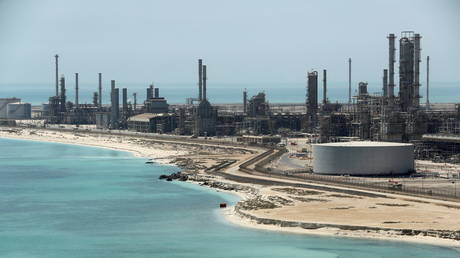
Ras Tanura oil refinery in Saudi Arabia. May 21, 2018. © Reuters / Ahmed Jadallah
LEAKED documents reveal intense ‘lobby activism’ by fossil fuel players to ‘water down’ UN climate change report – media

Earlier this week, a large group of scientists and academics in Canada urged their country’s government not to sponsor companies using the technology. Tax credits should not become “a fossil fuel subsidy,” they said in a letter. 

Shell claims its carbon-capture technology “overall has met or exceeded our expectations,” according to Vice, quoting the company’s regional spokesperson. Apparently Quest doesn’t cover the whole facility.

“This analysis is simply wrong. Our Quest facility was designed some years ago as a demonstration project to prove the underlying… concept, while capturing around a third of CO2 emissions,” an unnamed Shell spokesperson said, according to Sky News. 

The expensive technology is promoted as a solution to make fossil fuels more environmentally friendly by trapping and storing emissions. A coalition of more than a dozen energy companies has been formed to support a major carbon-capture hub in Houston, US. Shell has recently joined in, supporting the carbon-capture and storage project, which is estimated to cost $100 billion. 

Private space investment hits all-time high

$14.5 billion was poured into the space industry last year

Research by New York-based firm Space Capital showed that space infrastructure companies got billions of dollars in private investment in 2021. The funds grew by more than 50% from the previous year to a record $14.5 billion.

After a historic third quarter for human spaceflight, the fourth quarter brought in $4.3 billion thanks to “mega-rounds” of $250 million or more by Sierra Space, Elon Musk’s SpaceX, and Planet Labs.

In total, Space Capital tracked 1,694 companies that have raised nearly $253 billion in cumulative global equity investments since 2012 across the three space categories – infrastructure, distribution, and application. 

“As we look ahead, we see tremendous opportunities to scale mass adoption of the existing infrastructure as we look for radically new approaches to build and operate space-based assets,” said Space Capital’s managing partner, Chad Anderson.


READ MORE: Astronomers complain about SpaceX satellites

According to the report, space-related companies received $17.1 billion in venture capital last year, which made up 3% of total global venture capital investment in 2021.

“It’s important for investors to realize that investment in the space economy requires specialist expertise. We believe this will become more apparent in 2022 as some of these overvalued companies come back down to Earth and the quality companies rise above,” Anderson said.

For more stories on economy & finance visit RT’s business section

US looking for ways to get extra cash out of EU energy crisis – reports

Washington is in talks with Qatar over gas supplies for Europe as speculation over Russian invasion of Ukraine intensifies

US officials are reportedly negotiating opportunities for contingency steps to secure energy supplies to European nations if a possible conflict between Russia and Ukraine disrupts current deliveries.

“We’re looking at what can be done in preparation for an event, especially midwinter with very low [European natural gas] supplies in storage,” a senior US administration official said, as quoted by FT.

“We discussed what can be moved around the market, what can help… the things we can prepare now for deployment if and when there is an escalated crisis.”

The talks with Qatar and member states of the European Union are being held as the bloc is struggling with a severe energy crunch, which is sending prices for natural gas soaring to record highs. The crisis could become even more intense if the White House introduces new punitive measures against Russia should Moscow launch a military assault on Ukraine.

Read more

© Sputnik / Maksim Blinov
Crippling sanctions against Russia could boomerang back onto US & allies – reports

Speculation about an invasion was initiated by Ukrainian and US officials several months ago, and has been actively fueled by both government officials and Western media outlets. The Russian authorities made it clear that it has no plans of this kind.

Moreover, Western nations have accused Russia of squeezing gas supplies in the midst of the energy crunch. The allegations, repeatedly rejected by the Russian government, have been actively used by Washington in the longstanding debate with Berlin over the necessity of launching the Nord Stream 2 gas pipeline, the construction of which was led by Russian state-run energy giant Gazprom.

In an attempt to ramp up sales of liquified natural gas (LNG) to Europe markets, the US has regularly accused EU member states of heavy reliance on Russian gas supplies, persistently offering its LNG, the price of which is up to 40% higher than the piped gas, as an alternative source of fuel. 

Read more

RT
US seeking ways to profit should Russia-Ukraine conflict break out – reports

Potential sanctions over the Russia-Ukraine conflict may target major Russian commercial banks, Russia’s energy sector, blocking the state’s access to bond markets, cutting the country off from the SWIFT international payment system, and intensifying export control measures.

Europe will almost certainly face extremely high prices in the event of sanction-related supply disruptions, and co-ordinated government action will be required to source seaborne LNG cargoes, according to an unnamed energy industry executive, as quoted by the media. 

“They will effectively have to compete for all the supply in the market, taking cargoes away from Asia, and the likely end result is the taxpayer will pay,” the executive said.

For more stories on economy & finance visit RT’s business section

Telegram CEO assesses impact of Russia’s proposal to ban crypto

Russian tech billionaire Pavel Durov warns of major risks for high-tech economy

Pavel Durov, the executive director and founder of Telegram, one of the world’s most popular messaging apps, has said a proposal to ban cryptocurrency mining and crypto-related transactions via Russian financial services would lead to an inevitable outflow of IT specialists.

The ban, which has been touted by Russia’s central bank, would also destroy a number of sectors in the high-tech economy, the billionaire said, noting that no developed country has prohibited cryptocurrencies.

“Such a ban will inevitably slow down the development of blockchain technologies in general,” Durov said in the post shared on his Telegram channel and on VK, Russia’s most popular social media platform.

“These technologies improve the efficiency and safety of a wide range of human activities, from finance to the arts.”

Read more

RT
Russia’s ban on crypto: What it means in reality

Earlier this week, the Central Bank of Russia called for the issuance, circulation, exchange, and trade of cryptocurrencies and stablecoins to be prohibited, as well as banning the organization of these operations on Russian soil.

The 37-year-old billionaire highlighted that “Russia’s neighboring states, from Ukraine to Uzbekistan, are adopting advanced laws and regulations related to the blockchain sector, as they are not willing to be left behind technological and economic progress.”

According to Durov, Russia is one of the world’s leading nations when it comes to the number of high-end professionals working in the blockchain industry.

“Thoughtful regulation will allow the country to balance the distribution of forces in the international financial system and become one of the major players in the new economy,” he added.

The businessman admitted that regulatory drive is natural for state authorities when it comes to the circulation of cryptocurrencies, but a total ban on assets of this kind is throwing “the baby out with the bathwater.”

“The step could hardly stop unconscientious participants, but it will put an end to legal Russian projects in the area,” Durov said.

For more stories on economy & finance visit RT’s business section