
Responding with ‘好的’(hǎo de), ‘好啊’(hǎo a), ‘好吧’(hǎo ba), ‘好嘛’(hǎo ma), ‘好啦’(hǎo la)

‘好(hǎo)’ in its original definition means ‘good’, and when it’s used as a response or reply, it automatically transforms to mean ‘fine’, ‘sure’ or ‘ok’. Yet, with various words and interjections following ‘好hǎo’, it changes to show different emotions or tones. In this article, let’s have a closer look at the use of ‘好的(hǎo de)’, ‘好啊(hǎo a)’, ‘好吧(hǎo ba)’, ‘好嘛(hǎo ma)’, ‘好啦(hǎo la)’.

好的(hǎo de)


  • ‘的(de)’, when placed at the end of sentences, it suggests a confirming sound, therefore ‘好的’ equals to ‘sure’ or ‘ok’, with a sense of confirmation.
  • ‘好的’ is often used when you agree to a request or suggestion without hesitation, while showing your understanding of it at the same time.

Example

经理:你明天9点前到公司吧!(Jīnglǐ: nǐ míngtiān 9 diǎn qián dào gōngsī ba!)
Manager: Arrive at the company at 9 tomorrow.

小刚:好的。(Xiǎogāng: hǎo de.)
Xiaogang: Sure.

妈妈:你能帮我买点儿鸡蛋吗?(Māma: nǐ néng bāng wǒ mǎi diǎnr jīdàn ma?)
Mum: Can you help me buy some eggs?

儿子:好的,没问题。(érzi: hǎo de, méi wèntí.)
Son: Sure, no problem.

好啊 (hǎo a)


  • ‘啊a’, when placed at the end of sentences, it shows exclamation and enthusiasm, therefore ‘好啊’ means ‘sure’ or ‘ok’ in a keen expression.

Example

A:你想去那家饭馆吗? (Nǐ xiǎng qù nà jiā fànguǎn ma?)
Do you want to go to that restaurant?

B:好啊!(Hǎo a!) 
Sure!

 A:我们一起踢足球,怎么样?(Wǒmen yìqǐ tī zúqiú, zěnmeyàng?)
Let’s play football together, how about it?

B:当然 好啊!(Dāngrán, hǎo a!)
Of course, great!

好吧 (hǎo ba)


  • ‘好吧’ often used when you agree to a request or suggestion, yet with an indifferent or relatively less passionate tone.
  • It’s similar to the way English uses ‘ok…’, ‘fine’, and ‘all right then.’

Example

妈妈:你先把作业写好才可以出去玩。(Mama: nǐ xiān bǎ zuòyè xiě hǎo cái kěyǐ chūqù wán.
Mum: You can then go out to play only after you finish your homework first.

儿子:好吧!(ér zǐ: hǎo ba!)
Son: Ok, fine.

老师:下个星期我们有考试,大家请记得。(Lǎoshī : xià ge xīngqī wǒmen yǒu kǎoshì, dàjiā qǐng jìdé.)
Teacher: There’s an exam next week, everyone please remember it.

学生:好吧!(Xuéshēng: hǎo ba!)
Students: Fine.

好嘛 (hǎo ma)


  • One function of ‘嘛ma’ is to make the tone sound more ‘cute’ when specifying your expectation, therefore ‘好嘛’ is often used when you’re seeking help from others, and hope they would say ‘yes’, ‘sure’, or ’ok’.
  • It’s similar to the meaning ‘please’, or ‘say yes, please’

Example

儿子:我真的很喜欢这个电脑游戏,你买给我吧!(érzi: wǒ zhēnde hěn xǐhuān zhè ge diànnǎo yóuxì, nǐ mǎi gěi wǒ ba!)
Son: I really like this computer game, buy it for me!

妈妈:走吧,别看了。(Māma: zǒu ba, bié kàn le.)
Mum: Let’s go, stop looking.

儿子:妈,好嘛!就买给我嘛!(érzi: mā, hǎo ma! jiù mǎi gěi wǒ ma!)
Son: Mum, yes please! Just buy me for me.

妈妈:不行。(Māma: bù xíng.)
Mum: No.

同学:小丽,借我看一下你的作业,行吗?(Tóng xué: Xiǎolì, jiè wǒ kàn yíxià nǐ de zuòyè, xíng ma?)
Classmate: Xiaoli, lend me your homework for a look, is it ok?

小丽:这个啊,让我想想。(Xiǎolì: zhè ge a, ràng wǒ xiǎng xiǎng.)
Xiaoli: For this …let me think.

同学:好嘛!(Tóngxué: hǎo ma!)
Classmate: Yes, please!

小丽:那好吧!看完了马上还我。(Xiǎolì: nà hǎo ba! kàn wán le mǎshang huán wǒ.)
Xiaoli: Fine, then! Return it to me once you’ve finished looking.

好啦 (hǎo la)


  • ‘好啦’ is often used when you agree to a request, yet with a relatively less passionate tone, showing unwillingness.
  • It’s similar to the way English uses ‘fine’, ‘ok…’and ‘alright then’, but with greater unwillingness.
  • The application is similar to ‘好吧’, but the ‘reluctant’ emotion is often perceived to be stronger.

Example

朋友:好啦,别哭了,我们出去散散步吧!(Péngyǒu: hǎo la, bié kū le, wǒmen chūqù sàn sàn bù ba!)
Friend: Fine, don’t cry anymore, let’s go out for a walk!

小红:好吧!(Xiǎohóng: hǎo ba!)
Xiaohong: Ok.

女儿:爸,可以带我去逛商场吗?(Nǚér: bà, kěyǐ dài wǒ qù guàng shāngchǎng ma?)
Daughter: Dad, can you bring me to the mall to go shopping?

爸爸:好啦,好啦!(Bàba: hǎo la, hǎo la!)
Dad: Ok, fine, fine!

As you can see, the word ‘好(hǎo)’, when combined with another character after it, can then alter the meaning of “OK”, “Fine,” or “All right” in different ways. If you can master these different words, you will be able to not only express yourself more clearly when you say “OK” in Chinese, you will also be able to tell what native Chinese speakers really mean whenever they say “OK” to you. Learning this can definitely make you a better speaker and listener of Chinese.

The post Responding with ‘好的’(hǎo de), ‘好啊’(hǎo a), ‘好吧’(hǎo ba), ‘好嘛’(hǎo ma), ‘好啦’(hǎo la) appeared first on .
The use of ‘了’(le)in Chinese

我去了公司了。”When you first read or hear this kind of sentence, you may wonder, why do I need to use two “了” in one sentence? Do they have the same meaning? What are their functions? How do I use “了” correctly? Many learners couldn`t tell the differences, and use “了” incorrectly even after they have reached a higher level. I will talk about “了” and give you a clearer understanding on how to use this Auxiliary word.

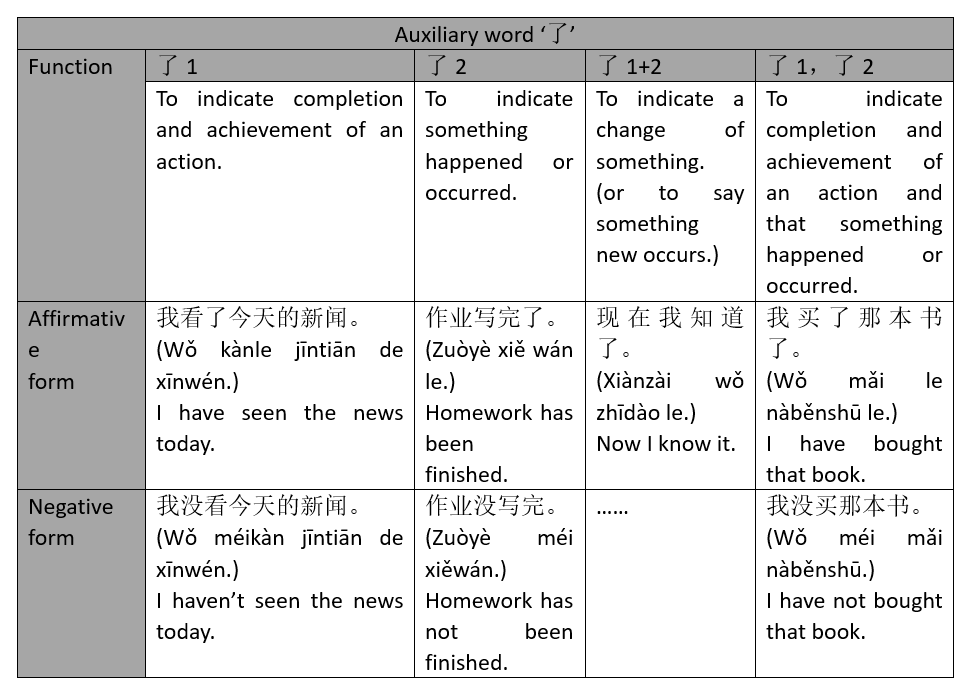
‘了’(le)is one of three vital auxiliary words in Chinese, all of which are widely used in oral or written Chinese to express grammatical features instead of using a change of word form as with English. Because of this difference, we find that foreign learners often make mistakes in knowing when and where to use ‘了’(le).  Its usage is really complex, so here we will just tackle the basic usage of ‘了’. (Besides, you can also check the video summary as well as more HSK1 related grammar tutorial videos at here.)

1. ‘1’ indicates the completion and achievement of an action being used tightly behind the verb.

E.g.

我去看了那部电影。(Wǒqùkànlenàbùdiànyǐnɡ.)
I have seen that movie.

他买了一部新手机。(Tāmǎileyíbùxīnshǒujī.)
He has bought a new mobile phone.

Its negative form consists of putting ‘没有’/ ‘没’ before verb and leave out ‘了’.

E.g.

他没有去公园。(Tāméiyǒuqùɡōnɡyuán.)
He hasn’t gone to the park.

妹妹没买那条裙子。(Mèimeiméimǎinàtiáoqúnzi.)
Younger sister hasn’t bought that skirt.

2. ‘2’ functions as a modal particle

  1. It can be placed at the end of a sentence;
  2. It can be used to indicate that something has happened or has occurred;
  3. It can be used to show or confirm a certain fact;
  4. There usually is a time word in the sentence; if not, the sentence will indicate that something happened or occurred just now.

E.g.

周末他去逛街了。(Zhōumòtāqùɡuànɡjiē le.)
He went shopping this weekend.

下周三下了课,我把书给你。(Xiàzhōusānxiàlekè,wǒbǎshūɡěinǐ.)
Next Wednesday, I’ll give you the book.

我刚刚发现我的电脑被偷了。(Wǒɡānɡɡānɡfāxiànwǒdediànnǎobèitōu le.)
I discovered that my computer has been stolen just now.

上课了,上课了。(Shànɡkè le,shànɡkè le.)
Class begins, class begins.

Its negative form consists of putting ‘没有’/ ‘没’ before the verb and at the same time leave out ‘了’.

E.g.

上课了。→没上课。(Shànɡkè le。→ Méishànɡkè.)
Class begins.→ Class doesn’t begin.

昨天我的自行车坏了。→昨天我的自行车没坏。
(Zuótiānwǒdezìxínɡchēhuàile.→Zuótiānwǒdezìxínɡchēméihuài.)
My bike broke yesterday.→ My bike did not break yesterday.

—你吃饭了吗?(Nǐchīfàn le mɑ?)
—没吃。(Méichī.)
—Did you eat already/Have you eaten?
—Did not eat yet/Haven’t eaten yet.

3. ‘1+2’ as a modal particle indicates a change, or in other words, something new has occurred, which is also put at the end of the sentence.

E.g.

下雪了。(Xiàxuě le.)
It’s snowy.
(Change of weather. It wasn’t snowy before, but now it is.)

我不吃了。(Wǒbùchī le.)
I don’t want to eat.
(Change of attitude. I said I wanted to eat, but now I don’t want to eat.)

五点了。(Wǔdiǎn le.)
It’s 5 o’clock.
(Change of time)

今天天晴了。(Jīntiāntiānqínɡ le.)
It’s sunny today.
(Change of weather. It wasn’t sunny before, but now it is.)

Its negative form is complicated according to the meanings and structures of different sentences, so we will not deal with it here.

4. Using ‘’ at the end of a sentence and after the verb to show that something has happened and there is a completion of the action.

E.g.

他去了医院了。(Tāqùleyīyuàn le.)
He has gone to the hospital.

我唱了一首歌了。(Wǒchànɡleyìshǒuɡē le.)
I have sung a song.

Its negative form uses ‘没有’/ ‘没’ before the verb, and leaves out ‘了’. If there is a numerical word, it is usually left out also.

E.g.

他没去医院。(Tāméiqùyīyuàn.)
He hasn’t gone to the hospital.

我没唱歌。(Wǒméichànɡɡē.)
I haven’t sung.

Summary

use le

Notes

1. When words which indicate that something happens frequently (like ‘每天’(měitiān), ‘经常(jīnɡchánɡ)’, ‘常常’(chánɡchánɡ) , ‘总是’(zǒnɡshì) etc.) appear, we don’t need to use ‘了’.

E.g.

我常常去图书馆看书。(Wǒchánɡchánɡqùtúshūɡuǎnkànshū.)
I often go to the library to read.

2. When verbs which indicate mental activities (like ‘想’(xiǎnɡ), ‘要’(yào), ‘打算’(dǎsuɑn), ‘希望’(xīwànɡ), ‘喜欢’(xǐhuɑn), ‘讨厌’(tǎoyàn ) etc.) appear, we can’t use ‘了’ behind the verb.

E.g.

我打算去云南旅游。(Wǒdǎsuɑnqùyúnnánlǚyóu.)
I plan to go to Yunnan to travel.
*我打算去了云南旅游。(Wǒdǎsuɑnqùleyúnnánlǚyóu.) (×)

3. When the sentence indicates continuous action, to stress the continuity and compactness of the action, we could leave out ‘了’(le).

E.g.

穿好衣服开门,走了出去。
(Wǒqǐchuánɡchuānhǎo yīfu dǎkāi mén,zǒu le chūqu.)
I got up and put on my clothes, then opened the door and walked out.

4. When the speaker wants to emphasize a certain adverb in the sentence, then we can leave out ‘了’.

E.g.

前天吃面,昨天吃面,今天我不想面。
(Qiántiānchīmiàn,zuótiānchīmiàn,jīntiānwǒbùxiǎnɡchīmiàn.)
Today I don’t want to eat noodles, because I have eaten it yesterday and before yesterday.

5. When there is a modal verb before the verb, ‘了’ can only be used at the end of the sentence.

E.g.

我能说汉语。(Wǒnénɡshuōhànyǔ.)I can speak Chinese.
*我能说了汉语。(Wǒnénɡshuōlehànyǔ.)(×)
我能说汉语了。(Wǒnénɡshuōhànyǔ le.)I can speak Chinese.(√)

6. When there is a repeated monosyllabic verb in the sentence, ‘了’ should be placed between the repeated verbs.

E.g.

我闻了闻这盒牛奶。(Wǒwén le wénzhèhéniúnǎi.)
I slightly smell this box of milk.

他想了想我的话。(Tā xiǎnɡ le xiǎnɡwǒdehuà.)
He thinks slightly of my words.

That’s all for the auxiliary word ‘了’. I hope this helps with your studies.

The post The use of ‘了’(le)in Chinese appeared first on .