Visiting the Ancient City of Pingyao

For those interested in Chinese history and culture, a great place to visit is the Ancient City of Pingyao (平遥古城 píng yáo gǔ chéng), located in central Shanxi province (山西省 shān xī shěng). Although the small city of the same name will be of little interest to travelers, the old town is a fantastic UNESCO World Heritage site, listed as “an exceptionally well-preserved example of a traditional Han Chinese city.” In fact, many consider the ancient walled town to be the best of its kind in China. This post is all about visiting the Ancient City of Pingyao and what you can do while there. But first, a little history lesson…
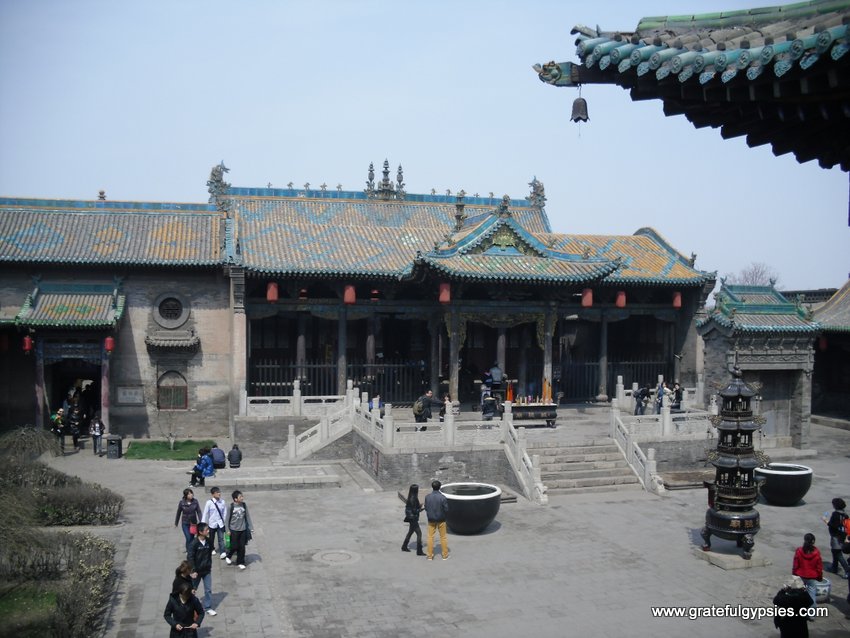
Wandering around Pingyao is a great trip back in time.

History of Pingyao

Pingyao was established way back in the 14th century when its city walls were constructed during the Ming Dynasty. Throughout the Ming and Qing dynasties, Pingyao was actually the financial center for all of China. At that time, Shanxi merchants had developed various trade routes both in China and abroad, and carrying their silver coins with them everywhere they went wasn’t exactly safe.

As such, the first exchange house in the country was established in Pingyao. Called a piaohao (票号 piào hào) in Chinese, these institutions provided remittance services, took deposits and made loans. The first one was called “Sunrise Prosperity” ( 日升昌 rì shēng chāng), and at its peak, it controlled almost half of the Chinese economy. There’s even a movie, titled “Empire of Silver” (白银帝国 bái yín dì guó) that tells the story of a banking clan in Pingyao during these boom times.

A nine dragon screen, a common sight in China.

The Ancient City

These days, the old city wall still stands, as do thousands of the traditional shops, dwellings, temples, and more. In an effort to preserve this historical and cultural gem, motorized vehicles are not allowed on the old cobblestone streets. While much of China’s history has met the bulldozer to make room for high-rise apartments and shopping malls, the ancient city of Pingyao managed to survive the country’s rush to modernization.

Aside from the tourists snapping photos with their smartphones and other modern sights, it’s easy to feel as if you’ve stepped back in time to the days of 19th century imperial China while strolling along the streets. The UNESCO status, granted in 1997, certainly helps there. Of course, with that status comes increased tourist numbers, and this small town is straining to meet the demand.
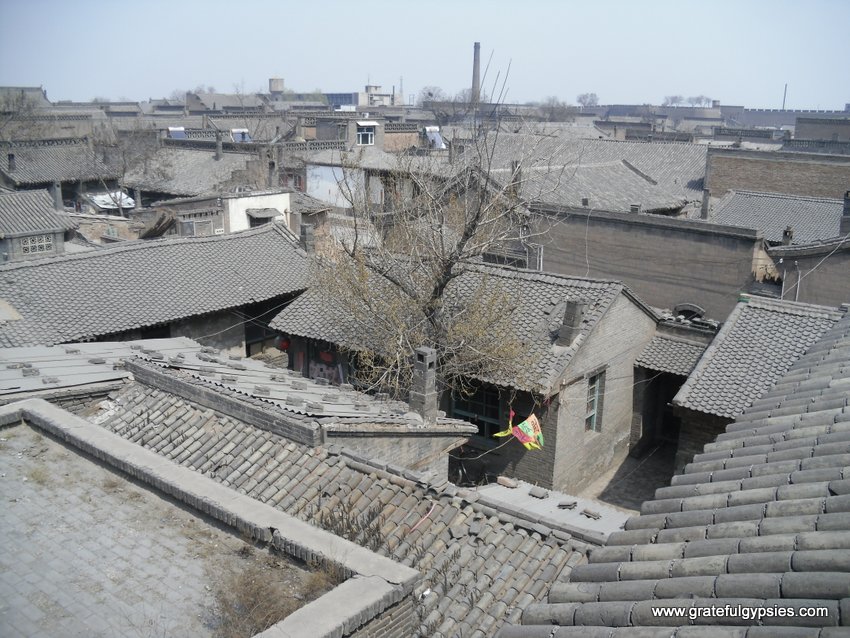
A view of Pingyao from above.

Visiting Pingyao

There are a few direct trains from Beijing to Pingyao every day. Your best bet is to take the K609 train, which leaves Beijing station at 11:51 PM and arrives the next morning around 9:30. This train has sleeper bunks, but they’re in hot demand so you’d better do your best to book in advance. Be sure to read this post about taking the train in China to learn the vocabulary necessary for buying tickets and for the journey itself.

Alternatively, you can take one of many daily high-speed trains from Beijing West to the provincial capital of Taiyuan (太原 tài yuán), from where you can easily hop on a bus and be in Pingyao in two hours.

In terms of getting around the ancient city, hoofing it is the best way to go. Without any cars on the roads, it’s quite pleasant to stroll around and take in the sights slowly. For a little bit of fun, you can also rent tandem bicycles to cruise the streets.
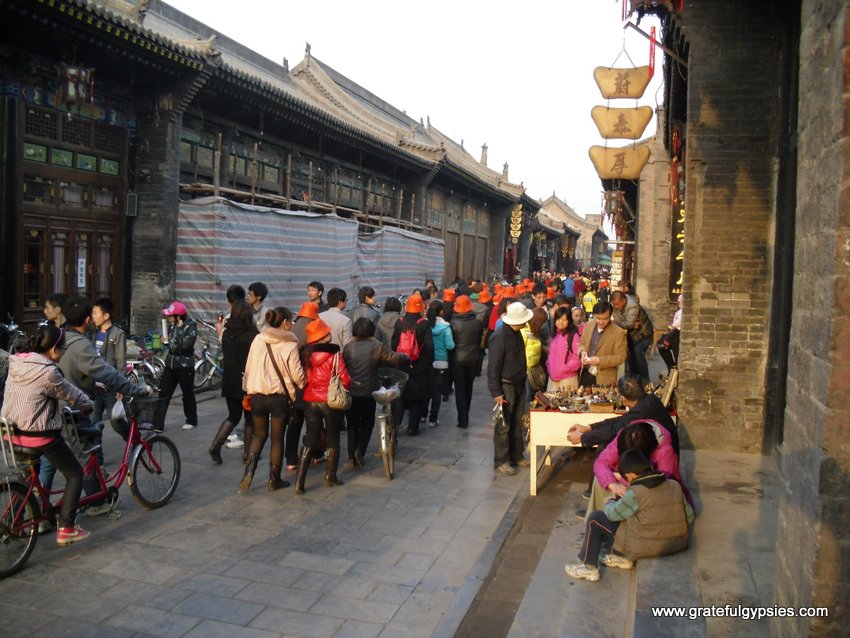
Here come the tour groups…

As far as sightseeing goes, there are plenty of temples, old shophouses, and more to keep you busy. There’s just one entrance ticket for the entire walled city, which will set you back 125 RMB. You can also take a stroll along the old city wall for a bird’s eye view of this traditional Chinese city. If you have more time, there are also two notable temples a few miles outside of the town – Shuanglin and Zhenguo.

There are plenty of guesthouses and hotels in Pingyao, as it is a wildly popular destination with Chinese tourists. More and more foreign tourists are including it on their China itinerary, but it’s still very much Chinese. When it comes to dining in Pingyao, you’ve got to try the specialty Pingyao beef (平遥牛肉 píng yáo niú ròu).

Shanxi is also famous for noodles, so you might as well try the “cat ear” (猫耳朵 māo ěr duo) variety. Don’t worry – no actual cat’s ears are used in the process, it’s just a clever name due to the appearance of the noodles.
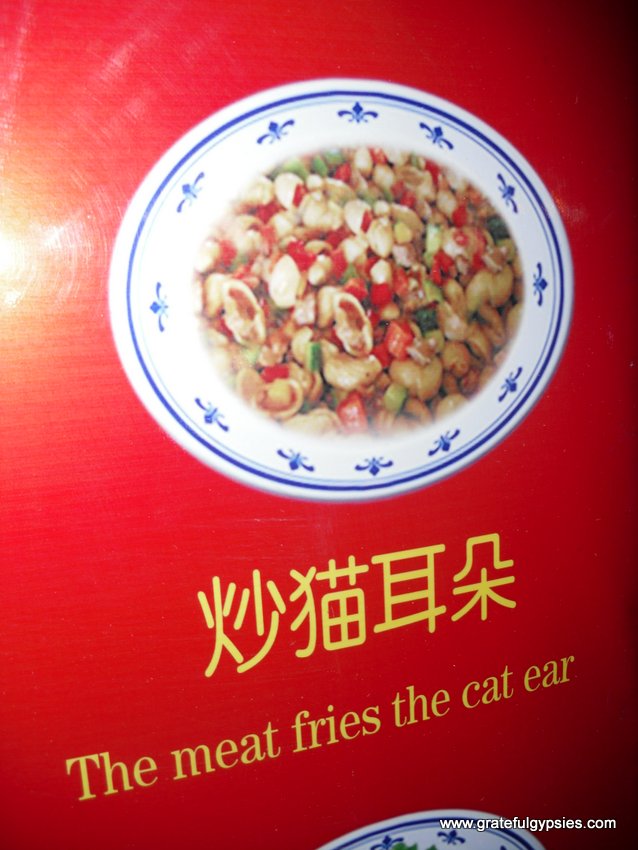
Not real cat ears.

Outside of the tourist attractions, you’ll have plenty of fun just wandering the streets and practicing your Chinese. There are tons of opportunities for silly photos, and you can even play some games in the street.

To give you more of an idea of what a weekend in Pingyao is like, here are two videos from my trip there a few years ago:

The post Visiting the Ancient City of Pingyao first appeared on Chinese Language Blog.
Eating Chinese Food in Italy

Now I’m traveling in Italy. Because Chinese people really like coming here, there’s a lot of Chinese food. (现在我在意大利旅游。因为中国人很喜欢来这里,所以有很多中国菜。 xiànzài wǒ zài yìdàlì lǚyóu。yīn wéi zhōngguó rén hěn xǐhuān lái zhèlǐ, suǒyǐ yǒu hěnduō zhōngguó cài). In this post, I’ll tell you all about eating Chinese food in Italy while teaching some useful expressions.

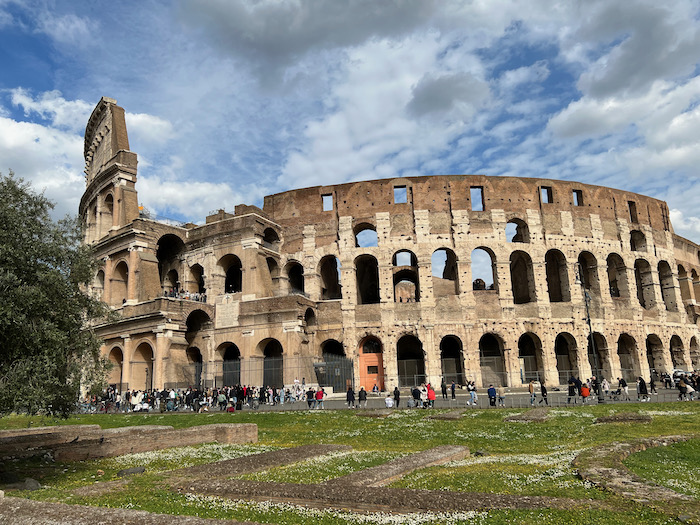
When in Rome…
Photo taken and used with permission from Sasha Savinov.

When in Rome…

Surely you’re familiar with that old expression – “When in Rome, do as the Romans do.” Well, I just finished up a week in Rome (罗马 luómǎ) and I definitely did my best to follow the local customs.

I ate a lot of pasta and pizza, and also drank many espressos (我吃了很多意大利面和披萨,也喝了几个浓咖啡 wǒ chīle hěnduō yìdàlì miàn hé pīsà, yě hēle jǐ gè nóng kāfēi).

There’s a Chinese idiom with a similar meaning to “When in Rome,” but it says nothing of the Italian capital. It goes like this:

入乡随俗
rù xiāng suí sú

If you translate this directly it basically means “when you enter a village, follow the local customs.” As you can see, it expresses the same meaning as the common English expression. There’s another way to say it in Chinese as well:

走乡随乡
zǒu​ xiāng ​suí ​xiāng​

Ok now that you know this important Chinese idiom, let’s move along with the story…

Finding Chinese Food in Italy

I love pizza and pasta and may have eaten my weight in both on this trip already. We are spending six weeks traveling around Europe (欧洲 Ōuzhōu) and we’ve been eating local food for almost every meal.

While it’s been great, once in a while I need some comfort food (舒适的食物 shūshì de shíwù). Yes, I’m American, but my comfort food isn’t hamburgers (汉堡包 hànbǎobāo) and hot dogs (热狗 règǒu). I get far more excited when I find a legit Chinese restaurant than I do when I see the golden arches.

We had a few hours to kill upon arriving in Rome before we could check into our Airbnb. Looking at the map around the main train station (火车站 huǒchē zhàn), I noticed many familiar Chinese characters (汉字 hànzì). By the way, have you read our post about the 100 most common Chinese characters?

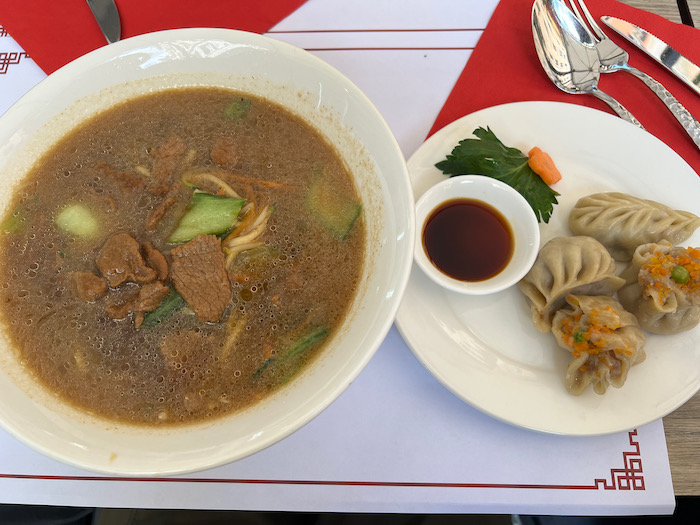
Noodles and dumplings!
Photo taken and used with permission from Sasha Savinov.

I read some reviews and perused the menu of one particular restaurant. My eyes lit up when I saw some of my favorite dishes from my years in China: lamb kebabs, dumplings, and pulled beef noodles (羊肉串儿,饺子,和牛肉拉面 yángròu chuàn er, jiǎozi, hé niúròu lāmiàn).

It wasn’t quite as good as what I’d order at my favorite Lanzhou restaurant in Beijing, but it was still delicious. They definitely cater more to the local tastebuds, just as Chinese restaurants do in the US.

Italians don’t really like eating spicy food (意大利人不太喜欢吃辣的 yìdàlì rén bù tài xǐhuān chī là de). We had to ask them for some chili sauce (辣椒酱 làjiāo jiàng) to fix the noodles to our liking.

Speaking of dumplings, you’re probably well aware of how much they mean to me. I even wrote a love letter to dumplings on the blog one year. In Italy, they’re listed on the menu as ravioli cinesi, or “Chinese ravioli.”

I always thought we had Marco Polo (马可波罗 mǎkěbōluó) to thank for bringing the idea of dumplings from China to Italy, but apparently, that’s historically inaccurate. Check out this interesting article for more about the history of dumplings.

We were so excited to find this place.
Photo taken and used with permission from Sasha Savinov.

Italian Jian Bing

Now back to my story about finding Chinese food here… We’re currently in Florence (佛罗伦萨 fóluólúnsà), which is a favorite of tourists (游客 yóukè) from China. Remember that Chinese expression we learned earlier? Well, it turns out a lot of people just want to eat what’s familiar. There are lots of Chinese restaurants here catering to tourists looking for a taste of home.

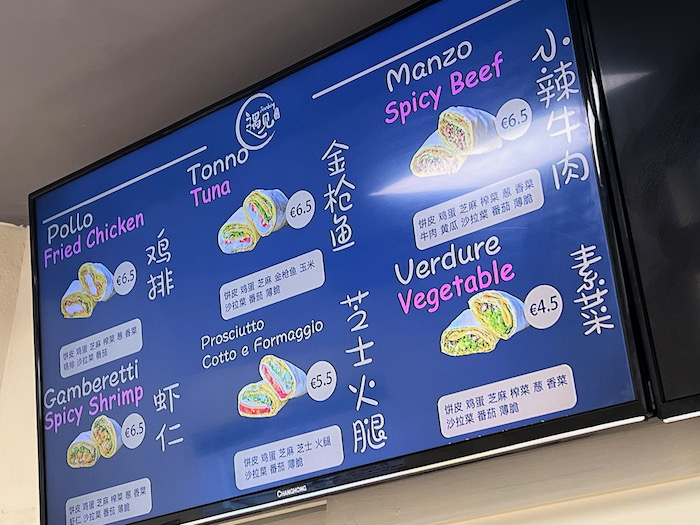
Once again scouring the map, I was super excited to find a place called “Meet Chinese Pancake” (遇见煎饼 yùjiàn jiānbing) just a 2-minute walk from our Airbnb. I used to eat a jian bing at least 2-3 times a week when I worked as an English teacher in Beijing. In fact, one of my first videos on the YouTube channel was about just that:

It had been about six years since the last time I got to bite into a tasty jian bing, so you can imagine my excitement. The couple that runs the shop is from Zhejiang province (浙江省 zhèjiāng shěng), and it was nice getting to practice my rusty Mandarin with them. She was quite impressed to find a few Americans in her shop in Italy speaking decent pu tong hua.

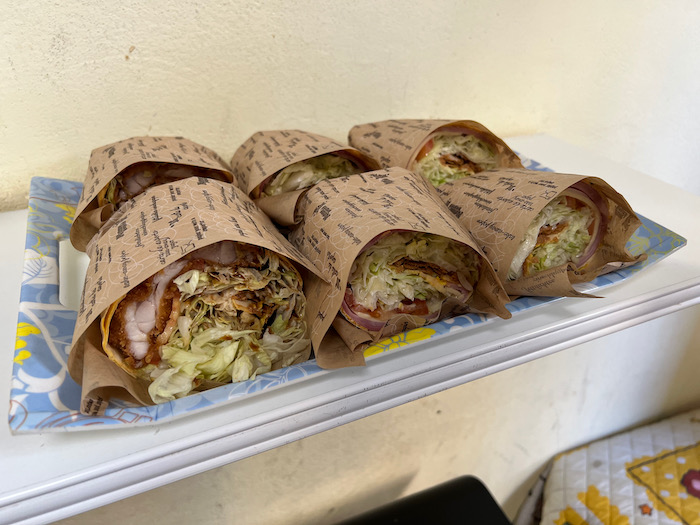
So how was the jian bing? It will never beat the guy with the ramshackle bicycle grill in front of my Beijing apartment, but it was good. It’s interesting how they combine Chinese and Italian flavors with their cheese and ham (芝士火腿 zhīshì huǒtuǐ) version of the famous Chinese street food. Once again, I found it a bit bland and needing some extra chili sauce.

Jian Bing with Italian characteristics.
Photo taken and used with permission from Sasha Savinov.

While I still miss the real deal, it’s been nice finding some familiar Chinese food in my travels around Italy. Where have you eaten Chinese food outside of China, and how did you find it? Leave a comment and let us know!

The post Eating Chinese Food in Italy first appeared on Chinese Language Blog.
Chinese Morning Exercises

Photo by Mikelmania from Pixabay.com, CCO

The Chinese phrase 晨练 is composed of two characters: (chén) that means morning, dawn; and (liàn) that means to practiceto exercise. Together 晨练 (chén liàn) means morning exercise.

晨练是早上进行的健身运动。

Chén liàn shì zǎo shang jìn xíng de jiàn shēn yùn dòng.

Morning exercise is the fitness workout one does in the morning.

The benefits of exercise are endless: improving health, strengthening the body, shaping the body, increasing self-confidence, raising the mood, and more. It’s true for 晨练 and it’s true for 黄昏练 (huáng hūn liàn, evening exercise). No matter how old you are or when during the day you exercise, you will always enjoy these benefits.

晨练有利身体健康。

Chén liàn yǒu lì shēn tǐ jiàn kāng.

Morning exercise is good for your health.

Compulsory 早操 (zǎo cāo, morning exercise) are part of every Chinese kindergarten and school. For the grown-ups, the public park replaces the schoolyard. Many people from all over China, especially the middle-aged and elderly people, went to the parks to work out at the beginning of the day. The morning scenes in central parks around China are lively. Early birds arrive even before six o’clock and start exercise (锻炼 duàn liàn). Many use the outdoor exercise bars for warming up, stretching, massaging, and performing some incredible fitness movements. Several videos went viral showing grandpas and grandmas (大爷大妈 dà yé dà mā) in great shape, displaying flexibility and strength. As in this video:

晨曦,公园就已经好热闹。

Chén xī, gong yuán jiù yǐ jīng hǎo rè nào.

At dawn, the park is already very lively.

中老年人参加晨练活动。

Zhōng lǎo nián rén shēn jiā chén liàn huó dòng.

Middle-aged and elderly people take part in morning exercise activities.

Beside the impressive 大爷大妈 working out on the exercise bars, you can also see people practicing many kinds of sports: square dancing, badminton, diabolo, devil sticks dance, jianzi, and so on.


Text vocabulary

晨练 chén liàn = morning exercise

黄昏练 huáng hūn liàn = evening exercise

早操 zǎo cāo = morning exercise

锻炼 duàn liàn = to work out, to exercise

进行 jìn xíng = to do, to conduct

健身运动 jiàn shēn yùn dòng = fitness activity

好好学习,天天向上!

The post Chinese Morning Exercises first appeared on Chinese Language Blog.
A Perfect Day in Beijing

Beijing is a massive, sprawling city that’s home to over 20 million people. As such, it can be an overwhelming place to explore. Having spent half a decade calling the city home, I’m here to help you plan a trip to the Chinese capital. In this post, I’ll share my advice for how to spend a perfect day (完美的一天 wánměi de yītiān) in Beijing.

Morning (早上 zǎoshang)

The early bird gets the worm (早起的鸟儿有虫吃 zǎoqǐ de niǎo er yǒu chóng chī). This is a great phrase to take to heart when plotting a day in Beijing. It’s worth suffering through the early alarm clock to get out there before the worst of rush hour (高峰时间 gāofēng shíjiān). Unless you enjoy being crammed like a sardine in a subway car, it’s best to avoid public transport for those couple of hours.

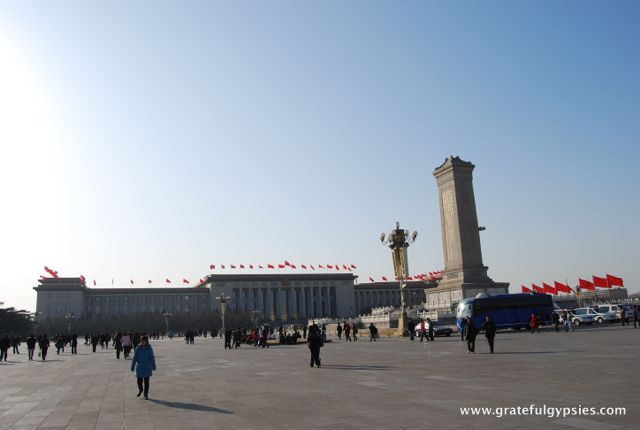
Tiananmen – the heart of China.

Getting out early means you can take part in a time-honored Beijing tradition – the flag-raising ceremony (升旗仪式 shēngqí yíshì) in Tiananmen Square (天安门广场 tiān’ānmén guǎngchǎng). It happens at sunrise, so once it’s finished you’ve got plenty of morning left to explore this corner of the city.

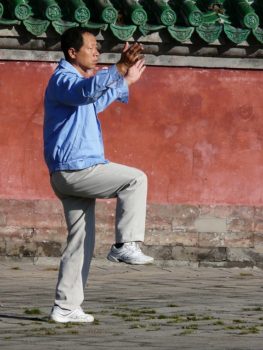
Another option is the Temple of Heaven (天坛 tiāntán). It’s a popular place to come do morning exercise and there’s not as big of a crowd as there is for the flag-raising ceremony. You still get to see one of the most iconic places in China to start your day, which is pretty awesome.

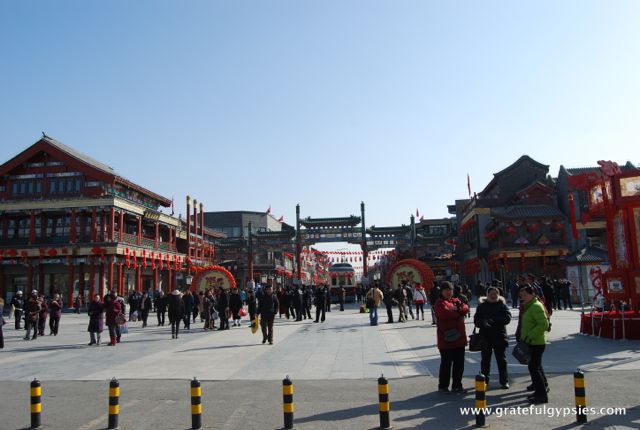
Take a stroll along Qianmen Street.

After leaving the square, it’s worth it to take a stroll along Qianmen Street (前门大街 qián mén dà jiē). This famous pedestrian street is now a tourist attraction and home to international brands like Starbucks. The real fun here is tucking down the random alleyways, known as hutong (胡同 hútòng) in Chinese.

While many have been torn down in the name of progress in recent years, it’s still possible to find hutong where life goes on much as it did hundreds of years ago. Pop into a local restaurant for a breakfast of steamed stuffed buns (包子 bāozi) and some soybean milk (豆浆 dòujiāng) before moving on.

Exploring the Central Axis of Beijing

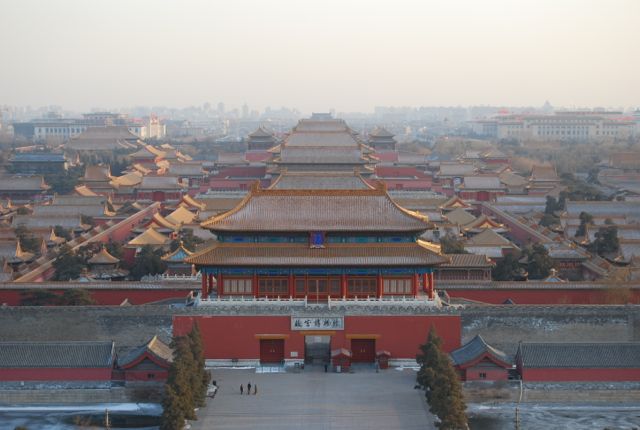
View of the Forbidden City from Jingshan Park. Photo taken and used with permission from Sasha Savinov.

Afternoon (下午 xiàwǔ)

One of the best ways to soak up the local culture (当地文化 dāngdì wénhuà) in Beijing is by heading to one of the city’s many parks. One of my personal favorites is Jingshan Park (景山公园 jǐngshān gōngyuán). You’ll see people here doing tai chi (太极 tàijí), flying kites, practicing water calligraphy, and much more.

Best of all, you get a panoramic view of the Forbidden City (紫禁城 zǐjìnchéng) from the top of the hill without bothering with the long lines and huge crowds. On a rare clear day, it’s hard to beat the view of Beijing from atop this hill.

Peaceful Beihai Park

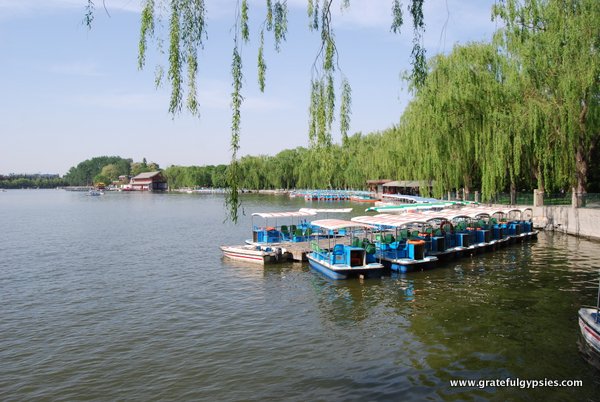
Right next door is the tranquil Bei Hai Park (北海公园 běihǎi gōngyuán), a former imperial garden. The name means “North Lake,” and while I’d consider it more of a pond, it’s still a pleasant place to visit. You can rent a paddleboat here to enjoy a spin around the lake and check out the impressive White Dagoba.

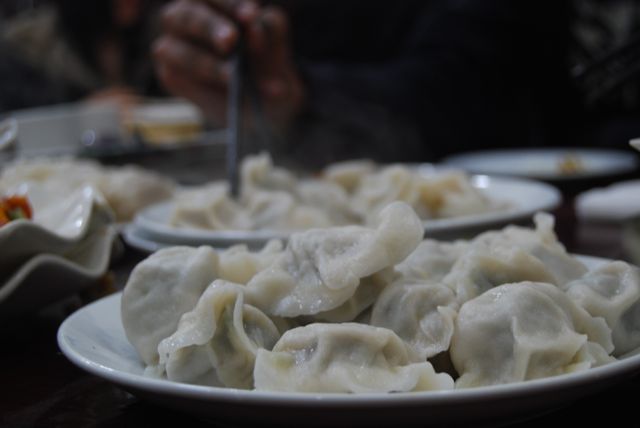
All of that walking is sure to leave you hungry. You don’t have to go far to find a delicious, cheap lunch in this part of the city. I always love a good plate of dumplings (饺子 jiǎozi) and you can’t go wrong with a big bowl of hand-pulled beef noodles (牛肉拉面 niúròu lāmiàn).

A tasty plate of dumplings.
Photo taken and used with permission from Sasha Savinov.

Evening (晚上 wǎnshàng)

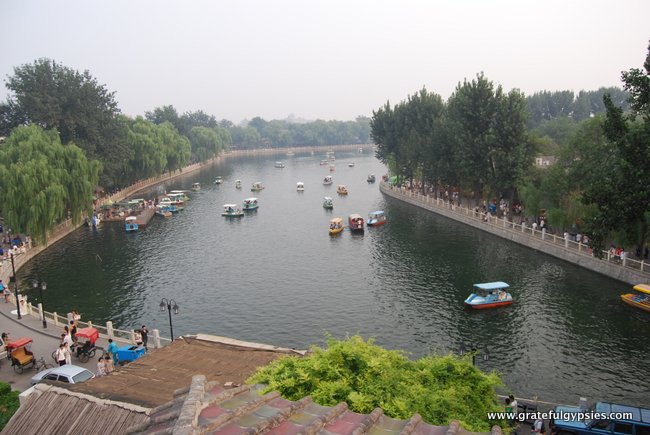
One of the best ways to enjoy the sunset (日落 rìluò) in Beijing is by walking around the Hou Hai area. If you didn’t get a boat at Bei Hai, definitely get one here and paddle around as you watch the sun go down and the neon lights come on. Then promptly get out of there before all the bars in the area turn their music up to an obnoxiously loud level.

It’s time for a drink, but not a lukewarm bottle of Yanjing. Instead, head to local craft beer establishment Great Leap Brewing (大跃啤酒 dà yuè píjiǔ). They were the first on the now-booming craft beer scene in the Chinese capital and now have several locations to choose from.

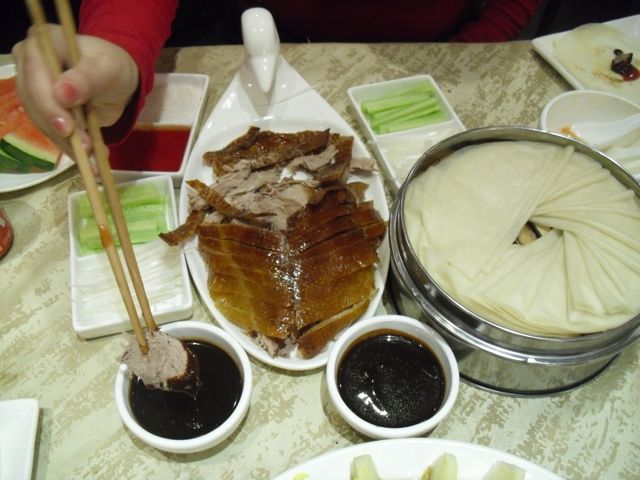
Beijing roast duck is amazing!
Photo taken and used with permission from Sasha Savinov

A few pints of this stuff will surely leave you with an appetite. When one is trying to plan a perfect day in Beijing, the only reasonable option is the imperial bird. I’m talking, of course, about Beijing roast duck (北京烤鸭 běijīng kǎoyā).

There are tons of restaurants cooking the city’s famous fowl, but my personal recommendation goes to Da Dong (大董 dà dǒng). Not only are their ducks crispy and perfect here, but their menu is impressive with tons of classic and innovative Chinese dishes. Your taste buds are in for a real treat when you dine here!

If you’re not in too big of a food coma after that dinner, there are plenty of bars and clubs to choose from. My favorite areas for nightlife are Nanluoguxiang (南锣鼓巷 nán luógǔ xiàng) and Sanlitun (三里屯 sānlǐtún), although I’ve heard both have changed quite a bit since my time in Beijing. If you make it to either place to party it up, please report back and let me know how it is.


There you have it – a perfect day in Beijing. I miss that crazy, polluted, overcrowded mess of a city sometimes. It’s not the easiest place to visit, but it sure is a fascinating one! Leave any comments or suggestions you may have for a perfect day in Beijing in the comments. We’d love to hear them!

The post A Perfect Day in Beijing first appeared on Chinese Language Blog.
Summer Fun in And Around Beijing

Summer is right around the corner (夏天就在拐角处 xiàtiān jiù zài guǎijiǎo chù). It’s definietly my favorite season (季节 jìjié). Get ready for it by brushing up on your Chinese summer vocabulary. In this post, we’ll dive into all the options for summer fun in and around Beijing (北京 běijīng).

Summer fun on Houhai.

Summer Fun in the City

The winter (冬天 dōngtiān) months in Beijing are brutal, so people like to get out and enjoy the warm weather while it lasts. There are tons of things to do in the city that are more fun in the summer, so get out there and take advantage of it!

Check out some of the parks and temples, play games in the street, or take a boat out on Houhai (后海 hòuhǎi). Wander through the maze of hutong (胡同 hútòng) – Beijing’s traditional alleways – and take in the local culture (地方文化 dìfāng wénhuà). You’ll find men playing chess or elders practicing water calligraphy.

In the evenings, it’s all about the music, as people congregate in local parks to boogie down. Square dancing (广场舞 guǎngchǎng wǔ) is definitely a favorite summer pastime across the country. You’ll see a clip at the end of this very old school video from our YouTube channel:

Go For a Hike

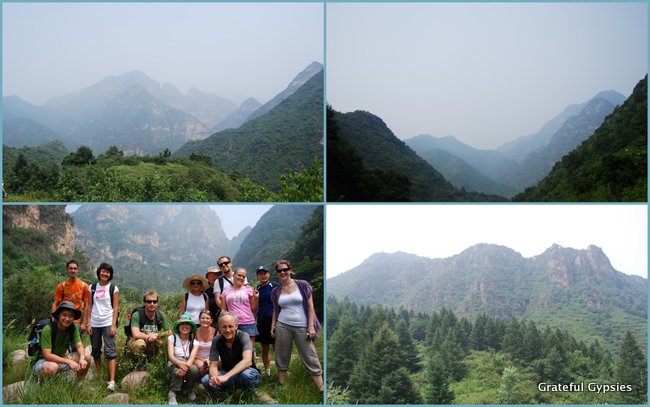
There are many great hiking opportunities in the Beijing area, as the city is actually surrounded by mountains. For many city-dwellers, a popular summer activity is heading out of the city to hike/climb (爬山 páshān). While the heat of summer in the concrete jungle (混凝土丛林 hùnníngtǔ cónglín) can be a bit intense, it’s usually much cooler up in the mountains.

If you’ve got the initiative and can surf the ‘net in Chinese, it’s possible to plan hiking trips on your own, as public buses will take you just about anywhere. However, if you’d rather just join a group and have all of the tedious planning work taken care of, you’ve got lots of choices. There are hiking groups that head out on trips 3-4 times a week from the city in the summer months. Escaping the traffic jams and crowds for at least a few hours is great, and it’s good exercise (锻炼 duànliàn) as well.

Nature and new friends on a summer hike.

Head to the Beach

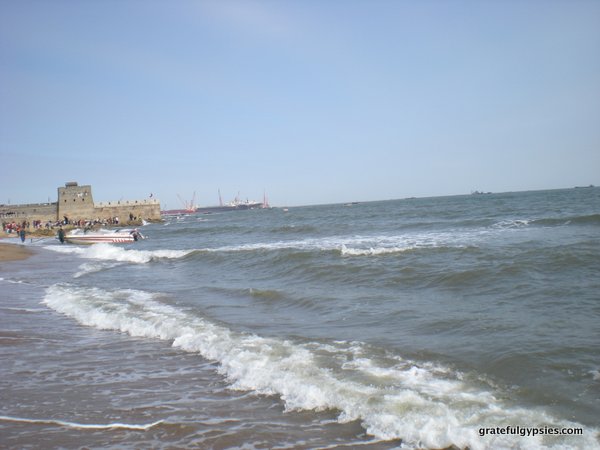
Beijing really isn’t that far from the coast, so you can get to the beach (海滩 hǎitān) in a matter of hours. The fastest and easiest option is to head to either Beidaihe (北戴河 běidàihé) or Nandaihe (南戴河 nándàihé) in Hebei province. Once a popular retreat for Communist party leaders, this area makes for a nice weekend escape.

Don’t expect the nicest beaches in the world, but it’s fun to hang out here for a few days and much cheaper than flying to Thailand. While laying on the beach, drinking Yanjing beer, and having seafood BBQs are great, make sure you take at least one day to visit Shanhaiguan (山海关 shānhǎiguān). This is the part of the Great Wall (长城 chángchéng) that meets the sea and is a cool place to visit.

Shanhaiguan

Camp on the Great Wall

Speaking of the Great Wall, why not just go have a camping (野营 yěyíng) trip on it? Many people are surprised to find out that this is actually allowed on a few sections. Pack up your tent, sleeping bag, and a little picnic, and head out for an adventure.

Based on my two experiences, I’d recommend the Gubeikou (古北口 gǔběikǒu) section. It’s a bit tricky to get out there, but all of the hard work pays off when you get to watch the sunset over one of the Seven Wonders of the World and then retreat to your tent in a watchtower to gaze at the stars. Check out some highlights in this video, which is one of my favorites I’ve made for the TL Chinese channel:

Hit a Beer Festival

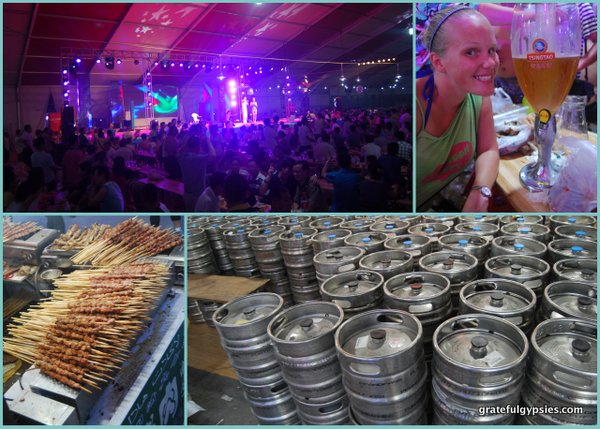
Lots of cities in China now host beer festivals (啤酒节 píjiǔ jié) in the summer months, but the biggest and most famous one is definitely in Qingdao. Home to China’s first beer – Tsingtao (the old Wade-Giles format of spelling Chinese characters is still used) – this seaside city in Shandong province gets wild for a few weeks every summer as thousands of people pack into tents to sing along to pop music, munch on kebabs, and drink absurd amounts of beer.

After attempting to swim through the literal sea of people on the beaches here, you’ll probably need a few beers anyway. Not many foreigners make it here, so it’s easy to make friends (who will most likely give you lots and lots of free beer). Just make sure you book an extra day to recover because the hangover (宿醉 sù zuì) will be brutal. For a more detailed account of the Qingdao Beer Festival, click here.

Beer and meatsticks!

Rock Out

Summer music festivals (音乐节 yīnyuè jié) are all the rage in China now, so why not check one out? From folk to heavy metal to drum & bass, just about every style of music is represented in the Middle Kingdom these days.

Some festivals go on in the city, while others take place in more remote locations where camping is available. I’ve had some wild times going to Chinese music festivals over the past few years – from getting lost and sleeping in a KTV, to sharing french fries with an Aussie metal band, to getting wild near the Great Wall with some international DJs. You can see what that experience was like by checking out this video:


That does it for our look at summer fun in and around Beijing. As you can see, there’s plenty to do to keep you busy for a few months! Let’s finish up with a practice question:

夏天的时候你喜欢做什么?
xiàtiān de shíhòu nǐ xǐhuān zuò shénme?
What do you like to do in the summer?


The post Summer Fun in And Around Beijing first appeared on Chinese Language Blog.