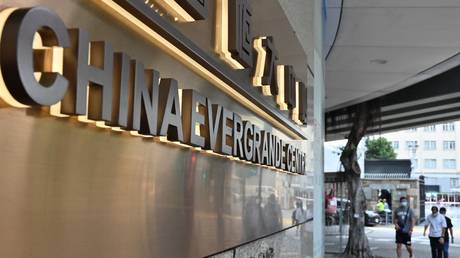
Six top managers of Chinese real estate major Evergrande had redeemed some of its investment products in advance earlier this year, the company said on Saturday, a day after it admitted to a risk of going bankrupt.
Earlier this week, Evergrande said it was under “tremendous pressure” and may not be able to meet its crippling debt obligations.
The executives, who haven’t been named, made early redemptions of 12 investment products between May 1 and September 7, the heavily indebted property group said in a statement, providing no details on the nature of the products.
“Regarding the early redemption of Evergrande wealth investment products by some managers, the group company views the matter seriously,” the corporation said.
The group also warned of severe penalties in case the redeemed funds are not returned within a certain time frame.
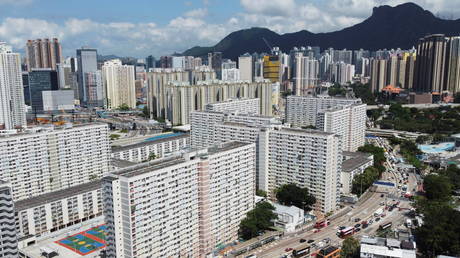
Evergrande, China’s second-largest real estate developer by sales, is facing a mounting liquidity crisis, forcing it to raise extra funds to pay lenders and suppliers. The company’s debts have reportedly ballooned to more than $300 billion.
Evergrande’s case is the embodiment of China’s freewheeling epoch of borrowing and building. Uncertainty over the developer’s ability to meet its funding obligations, which is reportedly equal to 2% of China’s gross domestic product, has triggered market turbulence.
The corporation has been hit by ratings downgrades, with both S&P Global Ratings and Fitch Ratings warning of the risk of default. The company’s shares have plunged nearly 80% so far this year, with trading of its bonds repeatedly halted by Chinese stock exchanges in recent weeks.
Chinese real estate developer Evergrande has reportedly begun repaying investors in its wealth management products with property, as the giant appeared to be on the brink of collapse.
Investors interested in redeeming wealth management products for physical assets should contact their investment consultants or visit local offices, a unit of the company’s main Hengda Real Estate Group Co Ltd unit said in a WeChat post dated Saturday.
The embattled corporation reportedly has an estimated 40 billion yuan ($6 billion) in outstanding Evergrande wealth management products.
Proposed methods of payment and details are subject to local conditions, a customer service representative told Reuters, while the earlier outline seen by the agency revealed that wealth management product investors can choose from discounted apartments, office, retail space or car parks as a form of repayment.
Evergrande repaid nearly 220 million yuan ($34 million) in overdue debts due to supplier Skshu Paint Co in the form of apartments in three unfinished property projects, a stock exchange filing revealed earlier this month.
Evergrande, China’s second-largest real estate developer by sales, is currently in the midst of its worst liquidity crisis. The company’s debts have reportedly ballooned to more than $300 billion. Last week, the property group had vowed to repay all of its matured wealth management products as soon as possible.
Gold production in Russia in January to June decreased by 1.9% compared to the same period last year, amounting to 135.51 tons, the country’s Ministry of Finance said.
The figures are based on raw materials supply data from Russian refineries.
Production of mined gold in the reporting period amounted to 112.61 tons, against 116.38 tons in January to June 2020, while production of by-product gold stood at 7.42 tons against 8.27 tons last year. Production of secondary gold in the first six months of the year increased to 15.48 tons, against 13.45 tons in 2021.
Meanwhile, silver production increased in the reporting period by 1.8%, rising to 445.18 tons, compared with 437.3 tons in 2020.
Russia’s Ministry of Finance has been publishing statistics on the country’s production of precious metals since 2014. However, it does not provide data on gold-bearing concentrates that are exported for processing and are not returned to Russian refineries.
Securities and Exchange Commission Chairman Gary Gensler assured the Senate that the regulator is working overtime to create a set of rules to take control of the volatile cryptocurrency markets.
Democrats and Republicans are united in their stance that the government needs to act in order to protect investors.
Boom Bust co-host Christy Ai is joined by Jeffrey Tucker of the Brownstone Institute to explore when and how the US government plans to regulate the world of crypto.
Russia and the Association of Southeast Asian Nations (ASEAN) have adopted a roadmap for boosting mutual trade and investment cooperation for the next five years, Russia’s Ministry of Economic Development announced.
“The pandemic has demonstrated that we can overcome the crisis only by means of scaling up cooperation in three key areas – trade and investment, digital economy, and sustainable development,” the ministry’s press service reported, citing Deputy Minister Vladimir Ilyichev.
According to the official, despite the Covid-19 pandemic, investments in joint Russia-ASEAN projects saw more than a threefold increase in 2020 compared to 2019, reaching $8.8 billion.
Ilyichev said that both ASEAN member states and Russia need to modernize their respective economic models to ensure more efficient cooperation. Also, he stressed that Russia sees great potential in joint work on climate-related projects under the plan.
According to the ministry, cooperation between the Eurasian Economic Union (EAEU), of which Russia is a member state, and ASEAN will also see changes in the near future.
“The sides (ASEAN and EAEU) agreed to draft a number of initiatives in the areas of the development of the single-window systems, e-trade, intellectual property protection, as well as the use of sanitary and phytosanitary measures,” the ministry said.
At the Eastern Economic Forum in Russia’s Vladivostok earlier this month, a proposal was unveiled to establish a free-trade zone between ASEAN and the EAEU in order to boost regional cooperation further.