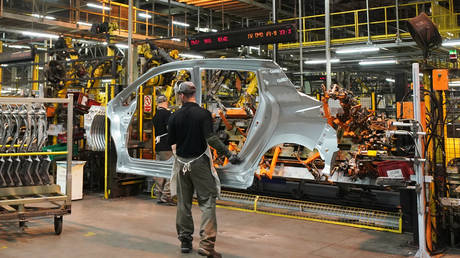
Key vehicles and eight factories in US, Mexico and Canada will be affected
Major US carmaker Ford will suspend or cut production at eight of its factories in the US, Mexico and Canada for at least one week, a spokeswoman told Reuters on Friday.
Factories in Michigan, Chicago and in Cuautitlan, Mexico will stop work, while the Ford factory in Kansas City will run only one shift for the production of Ford Transit cargo vans. The carmaker also plans to reduce the schedule at factories in Dearborn, Kentucky and Louisville, and has slashed overtime at the Oakville factory in Canada. The changes will lower the output of vehicles such as Ford Bronco and Explorer SUVs, as well as the Ford F-150 and Ranger pickups, the Ford Mustang Mach-E electric crossover and the Lincoln Aviator SUV.
The company says the semiconductor chip shortage is to blame for the changes, which are planned to be in place for one week, starting on February 7.
Also due to the chip shortage, Ford missed Wall Street expectations when it reported fourth-quarter earnings results earlier this week. The carmaker’s shares plunged 9.7% on Friday, but started to crawl back up in the after hours trading, regaining 0.67%. Ford warned that the persistent shortages would lead to a further drop in its vehicle production in the current quarter, ending in March. The company has forecast a slower recovery in car production in the first half of 2022, but was hopeful that output volumes will increase by year’s end.
The US Treasury Department says the rapidly growing token market could facilitate the illicit art trade
The US Department of the Treasury says the non-fungible tokens (NFTs) market could become a platform for money laundering using high-value art in a study published on Friday.
“The emerging digital art market, such as the use of non-fungible tokens (NFT), may present new risks, depending on the structure and market incentives,” the department stated in a press release. NFTs are units of digital data stored and traded online, which mostly comprise photos, videos and audio recordings.
In their 40-page study, analysts say high-value art is already used for money laundering but, most likely, not for financing terrorism. Physical art is easy to transport, and a number of art pieces have already been used to cover up illegally obtained funds, the study said.
Meanwhile, NFTs and the broader digital art sector could be used to facilitate more illegal transactions in the high-value art market, the study suggests.
“Recent sales of high-profile pieces of physical and digital art involving NFTs, including NFT-authenticated works such as Beeple’s ‘Everydays: The First 5000 Days’, which sold at a Christie’s auction for more than $69 million, indicate that this nascent art sector has reached similar valuations as traditional art mediums,” the document read.
The authors stated that licensed auction houses and art dealers “are increasingly offering NFTs,” pointing to platforms like Dapper Labs, OpenSea and SuperRare. However, if these platforms are considered virtual asset service providers (VASP) by the Financial Action Task Force (FATF), and are regulated as such, they may become subject to existing anti-money laundering (AML) laws. Still, the study says there are ways for art-related digital transactions to bypass regulators.
“NFTs can be used to conduct self-laundering, where criminals may purchase an NFT with illicit funds and proceed to transact with themselves to create records of sales on the blockchain. The NFT could then be sold to an unwitting individual who would compensate the criminal with clean funds not tied to a prior crime,” the study explained. Also, smart contracts designed to automatically send royalty payments to the content-maker every time the NFT is sold could encourage transactions that avoid regulations, while auction houses may not be able to keep up with all transactions or verify buyer identities, the analysts warned.
While the study did not outline specific regulatory recommendations, it did suggest that the Treasury Department should consider applying anti-money-laundering and counter-terrorist financing rules to the art market, including rules on customer identification and suspicious activity reports.
The NFT market saw $1.5 billion in trading in the first quarter of 2021, compared to some $20 billion in the physical US art market in 2020.
The index of global food costs advanced 1.1% last month
A new report by the Food and Agriculture Organization (FAO) of the United Nations showed that global food prices soared last month, led by a jump in vegetable oils and dairy. The index of prices, up by 1.1%, is edging closer to 2011’s all-time high, the research showed.
The fallout from an energy crisis, reduced export availability, and other supply-side constraints, especially labor shortages and unfavorable weather, have pushed prices higher, the FAO said.
The vegetable oils index surged 4.2% month-on-month in January to reach record levels. Quotations for all major oils rose, supported in part by rising crude oil prices. The dairy price index also increased 2.4%, its fifth consecutive monthly rise, with the steepest gains registered by skim milk powder and butter. The cereal price index was up just 0.1%, with maize posting a 3.8% gain on the month, according to the FAO.
Meat prices edged up in January, while the sugar price index decreased 3.1% from the previous month due partly to favorable production prospects in majorexporters India and Thailand, the report said.
Meanwhile, world wheat prices dropped 3.1% on the back of large harvests in Australia and Argentina. “For 2022, global wheat plantings are expected to expand, buoyed by mostly conducive weather conditions in the northern hemisphere, although high input costs could deter a larger expansion,” the FAO said.
The UN body has raised its projection of global cereal production in 2021 to 2.793 billion tons from a previous estimate of 2.791 billion tons.
Higher food prices have contributed to a broader surge in inflation as economies recover from the Covid-19 crisis. The FAO has warned that higher costs are putting poorer populations at risk in countries reliant on imports.
Bilateral commerce smashed a record high last year
China wants to boost bilateral trade to $250 billion a year. The goal was voiced by Chinese President Xi Jinping during a meeting with Russian President Vladimir Putin, according to Kremlin spokesman Dmitry Peskov.
“For China, this is not so much, but for [Russia] it is a very ambitious goal,” Peskov said, adding that the task is quite achievable. He pointed out that the trade turnover between the two countries hit a historic high of $140 billion in 2021.
Russian and Chinese leaders had previously set a target of doubling the volume of trade from $100 billion (reached in 2018) a year to $200 billion by 2024.
China has been the main importer from Russia of non-primary, non-energy goods since 2016. According to the Russian Export Center (REC), deliveries of those have been growing for seven consecutive years, and the trend has continued through 2021. Copper, aluminum, fertilizers, lumber, oilseeds, paper, and cardboard were among the products most purchased by China, the REC said.
The firm is yet to decide whether it would be willing to accept any offers
Tech giant Amazon and sportswear brand Nike are considering making separate bids for the struggling American home workout brand, Peloton, according to reports in the Financial Times and Wall Street Journal on Friday. The brand has seen sales dwindle and its share price collapse in the past 12 months.
The New York-based firm, whose sales of exercise bikes and treadmills soared during Covid lockdowns, is unsure whether it would accept any offers.
Amazon decline to confirm if a bid for Peloton was being considered. “We don’t comment on rumours and speculation,” a spokesperson told the BBC on Monday. Neither Pelton or Nike have commented on the speculation.
Peloton’s fortunes have changed for the worst over the last 12 months after a promising 2020 when people were confined to their homes for months on end and gyms were closed due to the pandemic.
With appetite for its bikes and treadmills dwindling, Peloton’s market value collapsed from nearly $50 billion 12 months ago to less than $8 billion last week.
In August the firm reported that its losses had widened as revenue growth slowed. It also announced that it would be cutting the price of its flagship bike by 20% to $1,495 (£1,105).
That same month, the US Department of Justice and the Department of Homeland Security announced an investigation into the firm, after a child was pulled under one of its treadmills and was killed.
Pelton warned in November that it expected revenue growth to slow further into 2022. “The primary drivers of our reduced forecast are a more pronounced tapering of demand related to the ongoing opening of the economy, and a richer than anticipated mix of sales to our original bike,” it said in a recent letter to shareholders.
The brand endured a turbulent winter as Mr. Big, a character from HBOs ‘Sex and the City’ and its sequel series ‘And Just Like That,’ was killed off after a Peloton workout, sending shares plunging. Peloton responded with an advert, featuring Mr. Big actor, Chris Noth, in which it emerged that he had not died, but run off with a mistress.
The advert was later pulled following two claims of historic sexual assault made against Noth.
Peloton’s share price jumped in after-hours trading on Friday following reports that bids may be incoming.