Coffee giant’s decision to reverse vaccine requirement for employees sparks backlash from some patrons and workers
The world-famous coffee giant Starbucks has come under fire for scrapping the Covid-19 vaccine mandate, with calls to ‘boycott Starbucks’ flooding social media.
Both customers and Starbucks baristas say they refuse to support a place, no matter how iconic, which does not require employee vaccinations.
“Who wants unvaccinated people handling your food and drinks?” wrote one Twitter user, while others bitterly joked with the idea of “Starbucks now serving Covid-19 with that delicious hot coffee.”
The public reaction was sparked by Starbucks’ decision to go back on its previously announced plan to require all its US workers to be vaccinated against Covid-19 by February 9 or submit to weekly testing. The company scrapped the plan after the Supreme Court earlier this month ruled against the vaccine mandate proposed by President Joe Biden’s administration for large businesses. Without the mandate, firms are left to decide how to counter the spread of the pandemic internally.
“We respect the Court’s ruling and will comply,” John Culver, head of Starbucks in North America, said in a note to employees on Tuesday. Culver noted, however, that Starbucks workers are still encouraged to get vaccinated. He added that the “vast majority” of Starbucks’ roughly 200,000 US employees have been fully vaccinated already, but did not give specific numbers.
The firm’s employees have not been happy with management’s decision, staging a walk-off earlier this month over “Covid-19 safety concerns that the company rebuffed” at a Starbucks in Buffalo, New York, the company’s first unionized store. The union – Starbucks Workers United – formed just last month, representing two Buffalo-area Starbucks stores. It slammed the company’s reversal on the vaccine mandate, stating that the decision was made without employee feedback.
Starbucks declined to comment on the public backlash regarding the mandate decision when asked by Yahoo Finance. The company introduced a number of Covid-19 safety protocols this week, including the requirement for workers to wear three-layered medical grade masks and the expansion of self-isolation policy. Starbucks also continues to offer two hours of paid leave for employees getting vaccinated.
Ukraine-related penalties may include the banning of Russian arms sales as well as curbing energy exports
The US is reportedly trying to convince its allies to impose new sanctions against Russia if a war with Ukraine breaks out. These would target arms and energy exports, costing Moscow around $50 billion, German tabloid Bild reported citing unnamed sources.
The drastic step was reportedly proposed by William Burns, the head of the CIA, during his visit to Berlin. US officials reportedly asked the German government to ban imports of Russian raw materials and block the launch of the Nord Stream 2 pipeline.
Berlin assured the US that in the event of an invasion of Ukraine, Russian gas would not go through the Nord Stream 2 pipeline, the sources told the media. However, the chancellor’s office voiced doubts over completely abandoning the vital pipeline. The remark caused irritation in Washington, Bild reported.
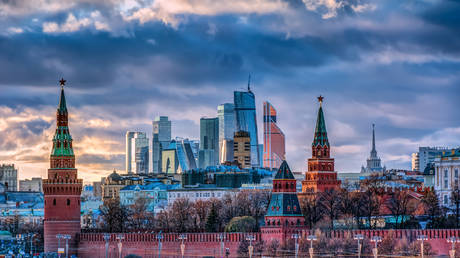
Over the past few months, a wide range of Western media outlets, along with multiple US officials, have been spreading speculation about an imminent Russian invasion of Ukraine. Washington and some of its allies threatened the Kremlin with a new round of ‘crippling’ sanctions if this happens, citing the movement of Russian troops within the country’s vast Western territory as evidence of the plan. Moscow has consistently rejected the accusations, saying it has a right to carry out military maneuvers as it pleases within its borders.
Bitcoin’s sharp sell-off is reminiscent of the great crypto crash of 2018
The dramatic sell-off of digital coins that saw Bitcoin drop below $34,000 and erased more than $1.4 trillion of the entire crypto market’s value since November has raised investor concerns that the worst is yet to come. They are now talking about the possibility of a “crypto winter,” referring to historic bear markets in the digital currency space.
The most recent such occurrence happened in late 2017 and early 2018 when, after an unprecedented boom, Bitcoin crashed by more than 80% to as low as $3,100, and didn’t reach a new high until December 2020. That so-called ‘Great crypto crash’ was worse than the Dot-com bubble’s 78% collapse in March 2000.
“It’s during crypto winters that the best entrepreneurs build the better companies. This is the time again to focus on solving real problems vs. pumping tokens,” the former head of crypto at Facebook-parent Meta, David Marcus, tweeted on Monday.
The crypto collapse raised concerns that the pain may persist for many months, according to UBS. “There’s this question of how do we characterize that and the nearest analogy is probably 2018, which is this idea of a crypto winter,” James Malcolm, head of foreign exchange research at UBS, told Fortune. “It looks likely to be a fairly difficult and potentially prolonged period and therefore, the crypto winter analogy is quite good,” he said, adding, “Remember, the crypto winter in 2018 wasn’t just over the Northern Hemisphere winter months. It basically extended for a whole year—so it was a crypto winter that lasted effectively a year.”
Analysts point out that the digital assets’ slump seems to be tracking broader market developments, in particular, the S&P 500 and Nasdaq indexes’ slide into correction territory last week. Cryptocurrencies are becoming more intertwined with traditional markets due to involvement from large institutional funds, they say. The crypto market has been plummeting since the Federal Reserve announced that it would reduce its stimulus to the financial markets.
The largest cryptocurrency, Bitcoin, sunk to its lowest price in six months at the start of this week to near $33,000 after it went into a nosedive on Friday with cryptos across the board plummeting in value. Ether has more than halved in value since reaching its peak in November, while Solana has suffered an even steeper decline, falling 65%. They have bounced back since then, with Bitcoin up by more than 4% to around $38,000 a token on Wednesday.
General Motors intends to boost spending on EV production to topple Elon Musk’s company
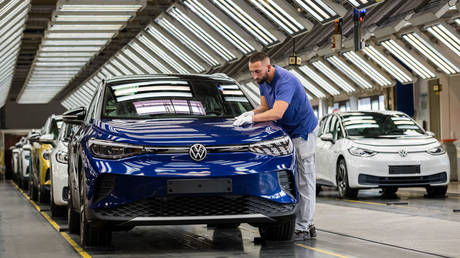
American automotive giant General Motors said on Tuesday it will pour $6.6 billion into boosting its electric pickup truck production and building a new electronic vehicle (EV) battery cell plant in its home state of Michigan.
The carmaker wants to overtake Tesla as the world’s biggest producer of electric vehicles.
“We will have the products, the battery cell capacity and the vehicle-assembly capacity to be the EV leader by mid-decade,” GM CEO Mary Barra said in a statement, as cited by CNBC.
The investment will include $2.6 billion for the construction of a new battery plant in partnership with LG Energy Solution and $4 billion for converting GM’s existing Orion Assembly plant in Detroit to produce electric trucks, like the recently announced and highly anticipated Chevrolet Silverado and GMC Sierra, scheduled for launch in 2024.
The announced funds also represent a part of GM’s $35 billion agenda to increase its North American production capacity to 1 million electric vehicles by 2025. The carmaker forecasts it may beat rival EV producer Tesla as the top US-based seller of electric vehicles by that time.
The company also pledged to invest an additional $510 million to upgrade two of its non-electric vehicle assembly plants in Michigan.
“Michigan will be the recognized hub and leader of innovation in the US for EV R&D and manufacturing,” the company’s president, Mark Reuss, said during a media briefing.
GM is also converting its plants in Tennessee, Canada, and Mexico to assemble EVs, projecting that by 2030 half of its North American plants will be focused solely on EV production.
The car company has a long and bumpy road ahead, however, if it plans to topple Tesla as the top EV producer. Elon Musk’s EV giant delivered 936,172 electric vehicles globally last year. According to some estimations, Tesla’s 2021 US deliveries were well over 300,000 EVs, while GM sold less than 25,000 units, ranking third after Ford with 27,140 Mustang Mach-E EVs sold.
Company that began as an aircraft engine maker powers car that transforms into a plane
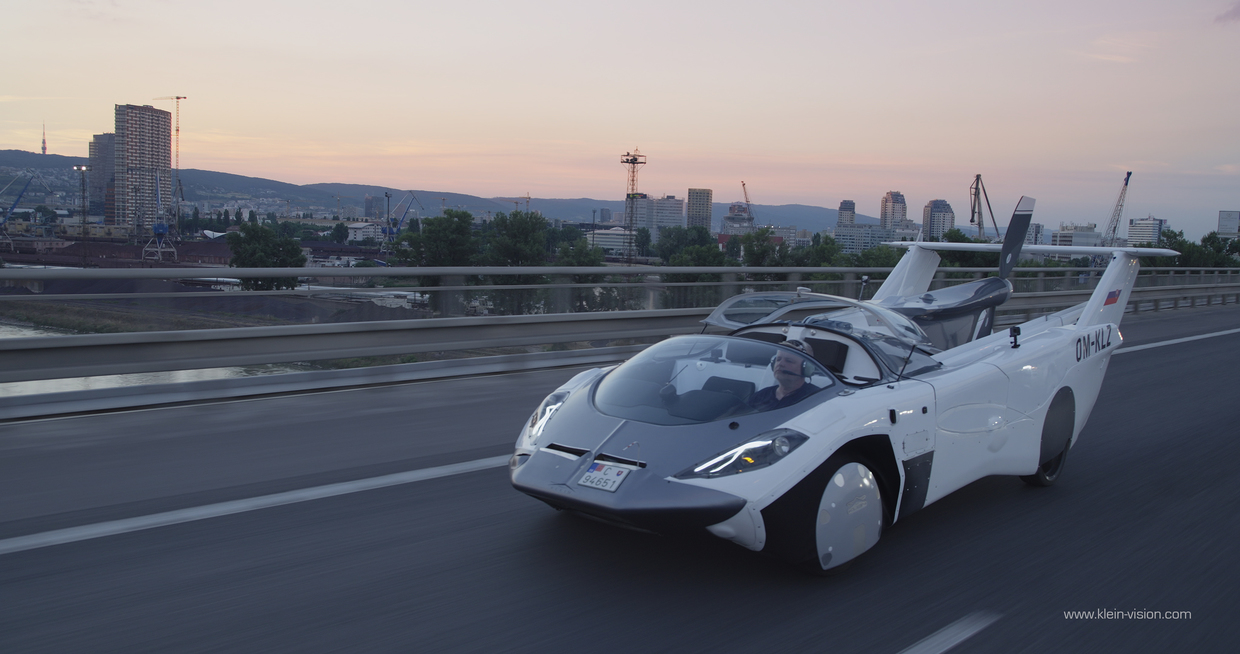
A car that can transform into a small aircraft has been awarded with an “official Certificate of Airworthiness” by the Slovak Transport Authority. According to Klein Vision, the company behind the AirCar, 70 hours of “rigorous flight testing,” including over 200 takeoffs and landings, have been completed. All of that was compatible with European Aviation Safety Agency (EASA) standards.
“The challenging flight tests included the full range of flight and performance maneuvers and demonstrated an astonishing static and dynamic stability in the aircraft mode,” Klein Vision said in a press release on Monday.
The AirCar is powered by a 1.6-liter BMW engine, and runs on “fuel sold at any gas station,” Anton Zajac, co-founder of Klein Vision, told CNN. The vehicle can fly at a maximum operating altitude of 18,000 feet, he added. It takes two minutes and 15 seconds to transform from car into aircraft. The wings and tail fold away automatically for road driving.
A spokesperson for Klein Vision also said that a pilot’s license is required to fly the hybrid vehicle. He has expressed hopes of having the AirCar commercially available within 12 months.
In June, the flying car completed a 35-minute test flight between airports in Nitra and the capital Bratislava in Slovakia. After landing, the aircraft converted into a car and was driven to the city center.
AirCar completes inter-city flight in Bratislava, Slovakia on June 30, 2021
“AirCar certification opens the door for mass production of very efficient flying cars. It is official and the final confirmation of our ability to change mid-distance travel forever,” the AirCar’s inventor Stefan Klein said as quoted by Top Gear Magazine.
BMW started as an aircraft engine producer, but after WWI Germany was forbidden to make airplanes or engines for them (for five years). So, the company switched to making motorcycles and cars. In 1924 they resumed the production of aircraft engines, and ultimately stopped in 1945. The iconic logo with the four colored quadrants represents a spinning airplane propeller.